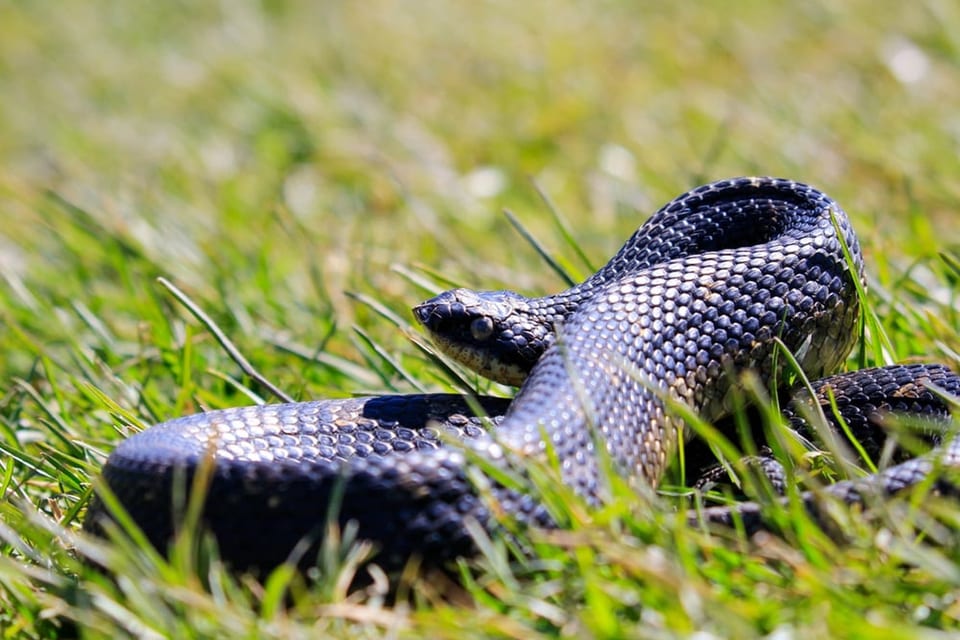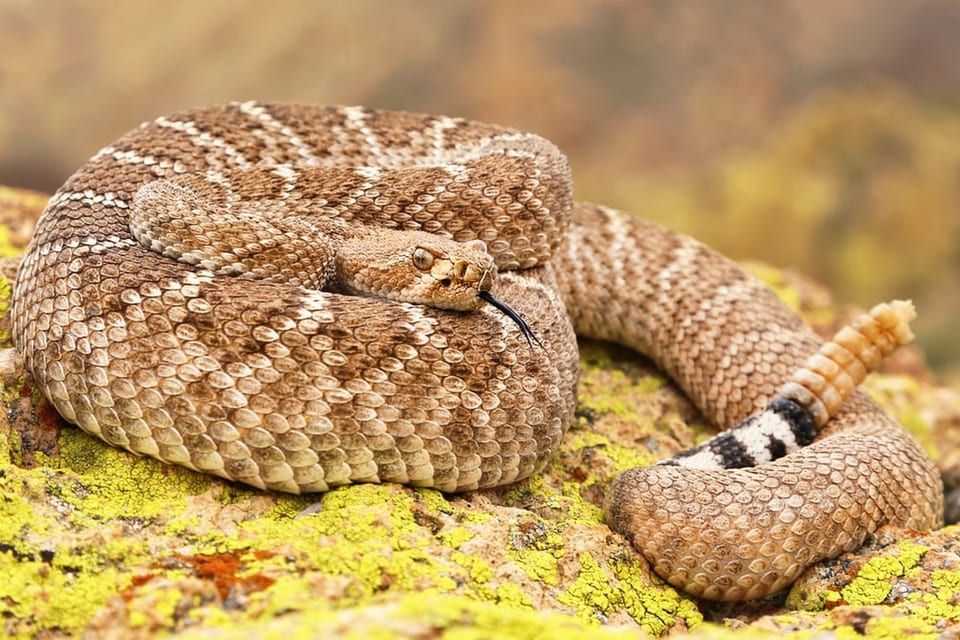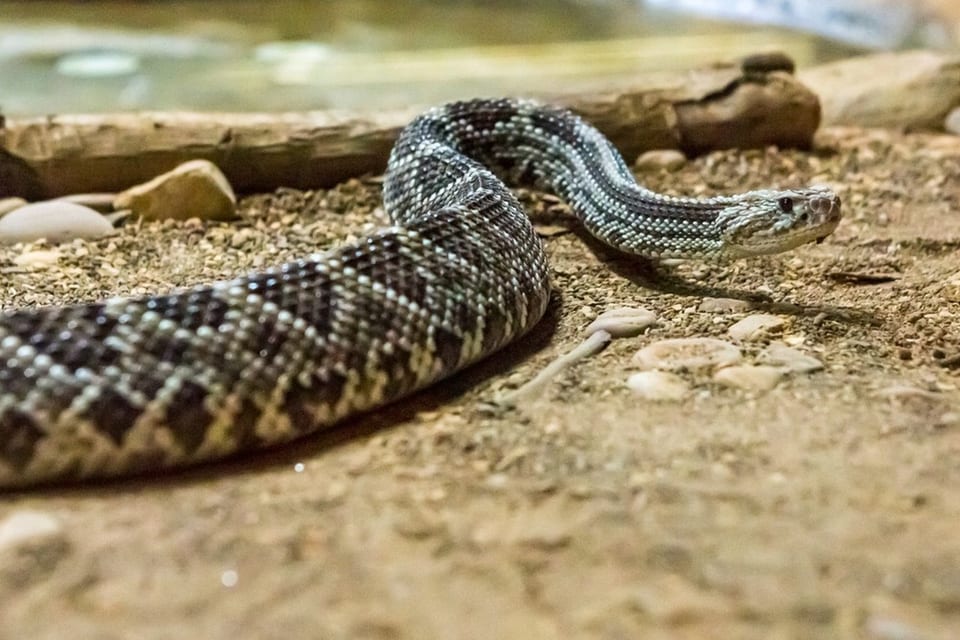
Arizona’s snakes are tied to deserts, sky islands, grasslands, riparian corridors, and rocky canyons. Low desert washes bring sidewinders, leaf-nosed snakes, shovel-nosed snakes, and glossy snakes; higher country adds gartersnakes, mountain rattlesnakes, black-headed snakes, and boas.
The state is especially rich in rattlesnakes, but it is not only a rattlesnake list. Arizona also has a coral snake, rosy boa, racers, whipsnakes, kingsnakes, nightsnakes, sandsnakes, threadsnakes, and several small fossorial species.
Use the sections below as a habitat-based walk through that mix, starting with the venomous species and then moving through the nonvenomous groups most likely to be confused with them.
Venomous snakes in Arizona
Arizona’s venomous list is unusual: one small coral snake plus a long rattlesnake roster. Use range and habitat first, then compare tail, head, and body pattern details.
1. Sonoran Coralsnake
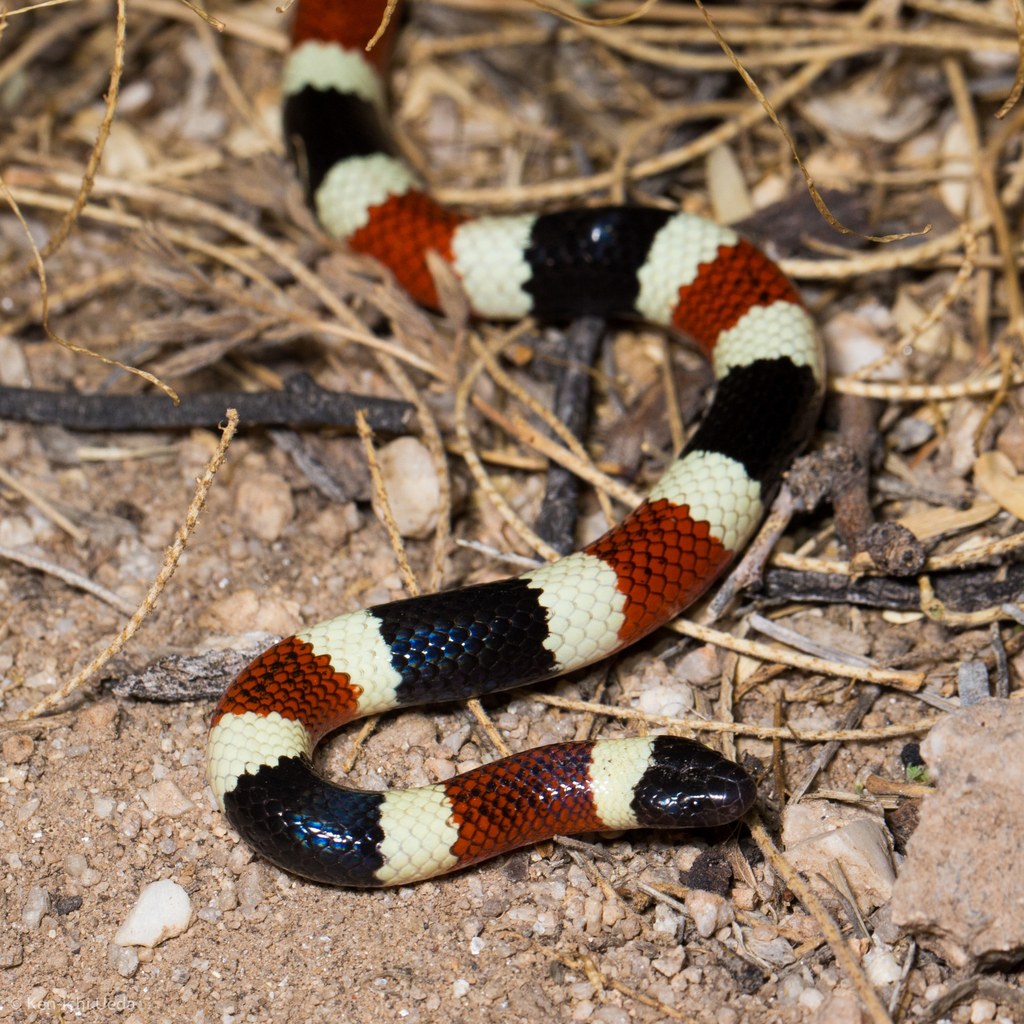
Sonoran Coralsnake (Micruroides euryxanthus) is the small ringed coral snake of the southern part of the state, usually below 6,000 feet. Adults stay slender and top out around 615 mm (24″).
Its black snout and complete red, yellow or cream, and black rings are the quickest visual checks. Red bands touch pale bands, and the snake can turn up in desert scrub, semidesert grassland, and lower woodland.
It is mostly nocturnal or crepuscular, though mild weather can bring it out at other hours. The diet is heavy on other small snakes, including threadsnakes, groundsnakes, and black-headed snakes, with small lizards taken occasionally.
| Key detail | What to look for |
|---|---|
| Adult size | Small, slender; up to 615 mm (24″) in total length |
| Fast ID cue | brightly colored rings of red, yellow/cream, and black that encircle the body; red bands touch yellow bands; black snout |
| Typical Arizona habitat | From desert scrub (Sonoran, Mohave, Chihuahuan) to semidesert grassland and lower woodlands |
| Arizona range | Found across most of southern Arizona below 6,000′ elevation |
| Bite / venom note | Venomous coral snake; potent venom, secretive and rarely seen |
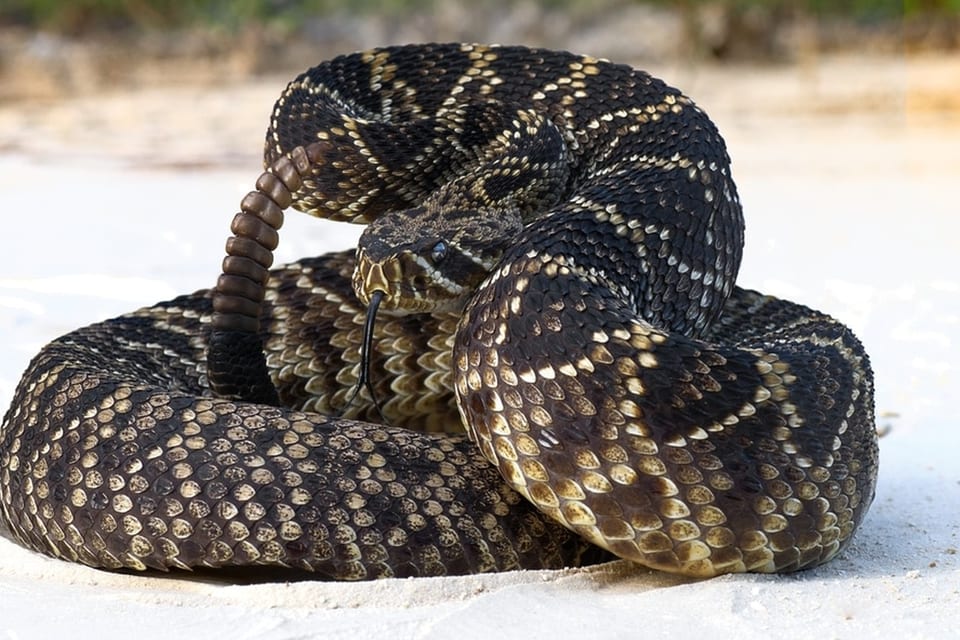
2. Western Diamond-backed Rattlesnake
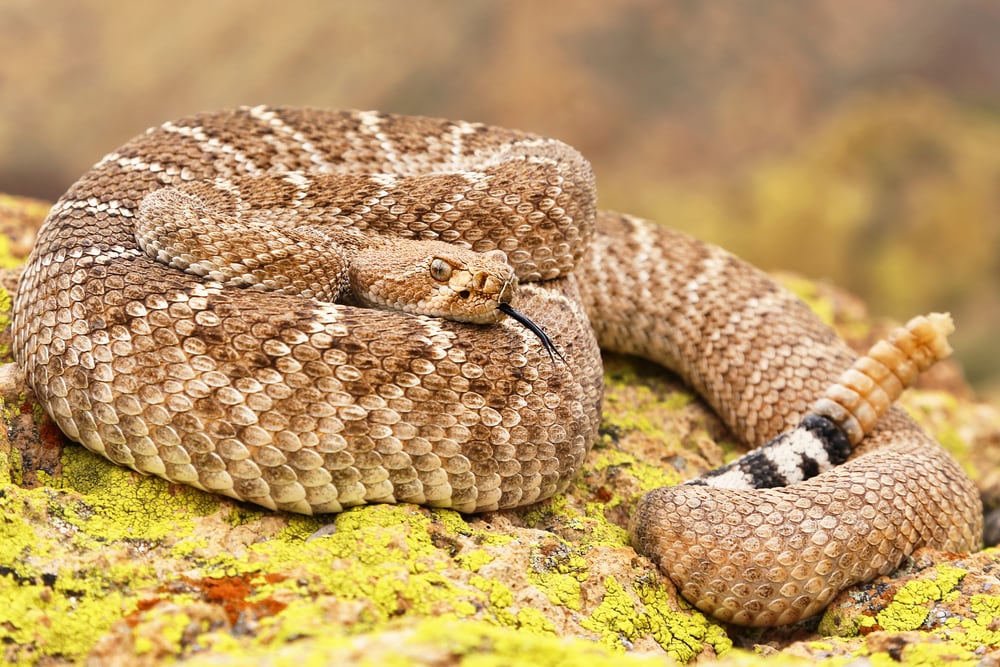
Western Diamond-backed Rattlesnake (Crotalus atrox) is the big familiar diamondback of the southern and western deserts. It is the state’s largest rattlesnake, sometimes reaching 1,676 mm (66 inches).
The back pattern does most of the work: gray or tan ground color, often flushed pink, rust, or orange toward the rear, with large dark-edged diamonds outlined in cream or pale gray. Expect it in desert scrub, semidesert grassland, lower chaparral, and Madrean evergreen woodland edges.
| Key detail | What to look for |
|---|---|
| Adult size | Arizona’s largest rattlesnake; can reach lengths of up to 1,676 mm (66 inches) |
| Fast ID cue | gray or tan, often with pinkish, rust, or orange hues on the posterior; large, dark-edged, diamond-shaped blotches along the back, often outlined in cream or pale gray |
| Typical Arizona habitat | Sonoran, Chihuahuan, and Mohave desert scrub, semidesert grassland, and lower reaches of interior chaparral and Madrean evergreen woodland |
| Arizona range | Found across all of southern and most of western Arizona |
| Bite / venom note | Venomous diamondback; large-bodied rattlesnake, serious bite risk |
3. Sidewinder
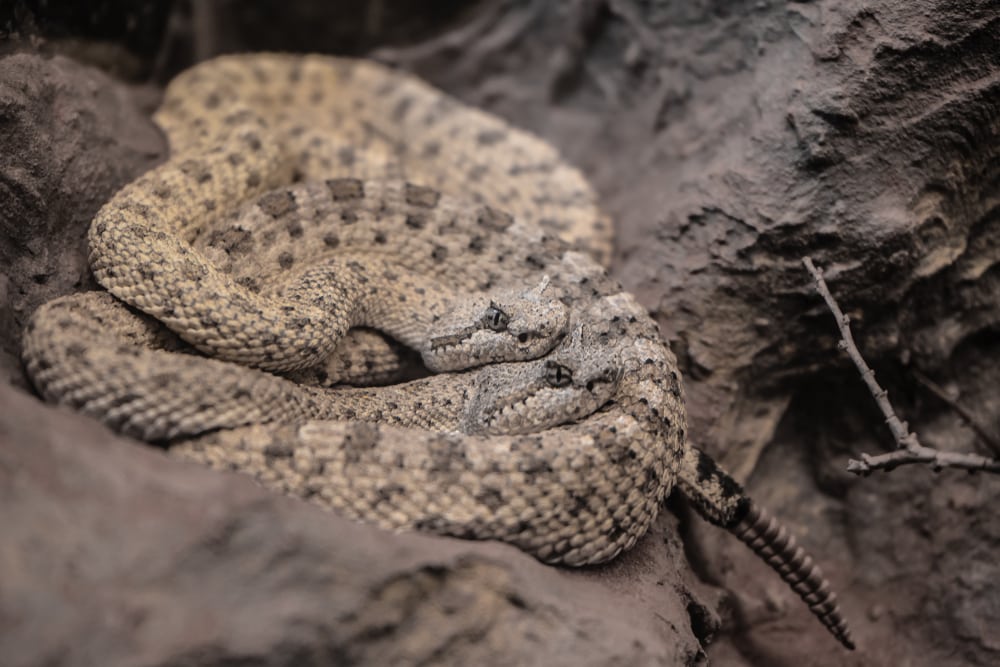
Sidewinder (Crotalus cerastes) is a small rattlesnake of the low western and southwestern deserts, from near sea level to about 2,800 feet. Adults reach about 628 mm (25 inches).
The raised horn-like scales over the eyes are the giveaway when you can see the head. Pale tan, pinkish, cream, or light gray coloring blends into open sandy flats, creosotebush country, and dune fields, and the sideways tracks in loose sand are often easier to notice than the snake.
Nocturnal and crepuscular in summer; diurnal or crepuscular during cooler spring weather. Ambushes lizards, mice, birds, and other snakes.
| Key detail | What to look for |
|---|---|
| Adult size | Small, reaching up to 628 mm (25 inches) in total length |
| Fast ID cue | tan, pinkish-tan, cream, or light gray body; brown or gray-brown blotches; enlarged upturned horn-like scales above the eyes; sidewinding tracks in loose sand |
| Typical Arizona habitat | Mohave and Sonoran desert scrub, especially open sandy or loamy flats, creosotebush areas, and dune fields |
| Arizona range | Low deserts of western and southwestern Arizona (sea level to 2,800’) |
| Bite / venom note | Venomous desert rattlesnake; small-bodied, serious bite risk |
4. Mohave Rattlesnake
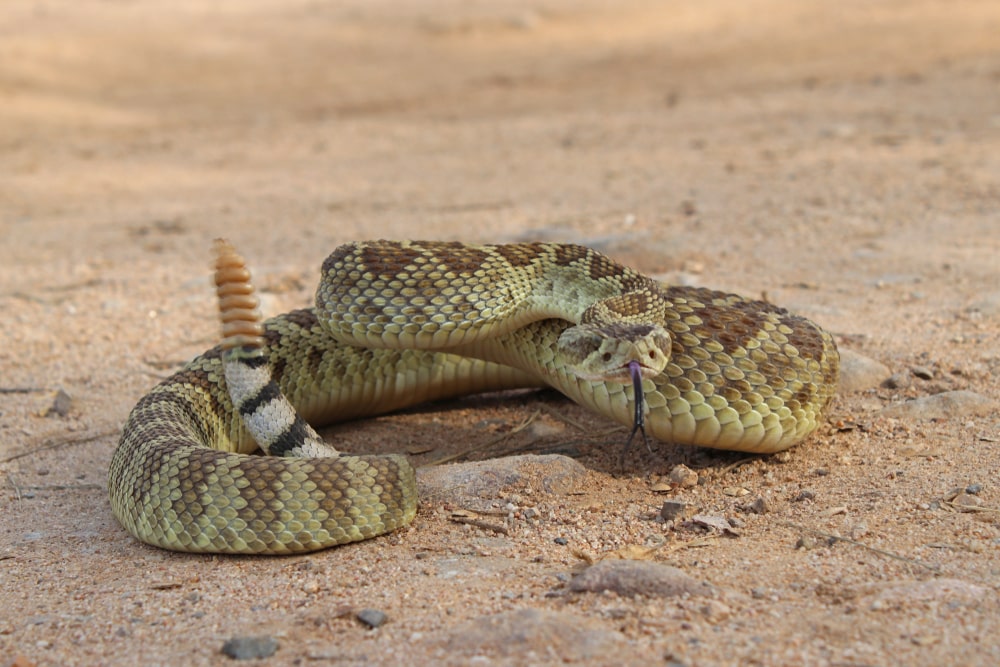
Mohave Rattlesnake (Crotalus scutulatus) ranges across much of the west and south. It is a large rattlesnake, up to 1,270 mm (50 inches), so size can help rule out smaller desert species.
Look for a tan, olive, or gray-brown body with dark-edged blotches, narrow dark tail rings separated by wider pale spaces, and a thin light stripe running from the eye beyond the mouth. It favors desert scrub, semidesert grassland, creosotebush flats, low valleys, bajadas, and rolling foothills.
Primarily nocturnal, with crepuscular activity during moderate weather. Feeds on rats, mice, lizards, birds, and frogs.
| Key detail | What to look for |
|---|---|
| Adult size | Large, reaching up to 1,270 mm (50 inches) in total length |
| Fast ID cue | tan, olive, or gray-brown body with dark-edged blotches; tail rings narrower than the pale spaces; thin light stripe from the eye to beyond the mouth |
| Typical Arizona habitat | Sonoran, Mohave, and Chihuahuan desert scrub, semidesert grassland, creosotebush flats, low valleys, bajadas, and rolling foothills |
| Arizona range | Found across most of western and southern Arizona |
| Bite / venom note | Venomous desert rattlesnake; serious bite risk, pale tail bands help ID |
5. Tiger Rattlesnake
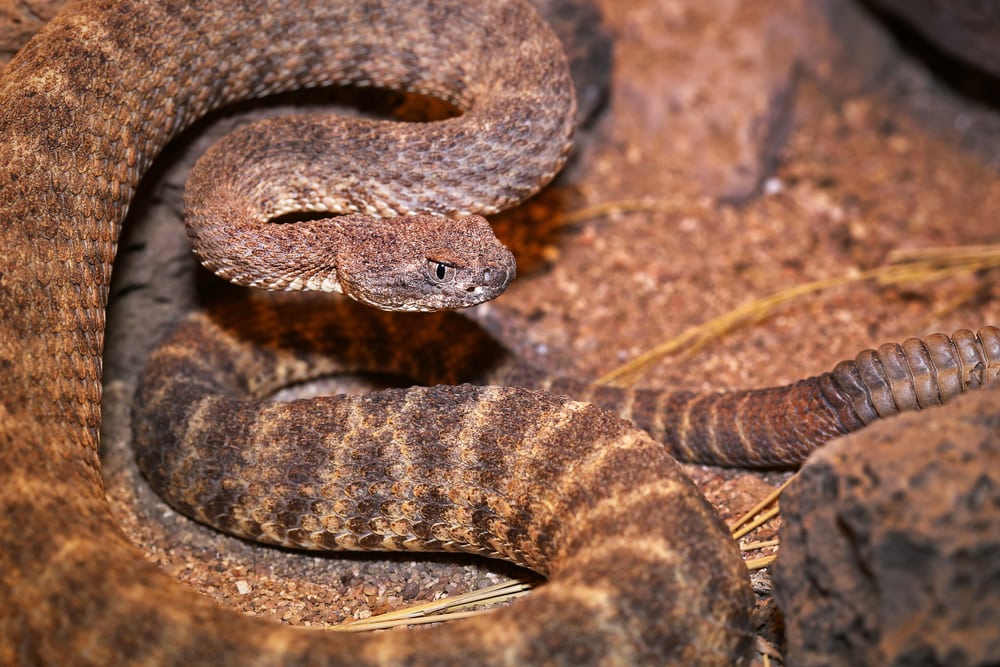
Tiger Rattlesnake (Crotalus tigris) is a medium-sized rattlesnake of central, south-central, and far southeastern parts of the state. Adults reach up to 885 mm (35 inches), excluding the rattle.
Color is not steady enough to use alone. Individuals are often blue-gray or orange-brown, so the small-head profile, desert foothill setting, and range are better checks.
Feeds primarily on mice, small mammals, and lizards.
| Key detail | What to look for |
|---|---|
| Adult size | Medium-sized; up to 885 mm (35 inches) in total length (excluding rattle) |
| Fast ID cue | highly variable, typically blue-gray or orange-brown |
| Typical Arizona habitat | Best narrowed by range, small-head profile, and local terrain |
| Arizona range | Found in central, south-central, and extreme southeastern Arizona |
| Bite / venom note | Venomous rattlesnake; small head, desert foothills, serious bite risk |
6. Black-tailed Rattlesnake
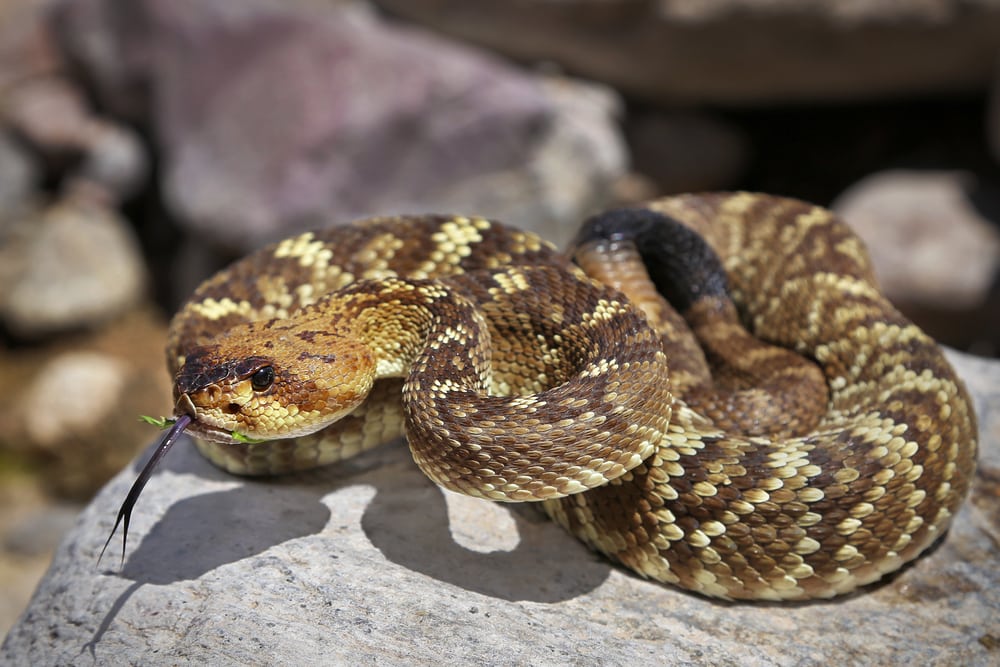
Black-tailed Rattlesnake (Crotalus molossus) covers nearly all of the southern part of the state but drops out on the northeastern plateau. Mature snakes are heavy-bodied and can reach 1,219 mm (48 inches), not counting the rattle.
The dark tail is the field mark to hold onto. This species crosses a wide habitat span, from Sonoran desert scrub up through mountain woodland and conifer forest, so the tail and overall build are often more useful than habitat alone.
Feeds on mice, rats, rabbits, birds, and lizards.
| Key detail | What to look for |
|---|---|
| Adult size | Large, reaching up to 1,219 mm (48 inches) in total length (excluding the rattle) |
| Fast ID cue | heavy body, dark tail, and broad mountain-to-desert range across southern Arizona |
| Typical Arizona habitat | Diverse biotic communities, from Sonoran desert scrub to Petran subalpine conifer forest |
| Arizona range | Found across nearly all of southern Arizona; absent from the northeastern plateau |
| Bite / venom note | Venomous rattlesnake; dark tail, rocky habitat, serious bite risk |
7. Speckled Rattlesnake
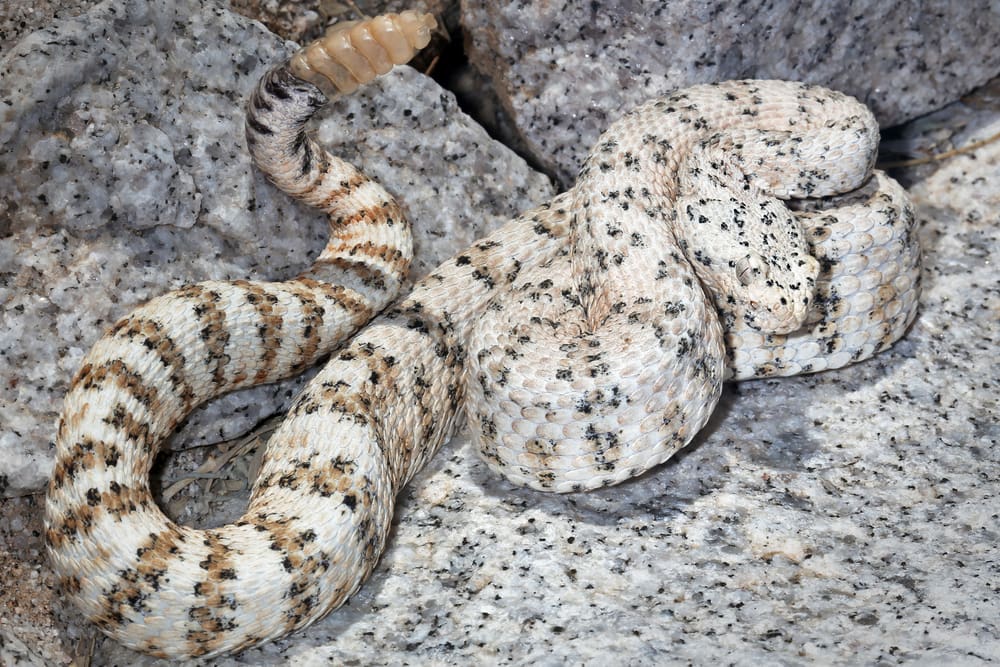
Speckled Rattlesnake (Crotalus mitchellii) is a western and southwestern rattlesnake. Adults are large, reaching up to 1,295 mm (51″), excluding the rattle.
Color changes with the rock around it: rusty tan, pinkish-brown, peach, off-white, pale gray, or blue-gray. That local-rock camouflage, combined with Sonoran and Mohave desert scrub, interior chaparral, or Great Basin conifer woodland, is the best clue.
Feeds on mice, rats, Chuckwalla lizards, smaller lizards, and birds.
| Key detail | What to look for |
|---|---|
| Adult size | Large, reaching up to 1,295 mm (51″) in total length (excluding the rattle) |
| Fast ID cue | Color ranges from rusty tan, pinkish-brown, and peach to off-white, pale gray, or blue-gray; markings often match the local rock substrate |
| Typical Arizona habitat | Sonoran and Mohave desert scrub, interior chaparral, and Great Basin conifer woodland |
| Arizona range | Western and southwestern Arizona |
| Bite / venom note | Venomous rattlesnake; rock-matching camouflage is a key clue |
8. Arizona Black Rattlesnake
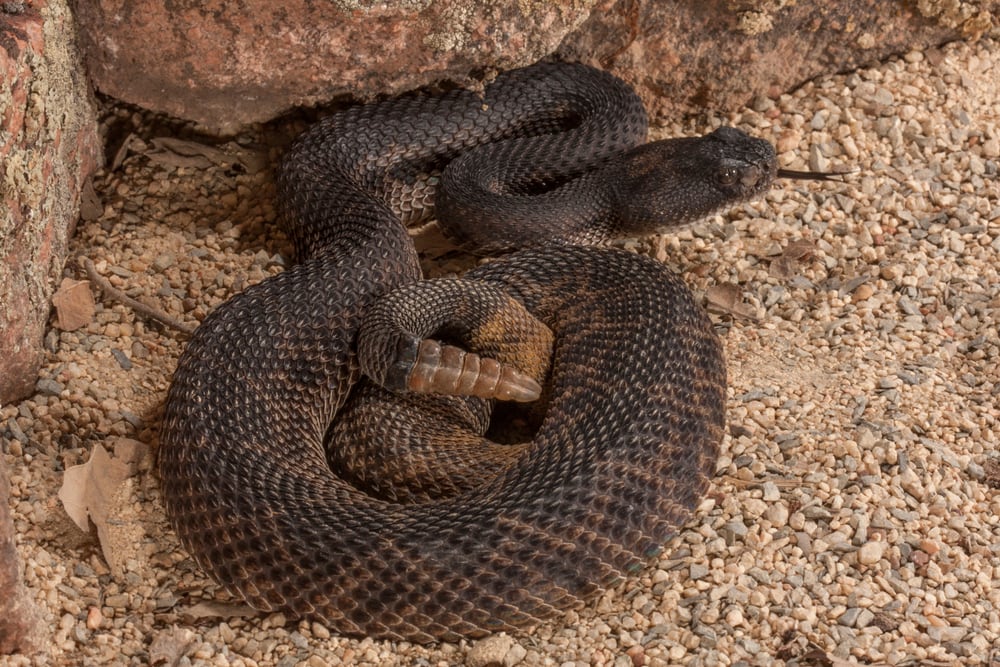
Arizona Black Rattlesnake (Crotalus cerberus) is a dark mountain rattlesnake of the central high country, from the Colorado River area through the Mogollon Rim and White Mountains, with records in southeastern sky islands such as the Pinaleño, Galiuro, and Santa Catalina ranges. Adults are medium to large, up to 1,062 mm (42 inches) without the rattle.
Freshly seen individuals may show dark gray-brown coloring with black blotches, while older snakes can look almost black. Range and elevation are useful checks because the body pattern can disappear on very dark animals.
Primarily diurnal, but can be active at any time under favorable conditions. Its diet includes rats, squirrels, mice, lizards, and birds.
| Key detail | What to look for |
|---|---|
| Adult size | Medium to large; up to 1,062 mm (42”) in length (excluding rattle) |
| Fast ID cue | dark gray-brown to black with black blotches |
| Typical Arizona habitat | Central and sky-island mountain country; use range with the dark body color |
| Arizona range | Central mountains from the Colorado River area through the Mogollon Rim and White Mountains, plus southeastern ranges including the Pinaleño, Galiuro, and Santa Catalina |
| Bite / venom note | Venomous rattlesnake; dark mountain species, serious bite risk |
9. Rock Rattlesnake
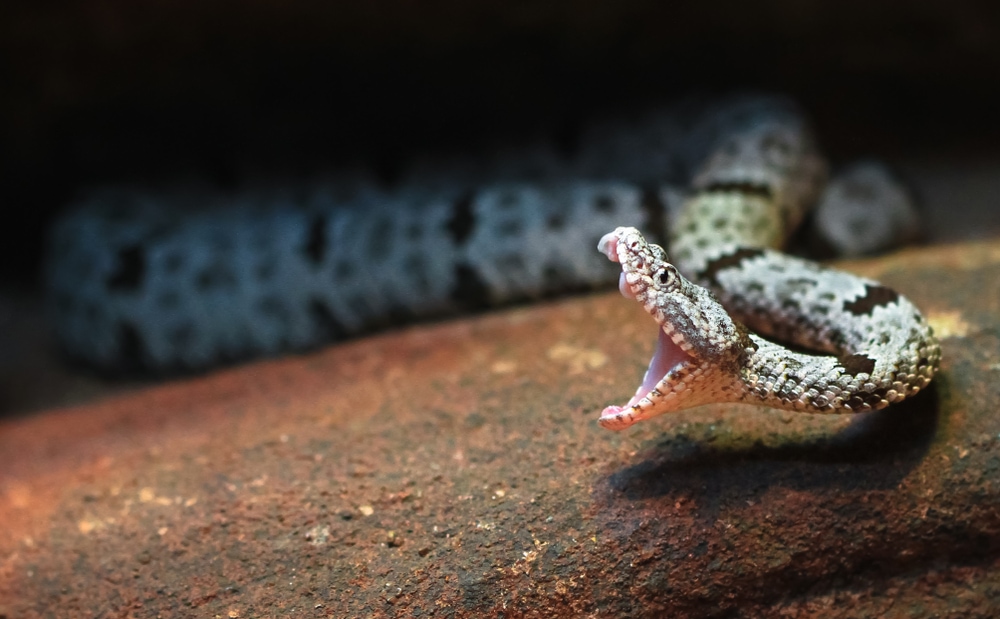
Rock Rattlesnake (Crotalus lepidus) is a small sky-island rattlesnake of southeastern ranges such as the Chiricahua, Peloncillo, Dragoon, Whetstone, Santa Rita, Huachuca, and Canelo mountains. Adults reach up to 840 mm (33 inches), excluding the rattle.
It earns the name: a compact rattlesnake with rock-colored patterning that can vanish against stone. Madrean evergreen woodland and Petran montane conifer forest are the main habitat clues.
Primarily diurnal, but can be active at any time of day or night if conditions are favorable. Feeds on centipedes, lizards, small rodents, and birds.
| Key detail | What to look for |
|---|---|
| Adult size | up to 840 mm (33”) in total length (excluding rattle) |
| Fast ID cue | small rock-colored rattlesnake profile and sky island mountain range |
| Typical Arizona habitat | Madrean evergreen woodland and Petran montane conifer forest |
| Arizona range | Found in the “sky island” mountain ranges of southeastern Arizona (e.g., Chiricahua, Peloncillo, Dragoon, Whetstone, Santa Rita, Huachucas, and Canelos) |
| Bite / venom note | Venomous mountain rattlesnake; rocky-slope species, serious bite risk |
10. Western Rattlesnake
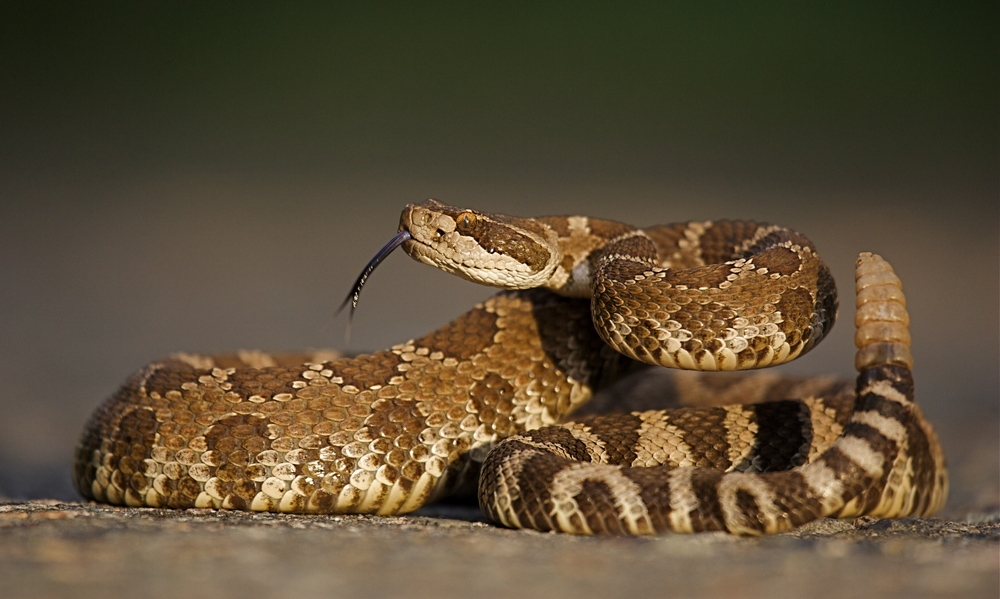
Western Rattlesnake (Crotalus oreganus) is the northwestern rattlesnake in this guide, tied to the Arizona Strip, upper Grand Canyon, Marble Canyon, and Glen Canyon. Adults are medium to large and can reach 1,650 mm (63″), not counting the rattle.
Use range first, then the classic pit-viper shape: broad triangular head, narrow neck, and vertical pupils. In this article, that northwestern canyon country separates it from the longer list of southern rattlesnakes.
It feeds primarily on rats, mice, squirrels, lizards, and birds.
| Key detail | What to look for |
|---|---|
| Adult size | Medium to large; up to 1,650 mm (63″) in total length (excluding rattle) |
| Fast ID cue | broad, triangular, with a slender neck; vertically elliptical pupils |
| Typical Arizona habitat | Northwestern canyon and plateau country within the listed range |
| Arizona range | Found in extreme northwestern Arizona, including the Arizona Strip (north of the Colorado River), the upper Grand Canyon, Marble Canyon, and Glen Canyon |
| Bite / venom note | Venomous rattlesnake; serious bite risk, use range to separate species |
11. Twin-spotted Rattlesnake
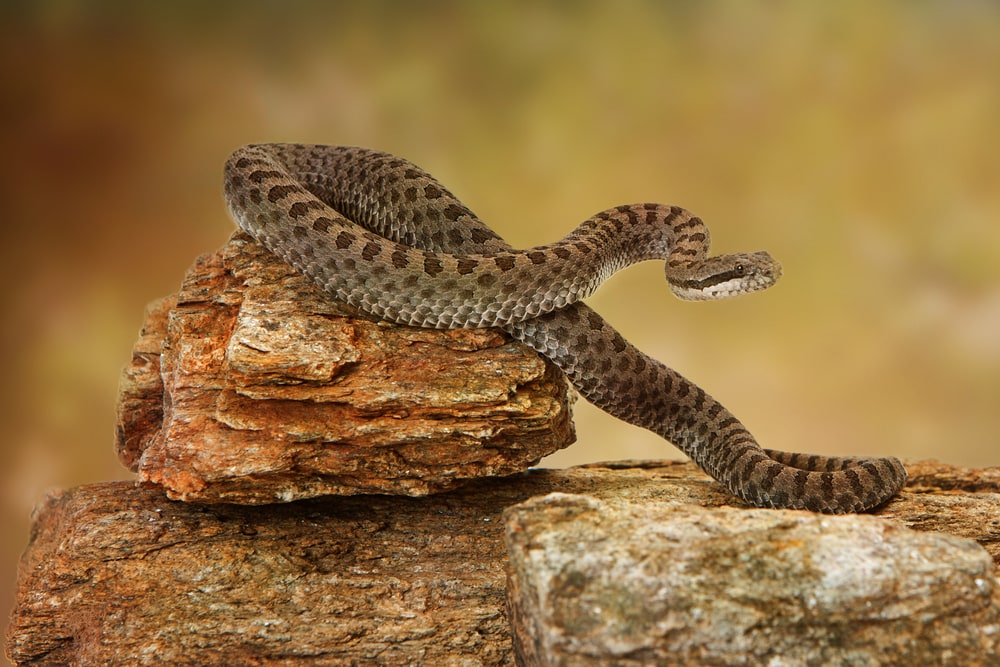
Twin-spotted Rattlesnake (Crotalus pricei) is a small high-elevation rattlesnake of the Chiricahua, Pinaleño, Huachuca, and Santa Rita ranges. Adults reach up to 660 mm (26″), excluding the rattle.
When the pattern is visible, the paired dorsal blotches are the feature to check. It belongs in cool sky-island settings, especially Petran subalpine and montane conifer forests, and is often seen basking on rock slides in mid-morning.
It eats lizards, small rodents, and birds.
| Key detail | What to look for |
|---|---|
| Adult size | up to 660 mm (26″) in total length (excluding rattle) |
| Fast ID cue | small mountain rattlesnake profile, paired dorsal blotches when visible, and high-elevation sky island habitat |
| Typical Arizona habitat | Petran subalpine and montane conifer forests |
| Arizona range | Found in the “sky island” mountain ranges of southeastern Arizona, specifically the Chiricahua, Pinaleño, Huachuca, and Santa Rita ranges |
| Bite / venom note | Venomous mountain rattlesnake; rocky-slope species, serious bite risk |
12. Prairie Rattlesnake
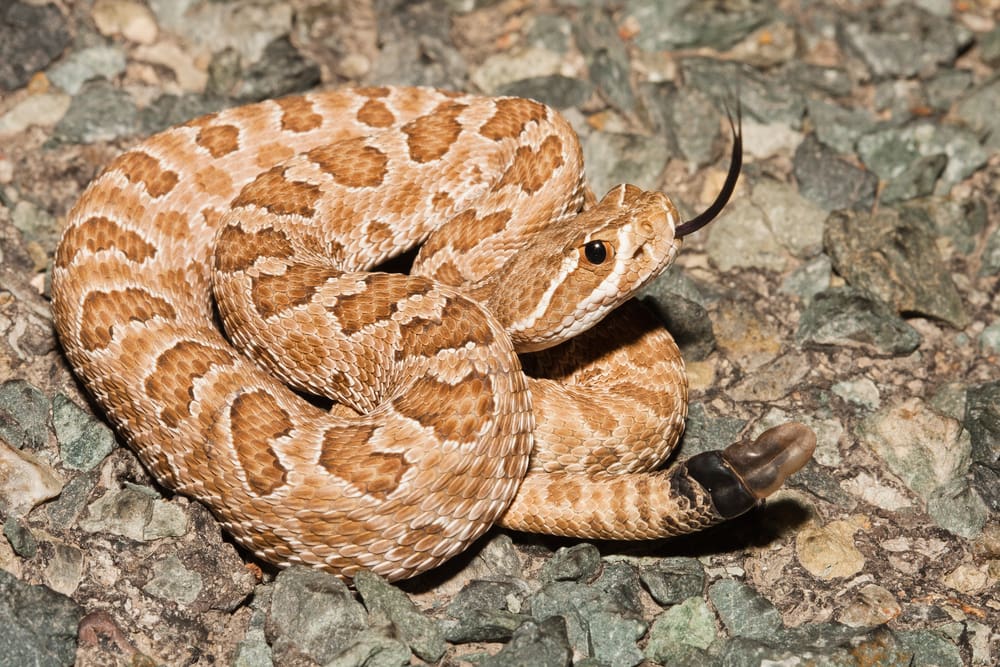
Prairie Rattlesnake (Crotalus viridis) is the northeastern plateau rattlesnake here, found south and east of the Colorado River. Adults range from 700 mm (28″) to 1,620 mm (64″), excluding the rattle.
It has the broad triangular head and vertical pupils of a rattlesnake, plus large dark back blotches often edged thinly in white. Two rows of smaller side blotches help separate it from the smoother-looking desert species.
It eats mice, small mammals, birds, and lizards.
| Key detail | What to look for |
|---|---|
| Adult size | Ranges from 700 mm (28″) to 1,620 mm (64″) in total length (excluding rattle) |
| Fast ID cue | broad, triangular shape with vertically elliptical pupils; large, dark dorsal blotches (often thin-edged in white) with two rows of smaller lateral blotches |
| Typical Arizona habitat | Northeastern plateaus within the listed range; use range before pattern |
| Arizona range | Northeastern Arizona, specifically plateaus south and east of the Colorado River |
| Bite / venom note | Venomous rattlesnake; serious bite risk, use range to separate species |
13. Ridge-nosed Rattlesnake
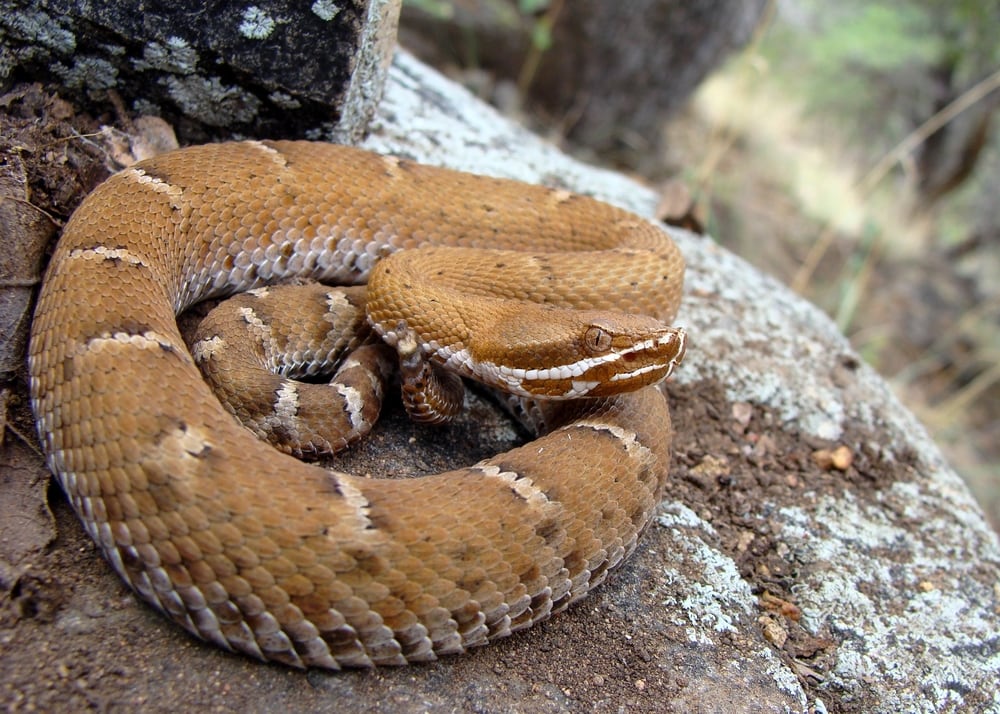
Ridge-nosed Rattlesnake (Crotalus willardi) is a small rattlesnake of southeastern sky-island ranges. Adults reach about 668 mm (26 inches), excluding the rattle.
The name points to the best field mark: a raised ridge of scales along the top of the snout between the nostrils. Look for it in Madrean evergreen woodland or Petran montane conifer forest, especially shaded, leaf-littered drainages.
Primarily diurnal, occasionally crepuscular or nocturnal at lower elevations. Feeds primarily on lizards, mice, and centipedes; occasionally birds and scorpions.
| Key detail | What to look for |
|---|---|
| Adult size | Small, reaching up to 668 mm (26 inches) excluding the rattle |
| Fast ID cue | a ridge of upturned scales along the top edge of the snout between the nostrils |
| Typical Arizona habitat | Madrean evergreen woodland or Petran montane conifer forest; prefers areas with abundant canopy cover and leaf litter near drainages |
| Arizona range | Found in “sky island” mountain ranges of southeastern Arizona |
| Bite / venom note | Venomous mountain rattlesnake; localized sky-island species, serious bite risk |
14. Massasauga
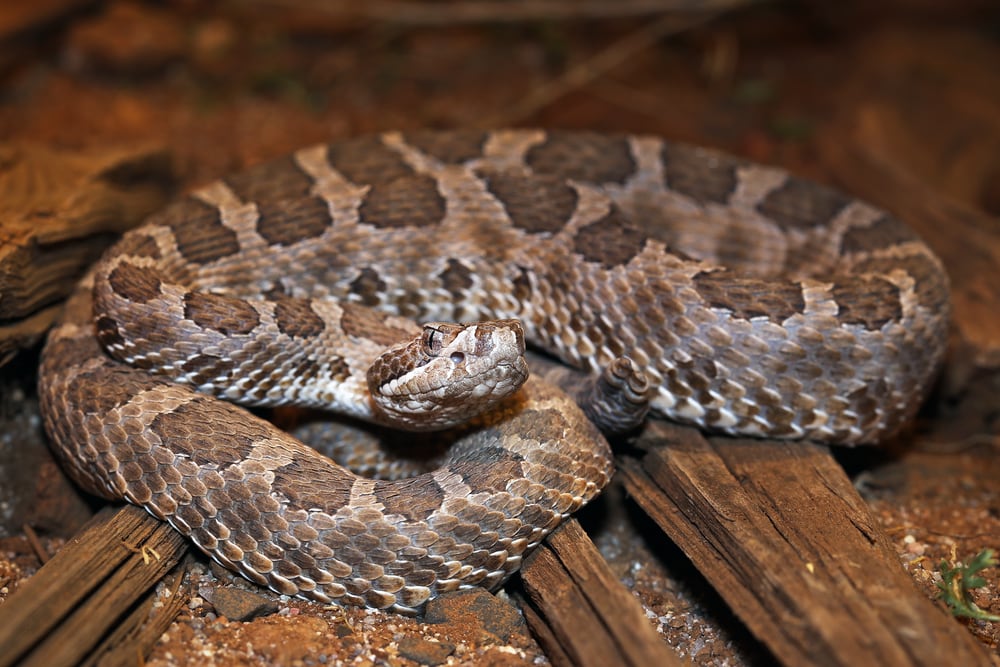
Massasauga (Sistrurus catenatus) is a small rattlesnake now limited here to a few isolated populations in the extreme southeast. Adults reach about 550 mm (22 inches), excluding the rattle.
The head is broad and triangular, with large plate-like scales on top. Habitat narrows the search to semidesert grassland settings such as valleys, low bajadas, and rolling grass-covered hills.
It is mostly nocturnal, though overcast days, mornings, and sunset can bring it above ground. It eats lizards, centipedes, mice, and other small mammals.
| Key detail | What to look for |
|---|---|
| Adult size | Small, reaching up to 550 mm (22”) in length (excluding the rattle) |
| Fast ID cue | Broad triangular head with large, plate-like scales on top |
| Typical Arizona habitat | valleys, low sloping bajadas, and rolling grass-covered hills within the semidesert grassland community |
| Arizona range | Currently limited to a few isolated populations in the extreme southeastern portion of Arizona |
| Bite / venom note | Venomous rattlesnake; small, localized grassland species |
Nonvenomous snakes in Arizona
Most Arizona snakes are not venomous. Many still look similar at a glance, so habitat, body build, color pattern, and location are usually more useful than a single field mark.
Boas and desert constrictors
15. Rosy Boa
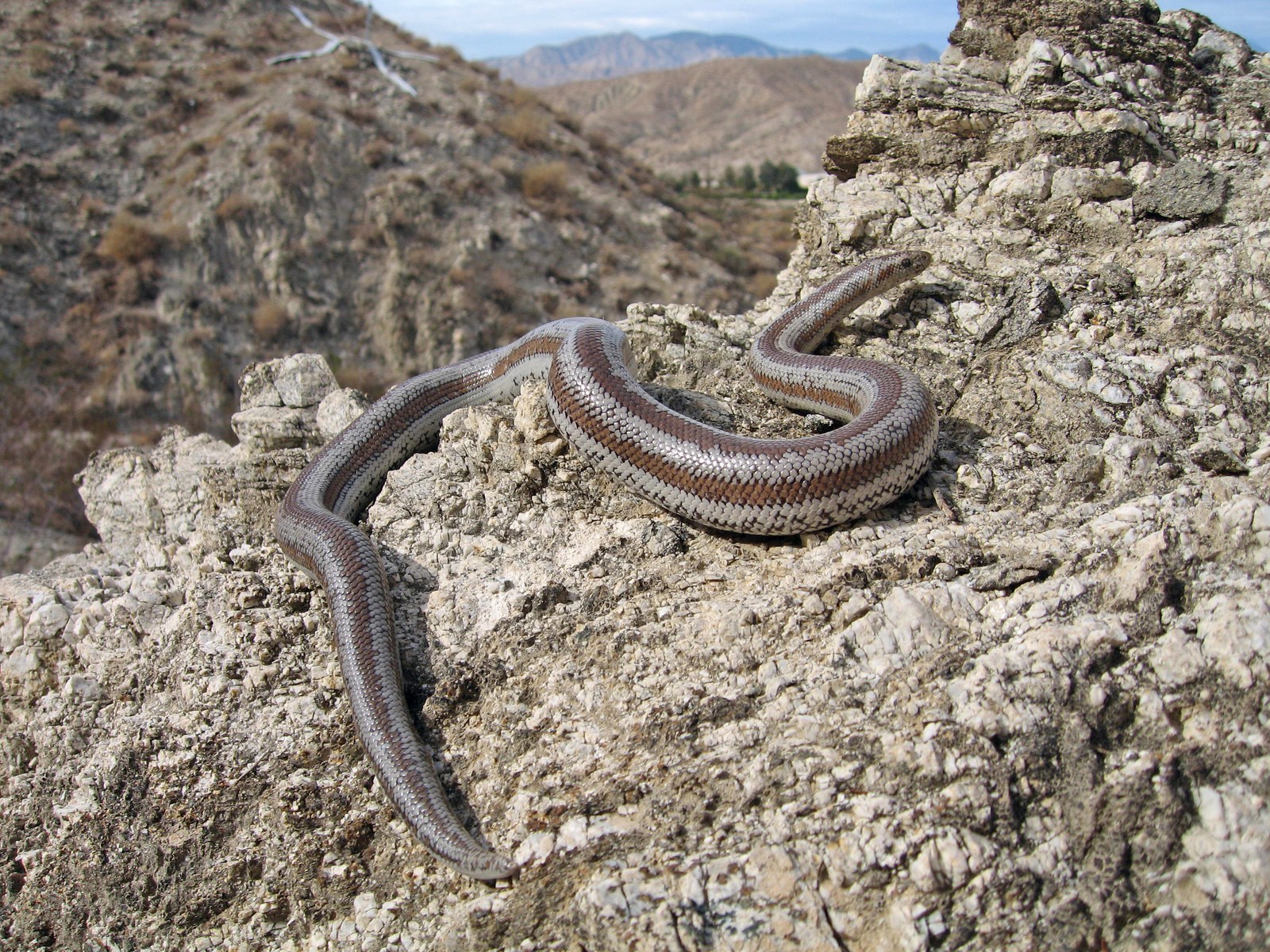
Rosy Boa (Lichanura trivirgata) is the thick, smooth-scaled boa of western, southwestern, and south-central parts of the state. Adults are medium-sized and can reach 950 mm (37″).
The cleanest mark is the trio of wide lengthwise stripes, brown, black, orange, or reddish-brown, on a lighter body. It fits rocky Sonoran and Mohave desert scrub as well as interior chaparral, where a slow heavy body stands out from the faster racers and whipsnakes.
Primarily nocturnal and crepuscular, though they may be active on spring mornings or overcast days. A powerful constrictor that feeds on small mammals and birds.
| Key detail | What to look for |
|---|---|
| Adult size | Medium-sized, up to 950 mm (37″) in total length |
| Fast ID cue | heavy-bodied with smooth scales; three wide, dark stripes (brown, black, orange, or reddish-brown) on a light background |
| Typical Arizona habitat | Sonoran desert scrub, Mohave desert scrub, and interior chaparral |
| Arizona range | Found in western, southwestern, and south-central Arizona |
| Bite / venom note | Nonvenomous boa; thick body, slow rocky-habitat snake |
Fast desert hunters
16. Brown Vinesnake
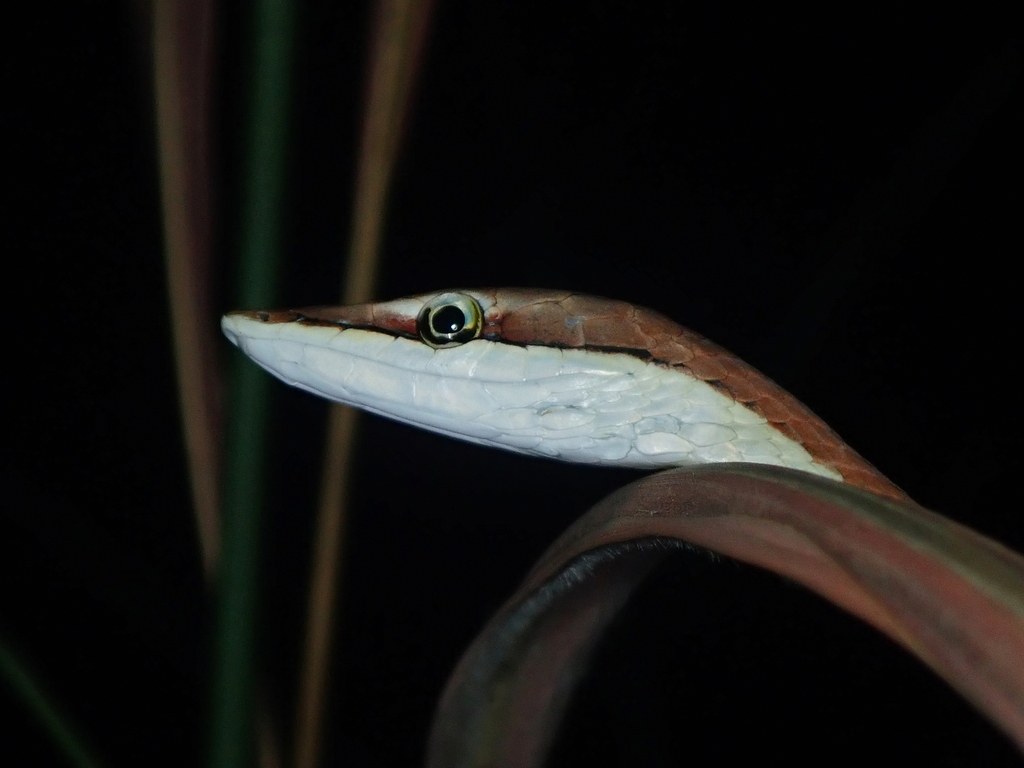
Brown Vinesnake (Oxybelis aeneus) is a very long, slender tree-climber whose range just reaches extreme south-central Arizona after running north through Mexico. Adults can reach 1,620 mm (60 inches), but the body stays whip-thin.
The vine-like shape is the main cue: gray, silver-gray, or copper coloring, short dark dash marks, a narrow pointed head, and a dark line through the eye. Look for it around trees, low shrubs, and dense canyon vegetation in Madrean evergreen woodland and upper semidesert grassland.
Primarily diurnal and an excellent climber. Feeds mainly on lizards, with frogs, fish, and insects also taken.
| Key detail | What to look for |
|---|---|
| Adult size | Very long and slender, reaching up to 1,620 mm (60 inches) in total length |
| Fast ID cue | exceptionally thin, vine-like body; gray, silver-gray, or copper color; short dark dash-like markings; narrow pointed head; dark line through the eye |
| Typical Arizona habitat | Madrean evergreen woodland and upper semidesert grassland, especially trees, low shrubs, and dense canyon vegetation |
| Arizona range | Extends from South America through Mexico into extreme south-central Arizona |
| Bite / venom note | Nonvenomous tree-climber; vine-thin body and pointed head |
17. Coachwhip
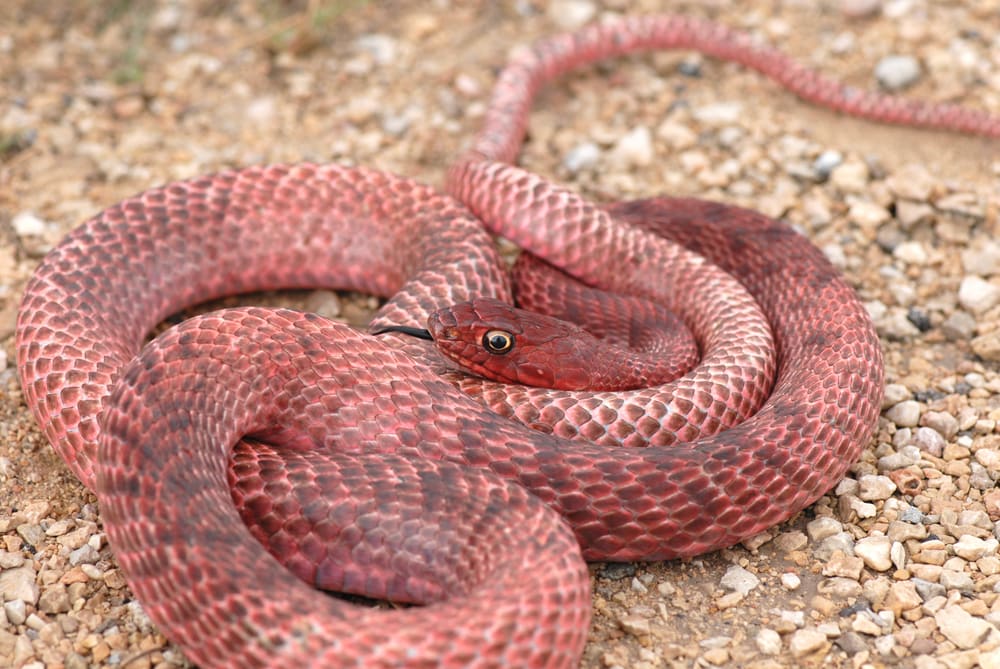
Coachwhip (Coluber flagellum) is a long, thin racer found through the western and southern parts of the state. Adults reach up to 1,728 mm (68 inches).
Color swings widely, from red and rusty orange to olive-brown, so build and behavior matter. Large eyes, smooth scales, a braided-whip look to the tail, and fast daytime movement are better clues in desert scrub, semidesert grassland, chaparral edges, flats, dune fields, bajadas, and foothills.
Diurnal, fast-moving, and highly alert. Eats lizards, snakes, mice, birds, insects, bats, frogs, toads, and small turtles.
| Key detail | What to look for |
|---|---|
| Adult size | Long and thin, reaching up to 1,728 mm (68 inches) in total length |
| Fast ID cue | highly variable color, from red, pinkish-red, orange, and rusty brown to olive-brown; large eyes; smooth scales; tail markings that can resemble a braided whip |
| Typical Arizona habitat | desert scrub, semidesert grassland, lower interior chaparral, desert flats, dune fields, bajadas, and foothills |
| Arizona range | Found throughout western and southern Arizona |
| Bite / venom note | Nonvenomous fast hunter; long tail and large eyes |
18. North American Racer
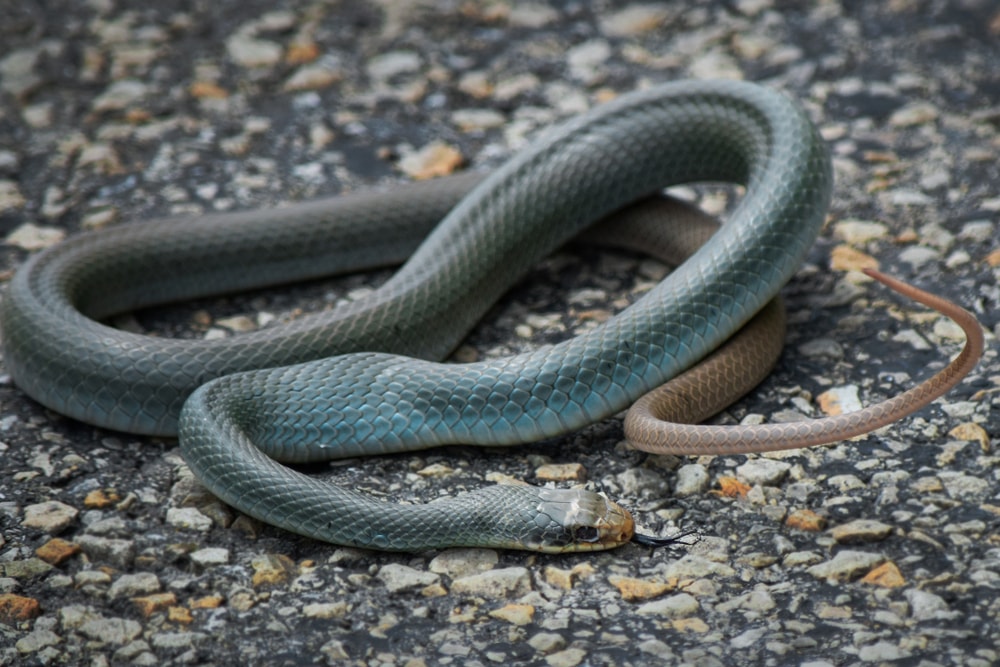
North American Racer (Coluber constrictor) is built for speed: medium to long, slim, smooth-scaled, and large-eyed. Adults can reach 1,900 mm (75 inches).
This is a movement-and-shape ID more than a habitat ID. If the snake is long, slender, alert, and racing through daylight, it belongs in this part of the shortlist before you start comparing the slower constrictors.
Diurnal, alert, and exceptionally swift. It eats mice, small mammals, lizards, snakes, birds, eggs, frogs, and insects.
| Key detail | What to look for |
|---|---|
| Adult size | Medium to long, reaching up to 1,900 mm (75 inches) |
| Fast ID cue | long, slender body, large eyes, smooth scales, and very fast daytime movement |
| Typical Arizona habitat | Best narrowed by range and fast daytime movement, not one habitat label |
| Arizona range | Scattered local records; pair county, fast daytime movement, and slim racer build for ID |
| Bite / venom note | Nonvenomous fast hunter; long tail and large eyes |
19. Sonoran Whipsnake
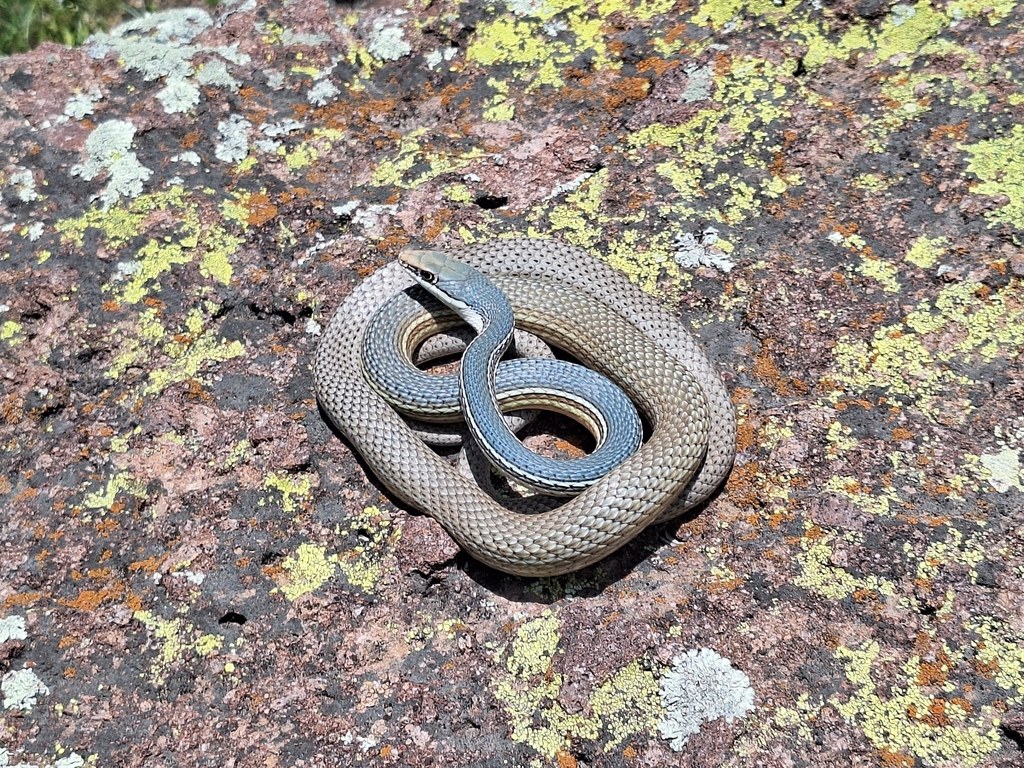
Sonoran Whipsnake (Coluber bilineatus) is a long, slender racer of sub-Mogollon Rim mountain ranges in the south-central and southeastern parts of the state. It can reach 1,778 mm (70″).
The color shift is distinctive when seen well: blue-gray to gray-green on the neck, yellow-green by mid-body, and gray-brown near the tail. Two thin white side stripes run from the neck toward mid-body.
Diurnal, alert, and extremely fast-moving. Active predator of lizards, snakes, bats, mice, rats, small mammals, birds, and amphibians.
| Key detail | What to look for |
|---|---|
| Adult size | Long and slender; reaches up to 1,778 mm (70″) in total length |
| Fast ID cue | blue-gray to gray-green on the neck, transitioning to yellow-green at mid-body, and gray-brown toward the tail; two thin white stripes on each side of the body (neck to mid-body) |
| Typical Arizona habitat | Mountain ranges below the Mogollon Rim; use range with the color shift |
| Arizona range | Found in most sub-Mogollon Rim mountain ranges in south-central and southeastern Arizona |
| Bite / venom note | Nonvenomous fast hunter; long tail and large eyes |
20. Striped Whipsnake
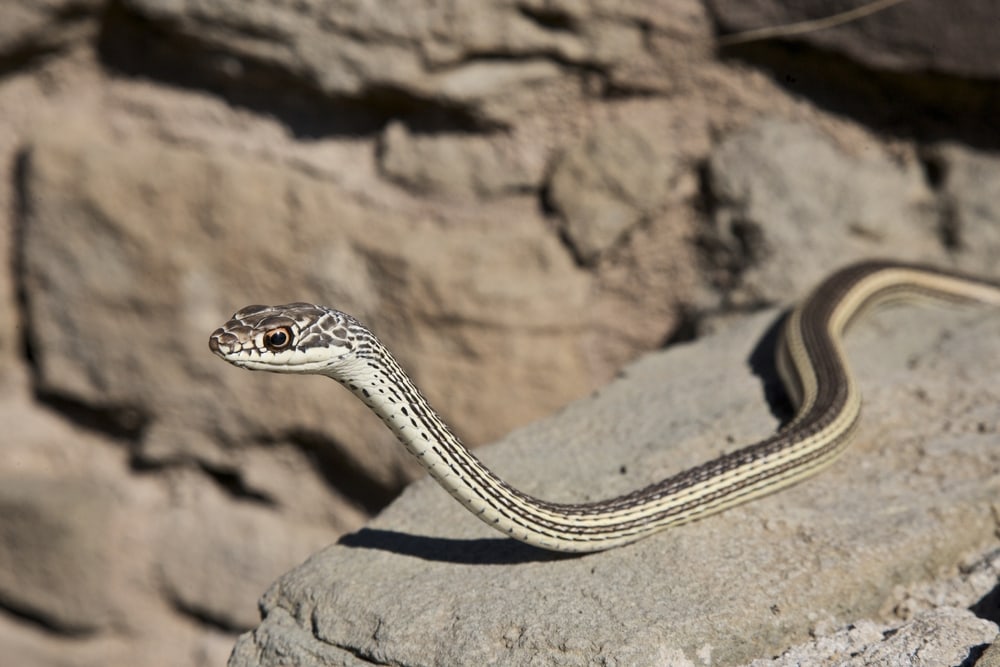
Striped Whipsnake (Coluber taeniatus) is a slender hunter of the northern plateaus and central mountains. Adults reach up to 1,652 mm (65 inches).
The body is dark brown, gray, or black with clear pale stripes running lengthwise. Its long build, speed, and northern or central setting help keep it apart from the warmer low-desert whipsnakes.
Diurnal, alert, and extremely fast-moving. Active forager consuming lizards, snakes, mice, small mammals, birds, frogs, and various insects.
| Key detail | What to look for |
|---|---|
| Adult size | Long and slender, reaching up to 1,652 mm (65 inches) in total length |
| Fast ID cue | dark brown, gray, or black base color; prominent light stripes run the length of the body |
| Typical Arizona habitat | Northern plateau and central mountain habitats within the listed range |
| Arizona range | Primarily inhabits Arizona’s northern plateaus and central mountains |
| Bite / venom note | Nonvenomous fast hunter; long tail and large eyes |
Kingsnakes, milksnakes, ratsnakes, and gophersnakes
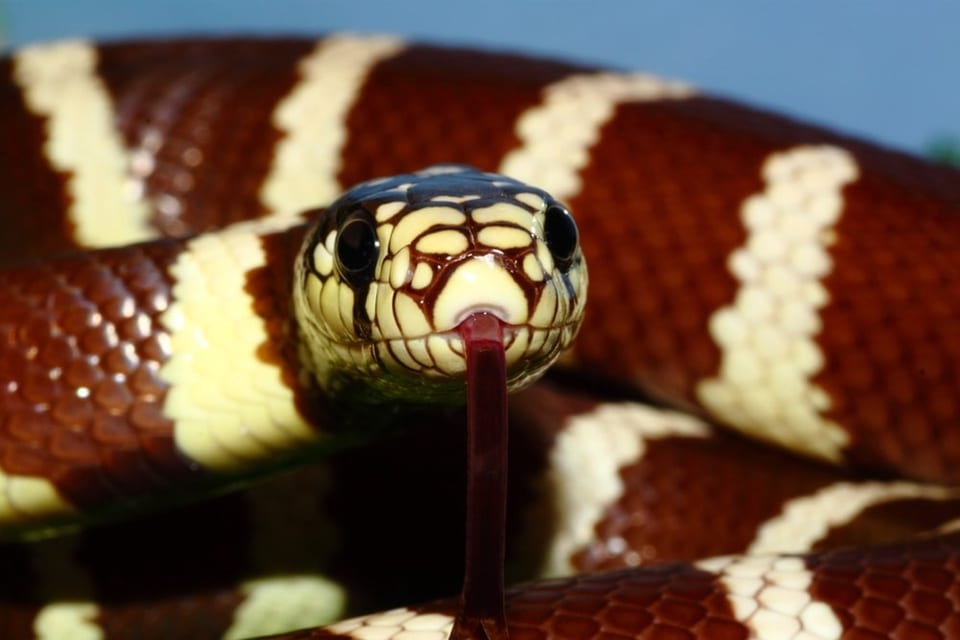
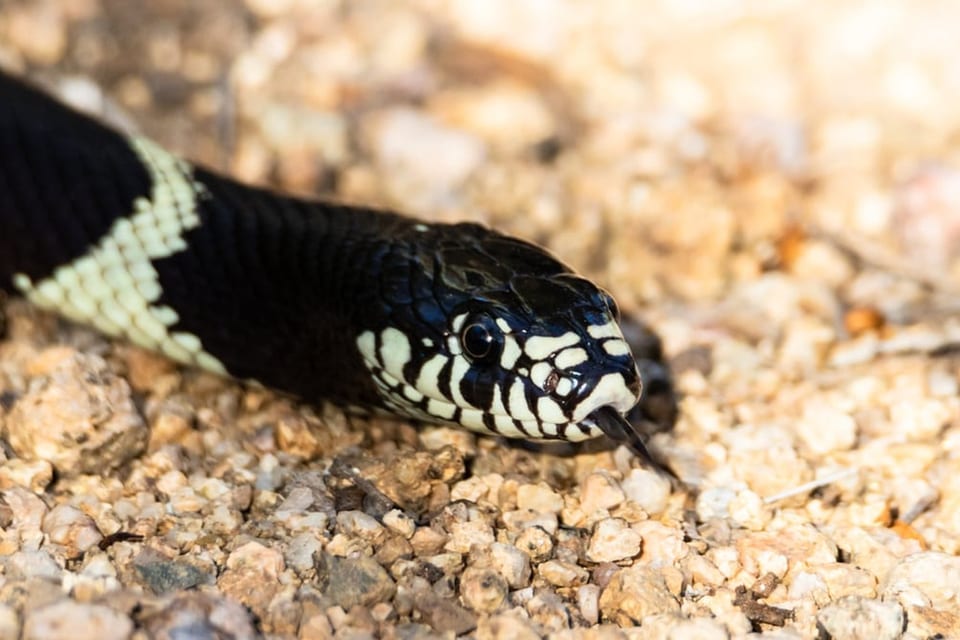
21. Common Kingsnake
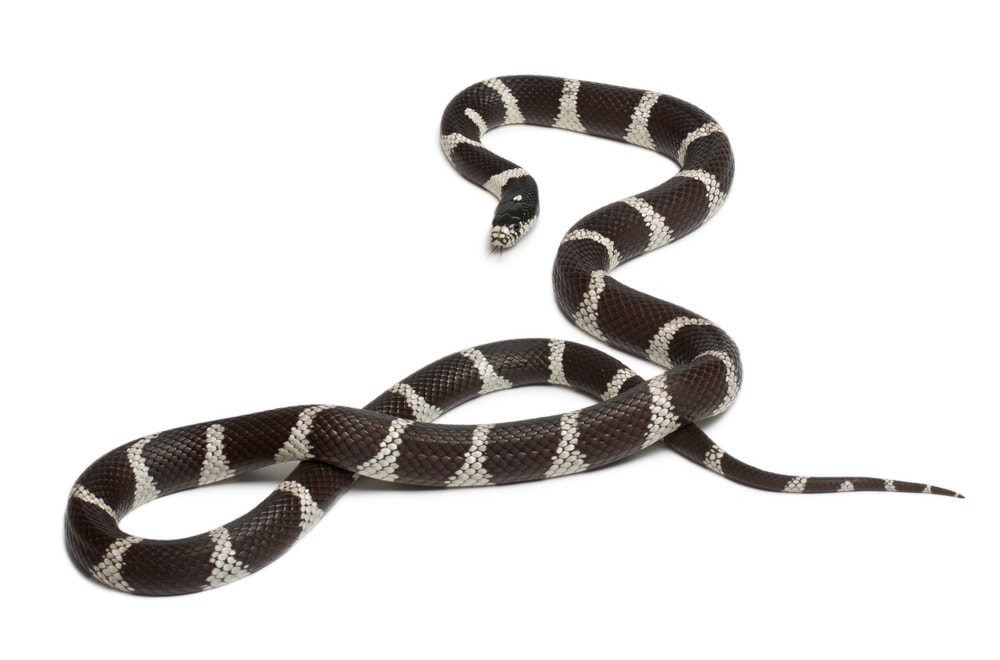
Common Kingsnake (Lampropeltis getula) is a large kingsnake found across most of the state, except high mountains and the high Mogollon Rim. Adults reach up to 1,422 mm (56 inches).
Do not force one color formula on this one. Pattern varies by region, so use the smooth kingsnake build, range, and overall banded or blotched look together.
A powerful constrictor.
| Key detail | What to look for |
|---|---|
| Adult size | Large, reaching up to 1,422 mm (56 inches) |
| Fast ID cue | variable by region; use smooth kingsnake build with bands or blotches |
| Typical Arizona habitat | Broad lowland habitats across the listed range; high mountains are the main exclusion |
| Arizona range | Found across most of Arizona, excluding high mountains and the high elevations of the Mogollon Rim |
| Bite / venom note | Nonvenomous constrictor; bold bands or blotches can confuse IDs |
22. Gophersnake
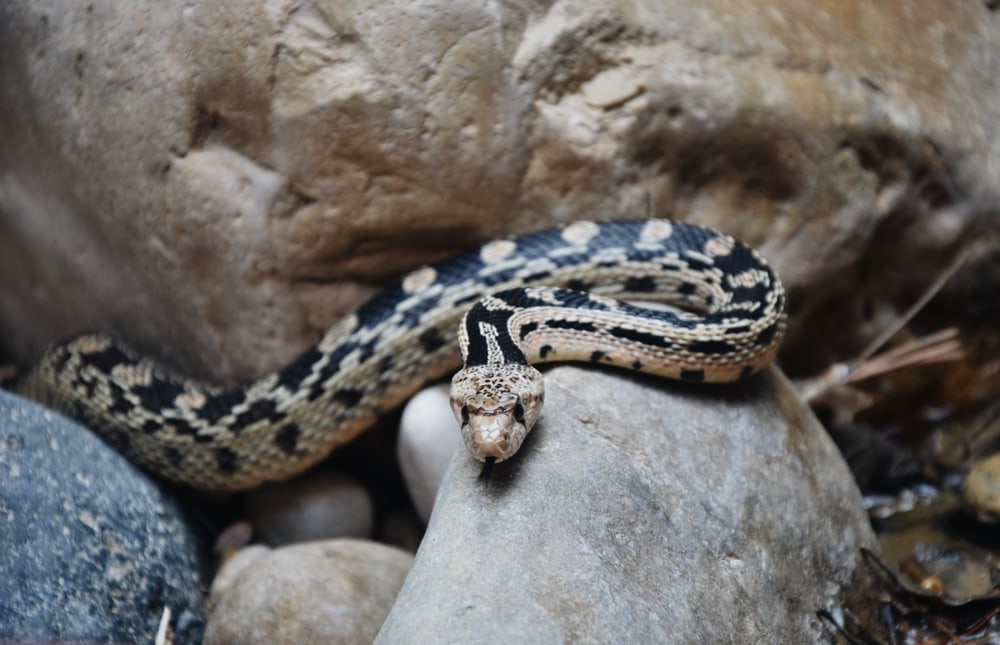
Gophersnake (Pituophis catenifer) is nearly statewide, missing only the highest mountain peaks. It is the state’s longest snake, reaching up to 2,337 mm (92″).
Look for a tan, cream, yellow, orange-brown, or pale gray body with large brown, reddish-brown, black, or olive dorsal blotches. Because it uses almost every biotic community except treeless alpine tundra on the San Francisco Peaks, the no-rattle body and blotched pattern do more work than habitat.
Can be active around the clock and hibernates during late fall and winter. It is a powerful constrictor that eats rats, mice, rabbits, lizards, birds, snakes, eggs, and insects.
| Key detail | What to look for |
|---|---|
| Adult size | Arizona’s longest snake, reaching up to 2,337 mm (92″) in total length |
| Fast ID cue | Tan, cream, yellow, orange-brown, or pale gray base color; large dorsal blotches (brown, reddish-brown, black, or olive) |
| Typical Arizona habitat | Nearly all Arizona biotic communities except for the treeless alpine tundra of the San Francisco Mountains |
| Arizona range | Found in nearly every part of Arizona, excluding only the highest mountain peaks |
| Bite / venom note | Nonvenomous constrictor; rattlesnake lookalike with no rattle |
23. Green Ratsnake
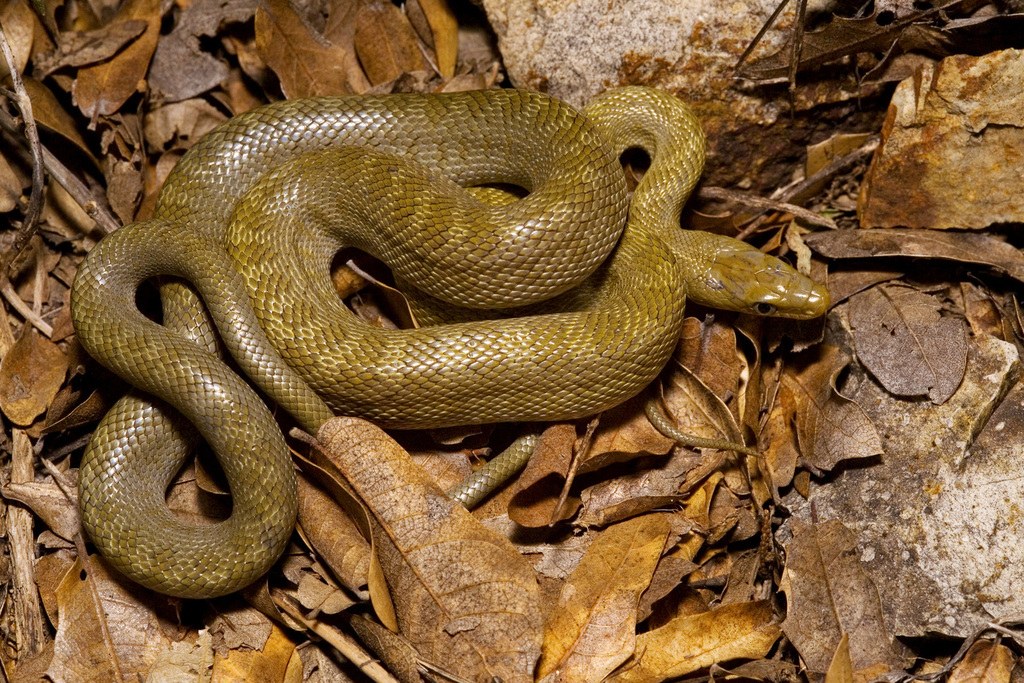
Green Ratsnake (Senticolis triaspis) is a large southeastern mountain ratsnake, known from ranges including the Baboquivari, Pajarito, Atascosa, Santa Rita, Empire, Patagonia, Chiricahua, Swisshelm, Pedregosa, and Peloncillo. Adults can reach 1,600 mm (63 inches).
Adults may be plain green, yellow-green, or olive above with a cream to light yellow underside, while other individuals appear gray to gray-green with prominent gray-brown blotches. Madrean evergreen woodland and upper semidesert grassland are the habitat clues.
Primarily diurnal and crepuscular, and it moves well through brush, trees, and rocky woodland edges.
| Key detail | What to look for |
|---|---|
| Adult size | Large, reaching up to 1,600 mm (63 inches) in total length |
| Fast ID cue | plain green, yellow-green, or olive coloration with a cream to light yellow underside; gray to gray-green with prominent gray-brown dorsal blotches |
| Typical Arizona habitat | Madrean evergreen woodland and the upper reaches of semidesert grassland |
| Arizona range | Found in the mountain ranges of southeastern Arizona, including the Baboquivari, Pajarito, Atascosa, Santa Rita, Empire, Patagonia, Chiricahua, Swisshelm, Pedregosa, and Peloncillo |
| Bite / venom note | Nonvenomous constrictor; green or blotched mountain ratsnake |
24. Milksnake
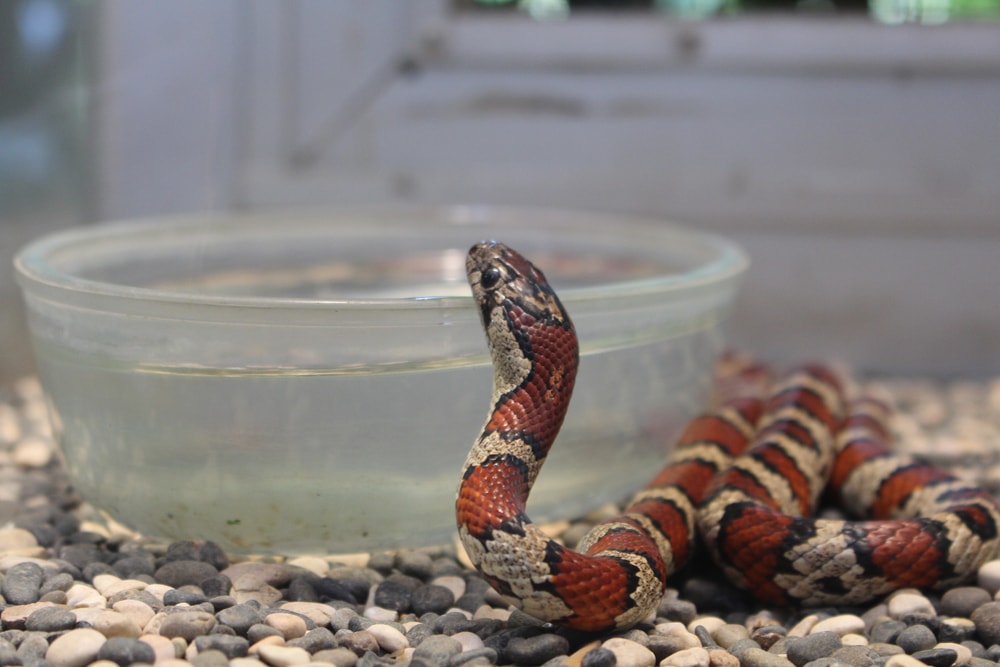
Milksnake (Lampropeltis triangulum) is a medium kingsnake relative of the northeastern plateau region, with a small southeastern pocket as well. Adults reach up to 900 mm (35.5″).
The black snout helps separate it from Sonoran Mountain Kingsnake, which has a light-colored snout. Its black bands often widen across the midline and can bridge across red bands, a useful clue in open plains, low valleys, and rolling grassland.
Diet includes reptiles, mice, small mammals, small birds, amphibians, and invertebrates.
| Key detail | What to look for |
|---|---|
| Adult size | Medium-sized, reaching up to 900 mm (35.5″) in total length |
| Fast ID cue | black bands often widen at the midline, sometimes “bridging” across the red bands; the snout is black, which differentiates it from the Sonoran Mountain Kingsnake (which has a light-colored snout) |
| Typical Arizona habitat | Open plains, low valleys, and rolling hills within Plains and Great Basin Grassland and semidesert grassland communities |
| Arizona range | Primarily the northeastern plateau region and a small portion of southeastern Arizona |
| Bite / venom note | Nonvenomous constrictor; bold bands or blotches can confuse IDs |
25. Sonoran Mountain Kingsnake
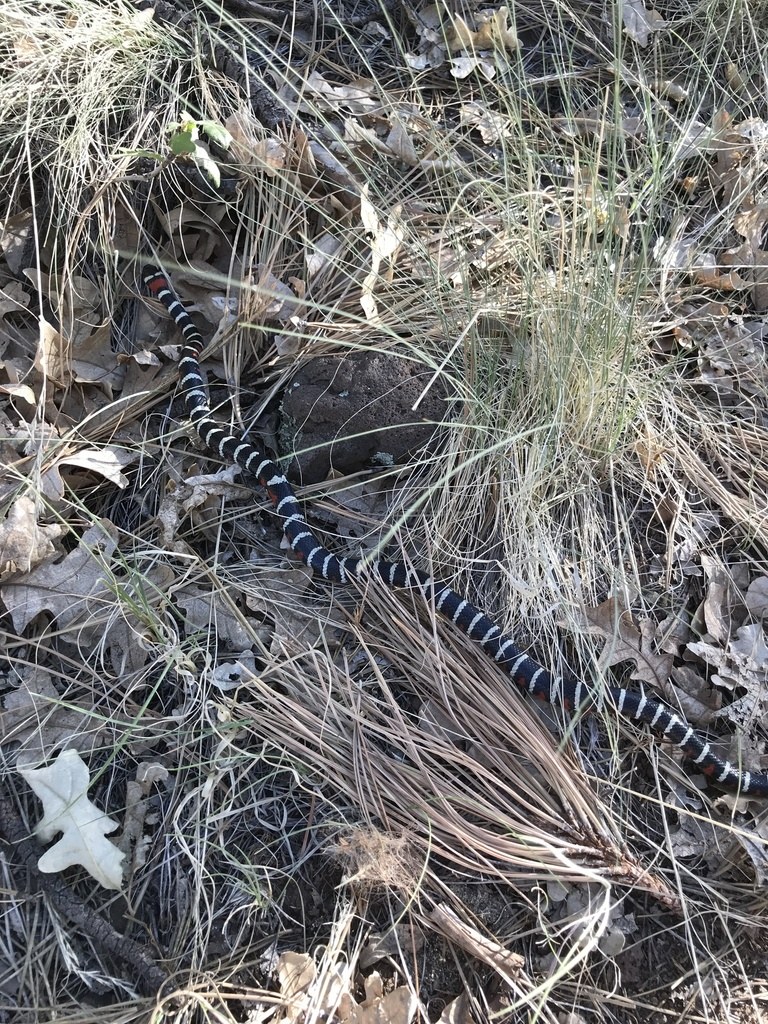
Sonoran Mountain Kingsnake (Lampropeltis pyromelana) is a medium mountain kingsnake, up to 1,088 mm (43 inches). The light-colored snout is one of the easiest ways to separate it from milksnakes in this guide.
Its red, black, and white or cream bands fit wooded, rocky slopes and steep canyon bottoms with leaf litter, fallen logs, and rocks. This is a cooler, cover-heavy mountain snake, not a low-desert sand specialist.
A powerful constrictor that feeds on lizards, rodents, birds, and bats.
| Key detail | What to look for |
|---|---|
| Adult size | Medium-sized, reaching up to 1,088 mm (43 inches) in total length |
| Fast ID cue | red, black, and white or cream bands with a light-colored snout |
| Typical Arizona habitat | Heavily wooded, rocky slopes, steep canyon bottoms with leaf litter, fallen logs, and rocks |
| Arizona range | Localized in wooded mountain and canyon systems rather than low desert flats |
| Bite / venom note | Nonvenomous constrictor; light snout helps separate it from milksnakes |
Gartersnakes of streams, ponds, and wet canyons
26. Black-necked Gartersnake
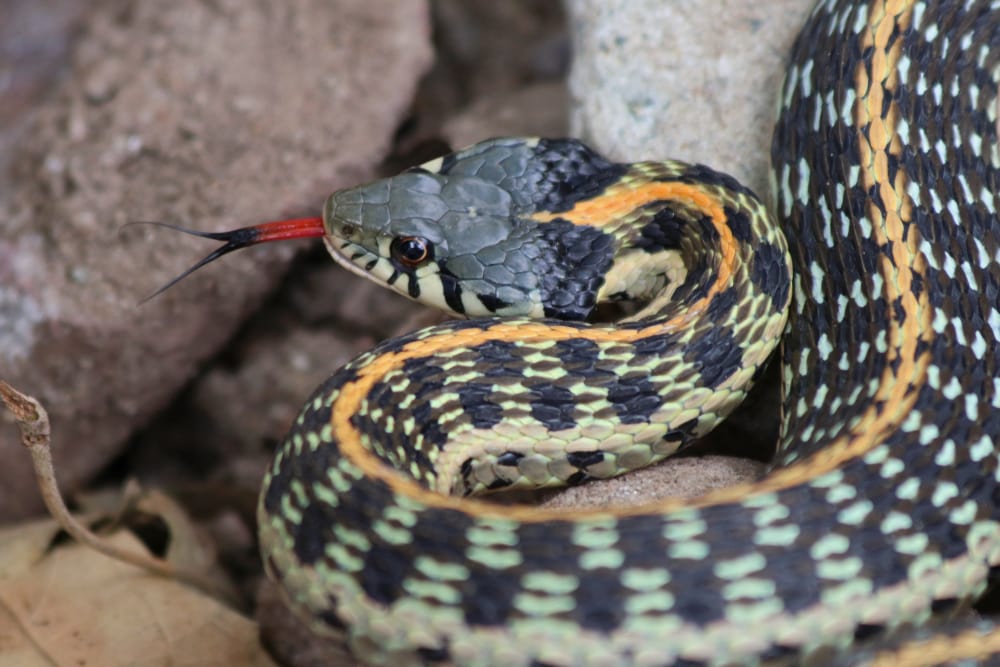
Black-necked Gartersnake (Thamnophis cyrtopsis) is a medium gartersnake of the central and southeastern parts of the state, with an isolated Ajo Mountains population in western Pima County. Adults reach up to 1,070 mm (42 inches).
The neck marks are hard to miss when visible: two jet-black crescent blotches, plus an orange or pale yellow mid-dorsal stripe and two side stripes on a dark olive-gray body. It uses everything from desert scrub and grasslands to chaparral, conifer forest, rocky upland canyons, and semi-permanent streams.
Primarily diurnal and crepuscular, often foraging in shallow water. Eats tadpoles, frogs, toads, lizards, salamanders, earthworms, and invertebrates.
| Key detail | What to look for |
|---|---|
| Adult size | Medium-sized, reaching up to 1,070 mm (42 inches) in total length |
| Fast ID cue | dark olive-gray body; orange or pale yellow mid-dorsal stripe; two lateral stripes; two jet-black crescent-shaped blotches on the neck |
| Typical Arizona habitat | Sonoran desert scrub, grasslands, chaparral, conifer forests, rocky upland canyons, and semi-permanent streams |
| Arizona range | Found primarily across southeastern and central Arizona, with an isolated population in the Ajo Mountains (western Pima County) |
| Bite / venom note | Nonvenomous striped snake; often near wet grass or streams |
27. Checkered Gartersnake
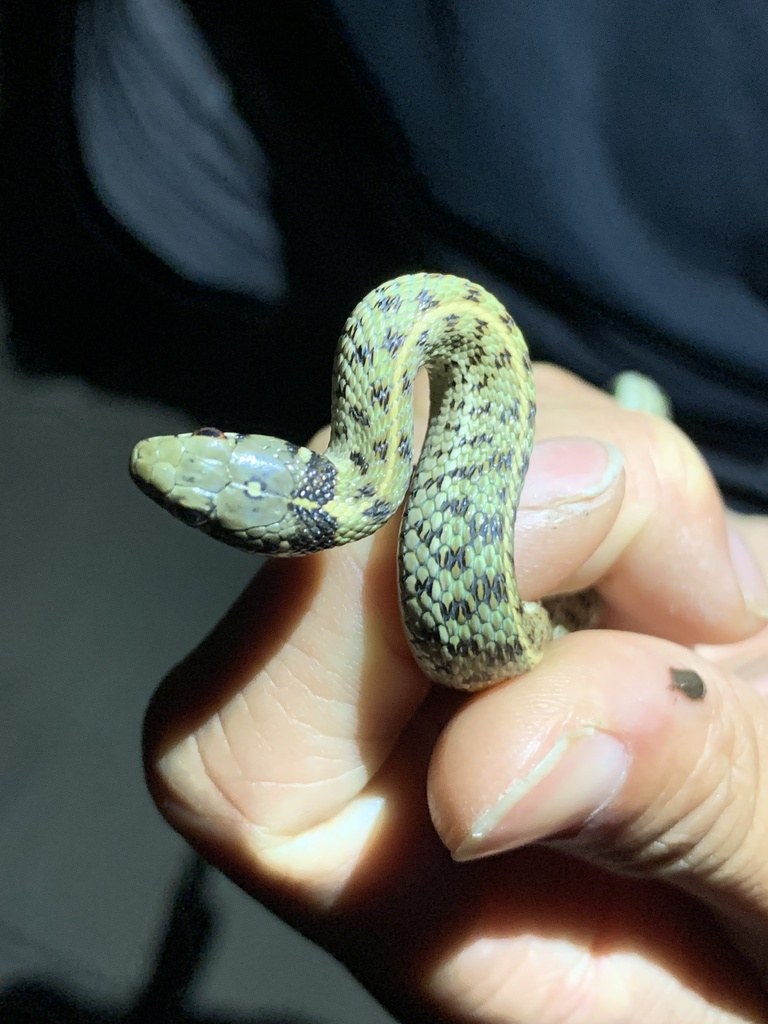
Checkered Gartersnake (Thamnophis marcianus) is a southeastern valley gartersnake. Adults are medium-sized and reach up to 1,088 mm (43 inches).
Look for a light olive-green, tan, or yellow-green base with a pale mid-dorsal stripe and side stripes on the third scale row. The name is a good reminder to watch for the checkered look between the stripes.
Diurnal and nocturnal when conditions are right. A dietary generalist that consumes frogs, toads, tadpoles, lizards, salamanders, snakes, small mammals, fish, and insects.
| Key detail | What to look for |
|---|---|
| Adult size | Medium-sized; reaches up to 1,088 mm (43 inches) in total length |
| Fast ID cue | light olive-green, tan, or yellow-green body; pale mid-dorsal stripe; side stripes on the third scale row; checkered dark marks between stripes |
| Typical Arizona habitat | Southeastern valleys; often near damp grass, canals, ponds, or stream edges |
| Arizona range | Primarily found in the valleys of southeastern Arizona |
| Bite / venom note | Nonvenomous striped snake; often near wet grass or streams |
28. Mexican Gartersnake
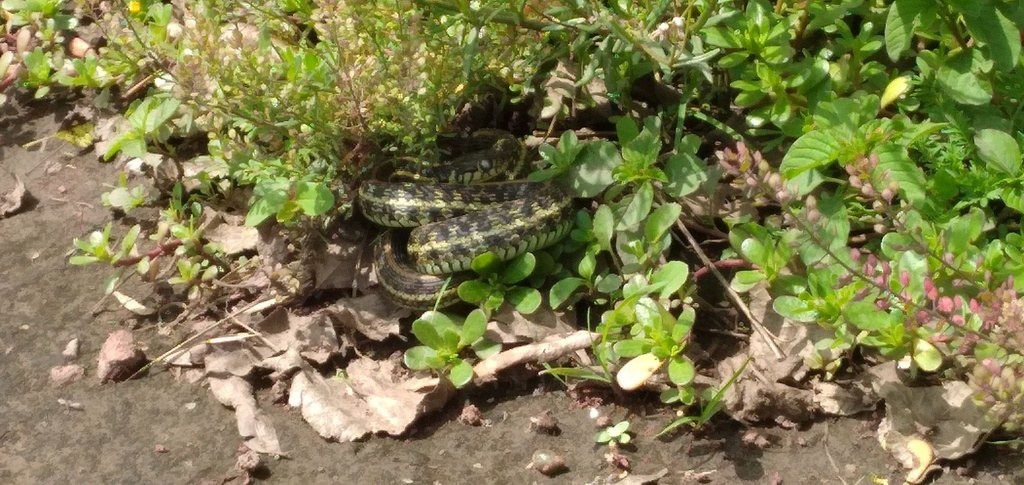
Mexican Gartersnake (Thamnophis eques) is tied to water in sub-Mogollon Rim drainages and parts of the south-central and southeastern region. Adults are medium-sized, reaching up to 1,120 mm (44 inches).
For ID, start with a medium gartersnake build at the water’s edge. Rivers, streams, and ciénegas are better clues than a dry hillside sighting.
Often forages in mid-morning sun. Feeds on frogs, toads, fish, lizards, and small mammals.
| Key detail | What to look for |
|---|---|
| Adult size | Medium-sized, reaching up to 1,120 mm (44 inches) in total length |
| Fast ID cue | medium gartersnake build, water-edge habitat, and south-central to southeastern Arizona range |
| Typical Arizona habitat | water sources, including rivers, streams, and ciénegas |
| Arizona range | Historically found in sub-Mogollon Rim drainage systems and parts of south-central and southeastern Arizona |
| Bite / venom note | Nonvenomous striped snake; often near wet grass or streams |
29. Narrow-headed Gartersnake
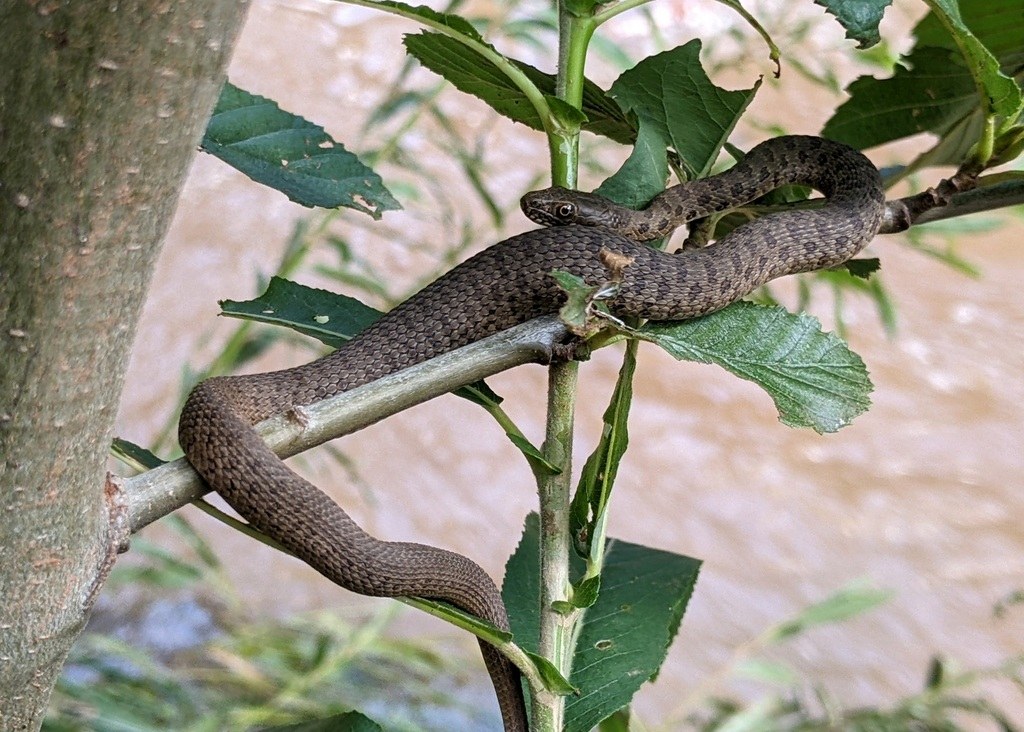
Narrow-headed Gartersnake (Thamnophis rufipunctatus) is a central Mogollon Rim gartersnake, found along and below the Rim from about 2,200 to 8,000 feet. Adults reach up to 1,115 mm (44″).
This is one of the more aquatic gartersnakes here. Look for gray, greenish tan, tan, or brown coloring with paired dark spots that fade toward the tail, plus a pale underside marked by two parallel rows of dark blotches. Clear rocky streams and rivers are the setting to match.
Highly aquatic, diurnal, and crepuscular. It eats mainly fish such as dace, chubs, and trout, with salamanders and Smallmouth Bass also recorded.
| Key detail | What to look for |
|---|---|
| Adult size | Medium-sized, reaching up to 1,115 mm (44″) in total length |
| Fast ID cue | gray, greenish tan, tan, or brown with paired dark spots along the back that fade toward the tail; pale cream to light gray with two parallel rows of dark blotches |
| Typical Arizona habitat | clear, rocky streams and rivers, ranging from Arizona Upland Sonoran desert scrub to Petran montane conifer forest |
| Arizona range | Found along and below the Mogollon Rim in central Arizona at elevations between 2,200′ and 8,000′ |
| Bite / venom note | Nonvenomous striped snake; often near wet grass or streams |
30. Terrestrial Gartersnake
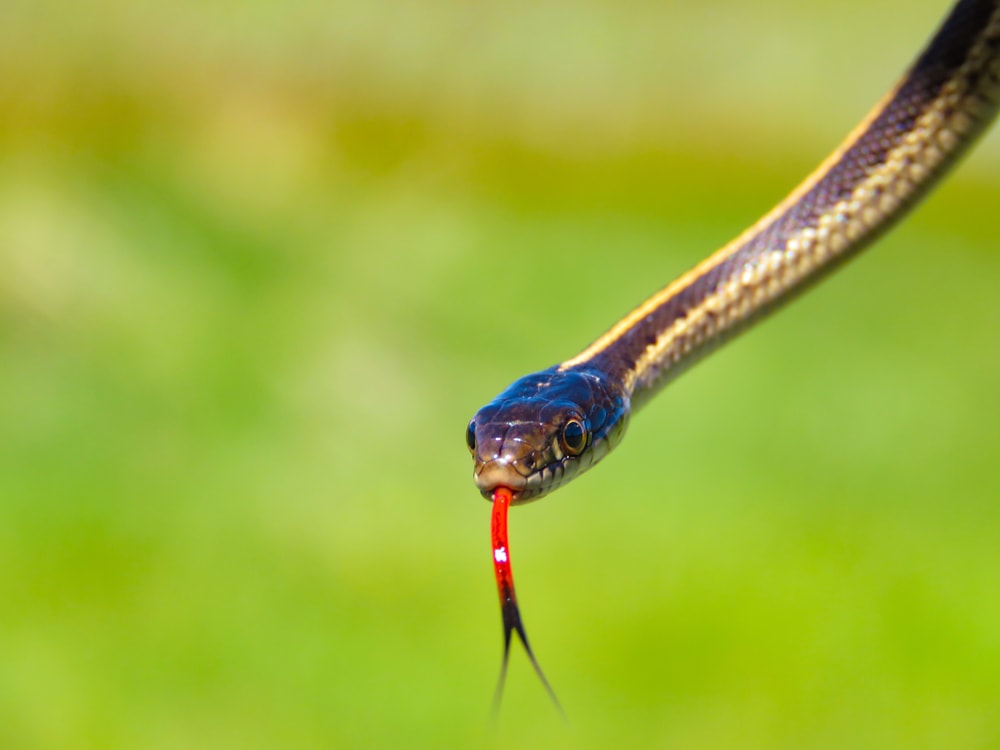
Terrestrial Gartersnake (Thamnophis elegans) belongs mainly to northern and northeastern Arizona, with isolated populations in the Sierra Ancha of Gila County and the Pinaleño Mountains of Graham County. Adults are medium to large, up to 900 mm (36 inches).
The body can be gray, brown, or orange-brown. Look for one cream-colored dorsal stripe and two thinner pale stripes on the second and third scale rows.
Highly opportunistic predator around wet meadows, streams, and other damp cover where its range allows.
| Key detail | What to look for |
|---|---|
| Adult size | Medium to large; up to 900 mm (36 inches) in total length |
| Fast ID cue | gray, brown, or orange-brown body with one cream dorsal stripe and two thinner pale side stripes on the 2nd and 3rd scale rows |
| Typical Arizona habitat | Northern and northeastern wet meadows, stream edges, and damp cover within the listed range |
| Arizona range | Primarily northern and northeastern Arizona, with isolated populations in the Sierra Ancha (Gila County) and Pinaleño Mountains (Graham County) |
| Bite / venom note | Nonvenomous striped snake; often near wet grass or streams |
Sand, leaf-nosed, hognose, and patch-nosed snakes
31. Chihuahuan Hook-nosed Snake
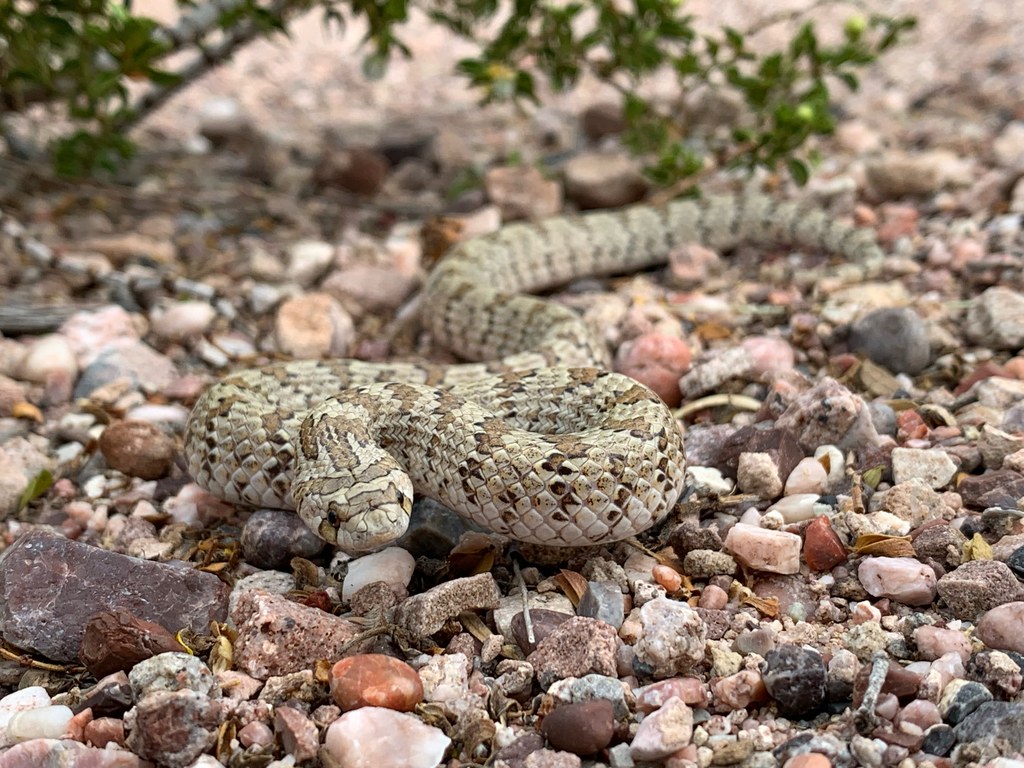
Chihuahuan Hook-nosed Snake (Gyalopion canum) is a small, stout snake of southeastern foothills, bajadas, and valleys. Adults reach up to 380 mm (15″).
The upturned hook-like snout is the feature to check first, followed by the compact body and southeastern range. It is easy to overlook because it spends so much time under cover and among loose desert ground.
Primarily eats spiders, insects, centipedes, and scorpions.
| Key detail | What to look for |
|---|---|
| Adult size | Small, stout-bodied; up to 380 mm (15″) in total length |
| Fast ID cue | small stout body, upturned hook-like snout, and southeastern Arizona range |
| Typical Arizona habitat | Foothills, bajadas, and valleys in the southeastern range |
| Arizona range | Found in the foothills, bajadas, and valleys of southeastern Arizona |
| Bite / venom note | Nonvenomous small snout-specialist; invertebrate eater |
32. Eastern Patch-nosed Snake
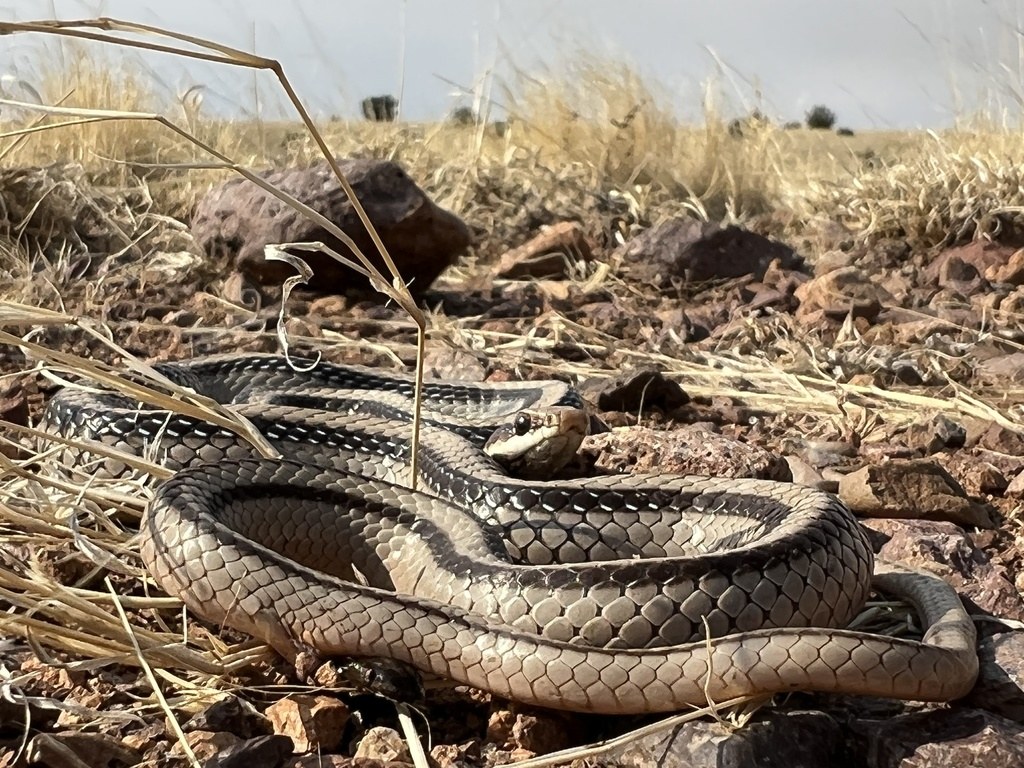
Eastern Patch-nosed Snake (Salvadora grahamiae) is a medium patch-nosed snake of southeastern sky islands and higher ranges below the eastern Mogollon Rim. Adults reach up to 900 mm (36″).
The body is slender and tan or cream-colored, with two wide, straight-edged dark brown or black stripes along the back. Range is helpful because it overlaps less with the western patch-nosed snake than the names suggest.
An active forager that consumes lizards, snakes, mice, small mammals, reptile eggs, and birds.
| Key detail | What to look for |
|---|---|
| Adult size | Medium-sized, reaching up to 900 mm (36″) in total length |
| Fast ID cue | slender, tan or cream-colored; two wide, straight-edged, dark brown or black stripes on the back |
| Typical Arizona habitat | Southeastern sky-island and high-range habitats within the listed range |
| Arizona range | Found in the “sky island” ranges of southeastern Arizona and higher ranges below the eastern half of the Mogollon Rim |
| Bite / venom note | Nonvenomous active hunter; striped patch-nosed snake |
33. Long-nosed Snake
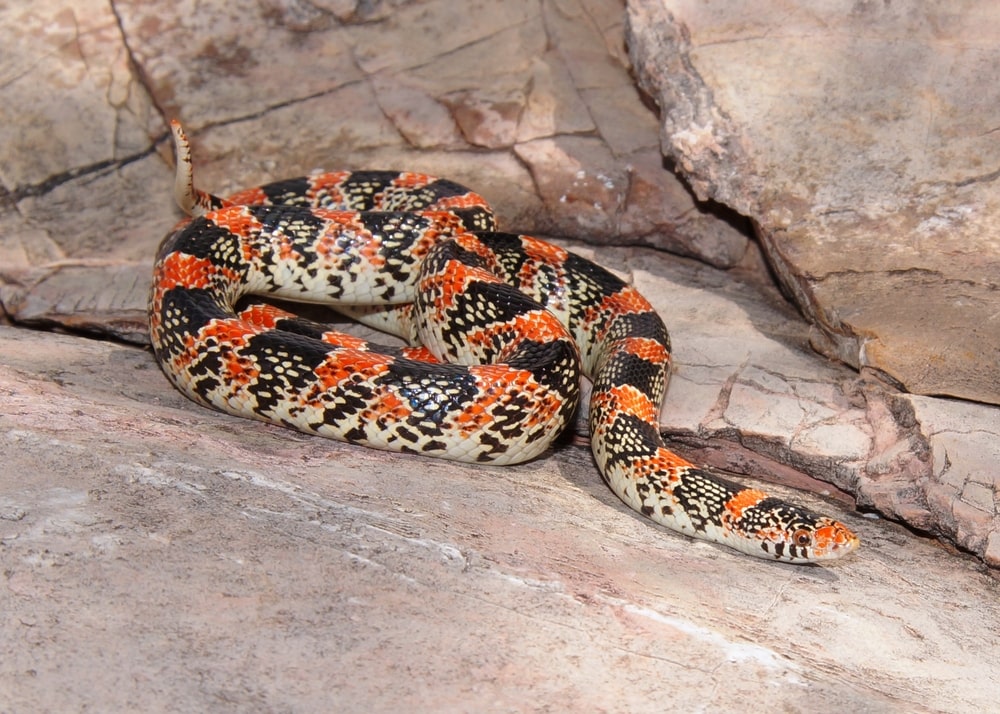
Long-nosed Snake (Rhinocheilus lecontei) is widespread across southern and western parts of the state, including the Arizona Strip north of the Colorado River. It can reach 1,520 mm, though most local specimens are under 890 mm (35″).
Look for the narrow head, countersunk lower jaw, pointed snout, smooth shiny scales, round pupils, and red or orange irises. Desert scrub and semidesert grasslands are the usual setting.
Active from April through September. A constrictor that feeds on lizards, especially Aspidoscelis whiptails, small mammals, snake and lizard eggs, and grasshoppers.
| Key detail | What to look for |
|---|---|
| Adult size | Can reach 1,520 mm, though most Arizona specimens are under 890 mm (35″) |
| Fast ID cue | narrow head, countersunk lower jaw, pointed snout, smooth/shiny scales, round pupils, and red or orange irises; most subcaudal scales are undivided |
| Typical Arizona habitat | desert scrub and semidesert grasslands |
| Arizona range | Widespread across southern and western Arizona, including the Arizona Strip (north of the Colorado River) |
| Bite / venom note | Nonvenomous constrictor; bold bands or blotches can confuse IDs |
34. Mexican Hog-nosed Snake
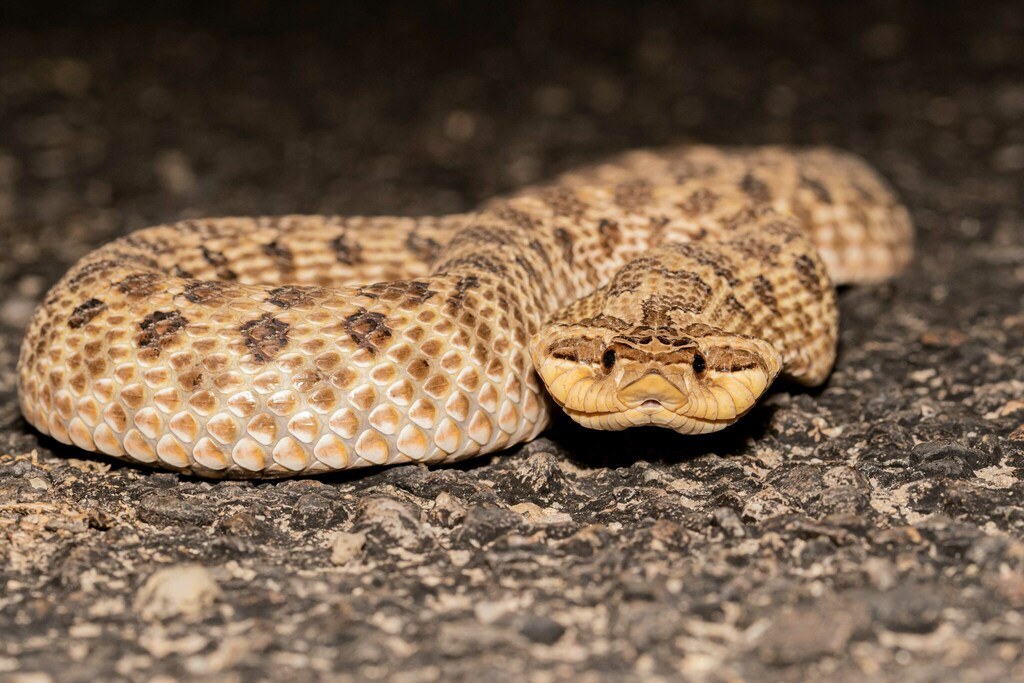
Mexican Hog-nosed Snake (Heterodon kennerlyi) is a southeastern valley hognose. Adults are medium-sized, up to 760 mm (30″).
The body is stocky, with a large head that barely narrows at the neck. The enlarged, flat-bottomed, upturned snout gives it the shovel-like look that hognose snakes use for burrowing.
Primarily diurnal and crepuscular from May to October, with some nocturnal activity during warm periods. It is a generalist predator of toads, frogs, lizards, small snakes, rodents, reptile eggs, salamanders, hatchling turtles, birds, eggs, and insects.
| Key detail | What to look for |
|---|---|
| Adult size | Medium, reaching up to 760 mm (30″) in total length |
| Fast ID cue | stocky body with a large head barely distinct from the neck; enlarged, flat-bottomed, upturned, and shovel-like (an adaptation for burrowing) |
| Typical Arizona habitat | Southeastern valleys; use loose-soil habitat with the upturned snout |
| Arizona range | Found in the valleys of southeastern Arizona |
| Bite / venom note | Nonvenomous toad hunter; upturned snout and defensive display |
35. Saddled Leaf-nosed Snake
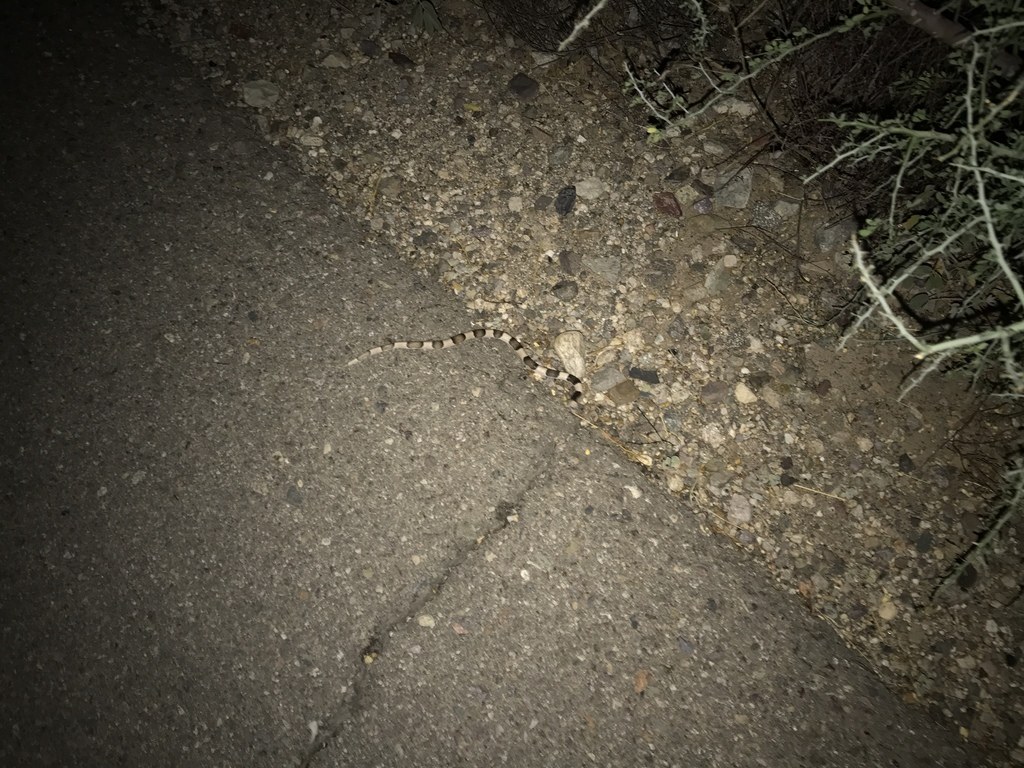
Saddled Leaf-nosed Snake (Phyllorhynchus browni) is a small south-central leaf-nosed snake. Adults reach about 508 mm (20 inches).
Pair the leaf-like snout with south-central Arizona Upland Sonoran desert scrub. At a glance it can read as another small pale desert snake, so the sandy wash setting and local range matter.
Saddled Leaf-nosed Snake is an egg specialist, taking mostly lizard and snake eggs and only occasional small lizards.
| Key detail | What to look for |
|---|---|
| Adult size | Small, reaching a maximum total length of 508 mm (20 inches) |
| Fast ID cue | small leaf-nosed snake in Arizona Upland Sonoran desert scrub |
| Typical Arizona habitat | the Arizona Upland subdivision of the Sonoran desert scrub |
| Arizona range | Found in south-central Arizona |
| Bite / venom note | Nonvenomous desert snake; sand or wash habitat is a key clue |
36. Sonoran Shovel-nosed Snake
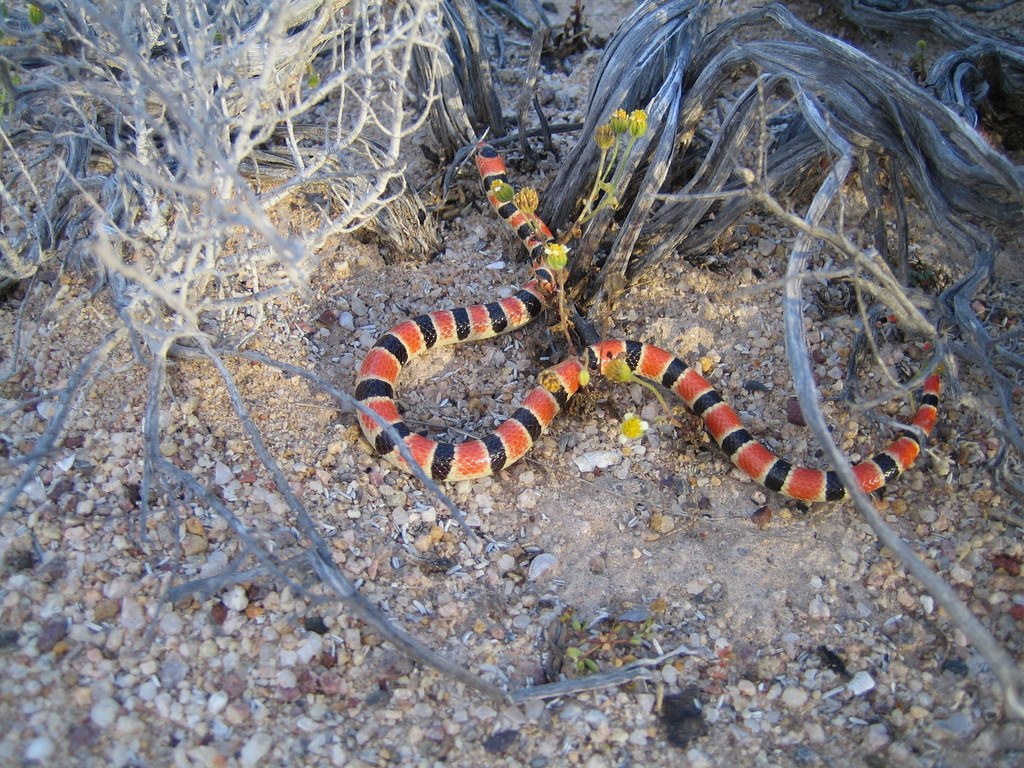
Sonoran Shovel-nosed Snake (Chionactis palarostris) is a small sand snake with an extremely limited local range: Organ Pipe Cactus National Monument in western Pima County. Adults reach up to 430 mm (17 inches).
The cream to light yellow body, red saddles, black bands, and light snout separate it from the black-snouted Sonoran Coralsnake. The habitat note is Arizona Upland Sonoran desert scrub.
Primarily crepuscular and nocturnal. Feeds on invertebrates, including insects, scorpions, spiders, and centipedes.
| Key detail | What to look for |
|---|---|
| Adult size | Small, reaching up to 430 mm (17 inches) |
| Fast ID cue | cream to light yellow background with red saddles separated by black bands; light-colored snout (distinguishes it from the black-snouted Sonoran Coralsnake) |
| Typical Arizona habitat | Arizona Upland Sonoran desert scrub |
| Arizona range | Extremely limited in Arizona; found only in the Organ Pipe Cactus National Monument (western Pima County) |
| Bite / venom note | Nonvenomous desert snake; sand or wash habitat is a key clue |
37. Spotted Leaf-nosed Snake
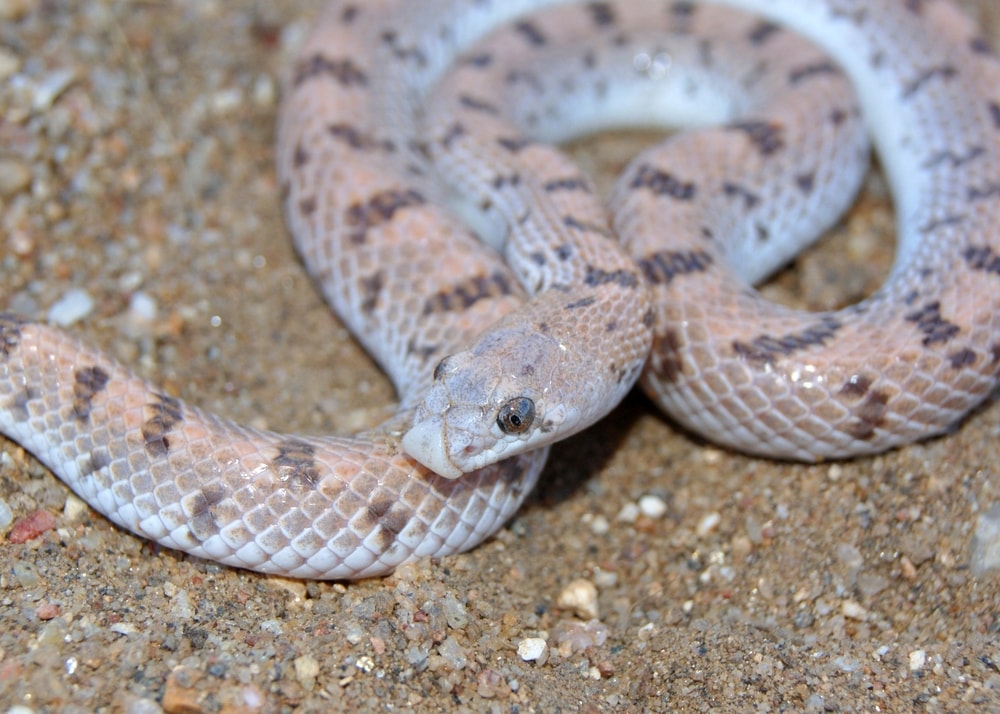
Spotted Leaf-nosed Snake (Phyllorhynchus decurtatus) lives across the western and southwestern deserts. Adults stay small, reaching about 510 mm (20 inches).
Look for a light tan, cream, or pinkish-tan body with 17 or more brown to gray-brown dorsal blotches, smaller side blotches, and a dark line from the eye to the upper lip. Like the saddled leaf-nosed snake, it relies heavily on reptile eggs in desert sand and wash habitats.
| Key detail | What to look for |
|---|---|
| Adult size | Small, reaching a maximum total length of 510 mm (20 inches) |
| Fast ID cue | light tan, cream, or pinkish-tan base with 17+ brown/gray-brown dorsal blotches; smaller blotches on the sides; a distinct dark line extends from the eye to the upper lip |
| Typical Arizona habitat | Desert sand and wash habitat within the western and southwestern range |
| Arizona range | Found across Arizona’s western and southwestern deserts |
| Bite / venom note | Nonvenomous desert snake; sand or wash habitat is a key clue |
38. Thornscrub Hook-nosed Snake
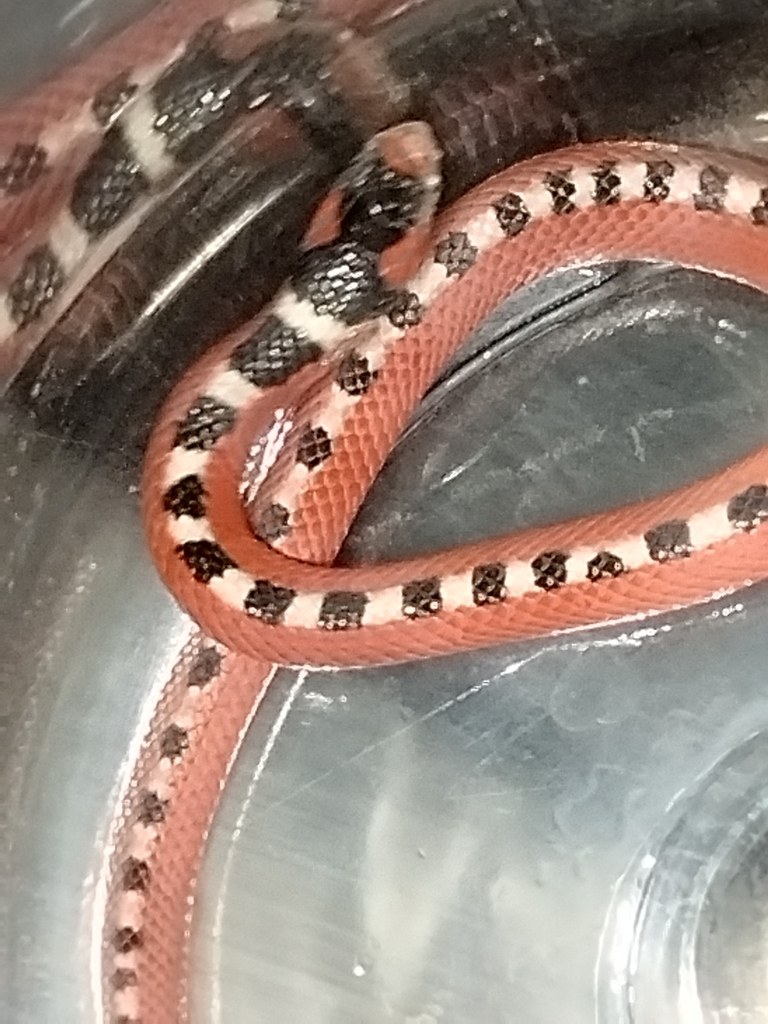
Thornscrub Hook-nosed Snake (Gyalopion quadrangulare) is a tiny hook-nosed snake restricted here to a small part of Santa Cruz County near the Mexican border. Adults reach up to 300 mm (12″).
Bold black saddles on a pale body, reddish side stripes, and a black eye mask are the best marks. It sometimes appears on the surface just before sunset, especially after recent rains.
The hooked snout helps it root through debris, rocks, and logs.
| Key detail | What to look for |
|---|---|
| Adult size | Small, reaching up to 300 mm (12″) in total length |
| Fast ID cue | bold black saddles on a pale background, reddish side stripes, and a black eye mask |
| Typical Arizona habitat | Borderland thornscrub and ground cover within the listed Santa Cruz County range |
| Arizona range | Restricted to a small portion of Santa Cruz County near the Mexican border |
| Bite / venom note | Nonvenomous hook-nosed snake; tiny borderland species |
39. Variable Sandsnake
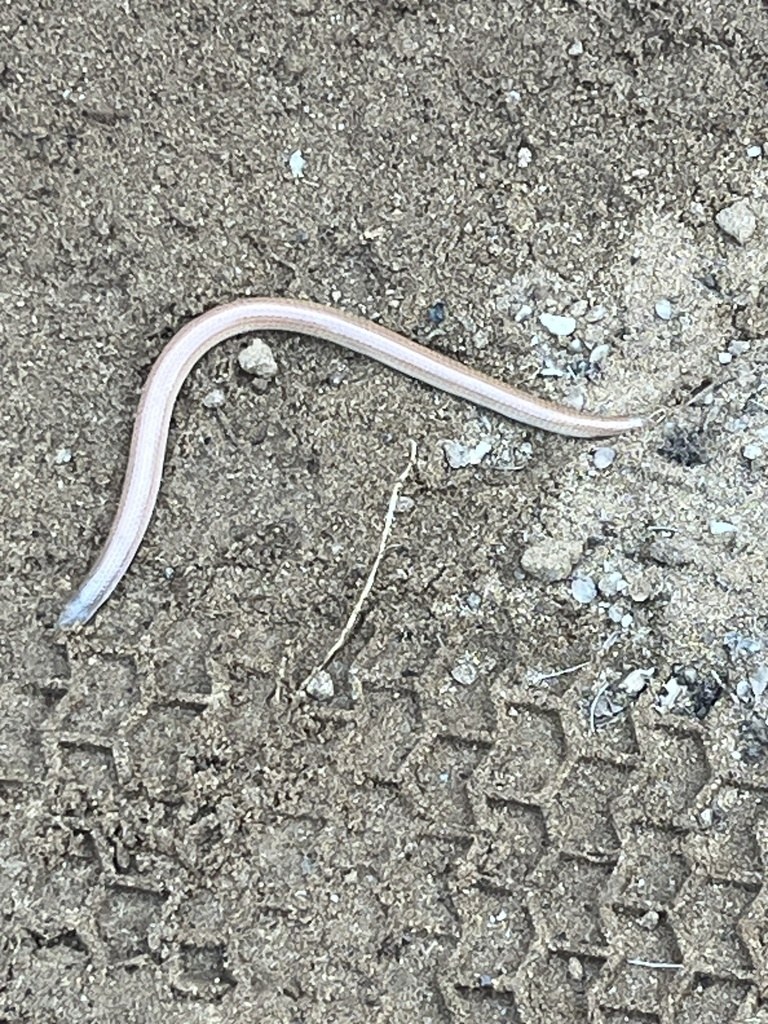
Variable Sandsnake (Chilomeniscus stramineus) is a small, stout sandsnake of the south-central region, with isolated populations extending west to Ligurta in Yuma County. Adults reach up to 285 mm (11″).
The best cue is the combination of small stout body and sandy Sonoran desert habitat, especially Arizona Upland Sonoran desert scrub. It is easy to miss because the body is built for loose sand and cover.
Feeds on insects and other invertebrates; consumes roaches, grasshoppers, and centipedes.
| Key detail | What to look for |
|---|---|
| Adult size | Small, stout-bodied; up to 285 mm (11″) in total length |
| Fast ID cue | small, stout body and sandy Sonoran desert habitat |
| Typical Arizona habitat | the Arizona Upland subdivision of the Sonoran desert scrub |
| Arizona range | Found across most of south-central Arizona, with isolated populations extending west to Ligurta in Yuma County |
| Bite / venom note | Nonvenomous desert snake; sand or wash habitat is a key clue |
40. Western Patch-nosed Snake
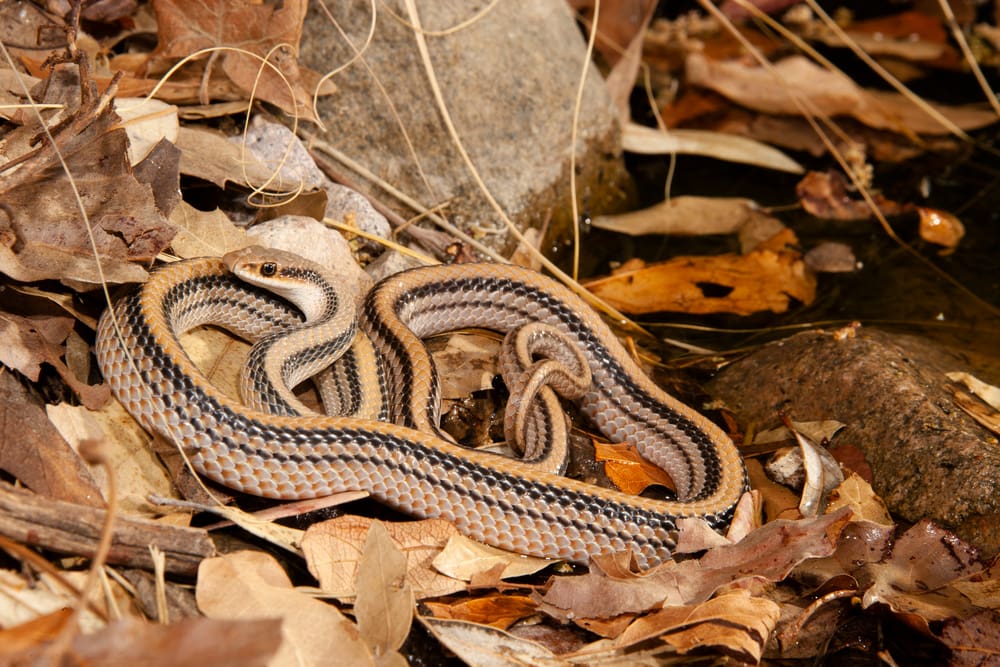
Western Patch-nosed Snake (Salvadora hexalepis) ranges below the Mogollon Rim across the south, along the western edge of the state, and into northern plateau deserts. Adults reach up to 1,014 mm (40 inches).
The body is slender and tan or cream-colored, with two wide dark brown or black stripes that often look irregular-edged or lightly flecked. It turns up in a broad sweep of flatlands, low valleys, rocky bajadas, foothills, and mountain slopes from low desert scrub to woodland.
Diurnal, alert, and fast-moving. An active forager that consumes lizards, mice, small mammals, reptile eggs, and birds.
| Key detail | What to look for |
|---|---|
| Adult size | Medium, reaching up to 1,014 mm (40 inches) in total length |
| Fast ID cue | slender, tan or cream-colored; two wide, dark brown/black irregular-edged stripes on the back, often with light flecks or mottling |
| Typical Arizona habitat | diverse environments including flatlands, low valleys, rocky bajadas, foothills, and mountain slopes, ranging from low desert scrub to woodlands |
| Arizona range | Found across southern Arizona (below the Mogollon Rim), the western edge of the state, and into the northern plateau deserts |
| Bite / venom note | Nonvenomous active hunter; striped patch-nosed snake |
41. Western Shovel-nosed Snake
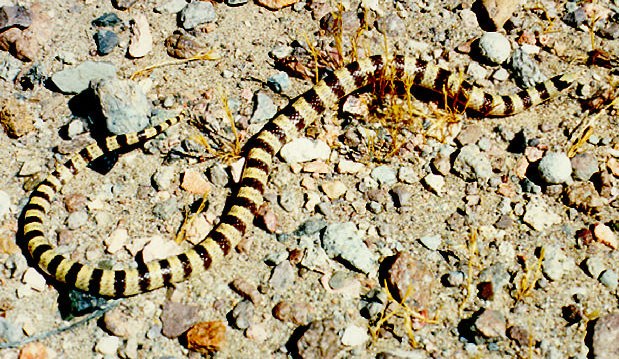
Western Shovel-nosed Snake (Chionactis occipitalis) is a small sand snake of the low western and south-central deserts. Adults reach up to 369 mm (about 15 inches).
Look for a cream or light yellow body with more than 20 dark brown to black bands, a black mask across the eyes, a pale snout, and smooth shiny scales. Sandy washes, dunes, desert flats, gentle bajadas, Lower Colorado River Sonoran desert scrub, and Mohave desert scrub all fit.
Primarily crepuscular, occasionally active at night or on mild days. Feeds on insects, spiders, centipedes, scorpions, and occasionally reptile eggs.
| Key detail | What to look for |
|---|---|
| Adult size | Small, reaching up to 369 mm (about 15 inches) in total length |
| Fast ID cue | cream or light yellow background with more than 20 dark brown to black bands; black mask across the eyes; cream or light yellow snout; smooth, shiny scales |
| Typical Arizona habitat | sandy washes, dunes, desert flats, gentle bajadas, Lower Colorado River Sonoran desert scrub, and Mohave desert scrub |
| Arizona range | Low deserts of western and south-central Arizona |
| Bite / venom note | Nonvenomous desert snake; sand or wash habitat is a key clue |
Night snakes and other secretive canyon snakes
42. Chihuahuan Nightsnake
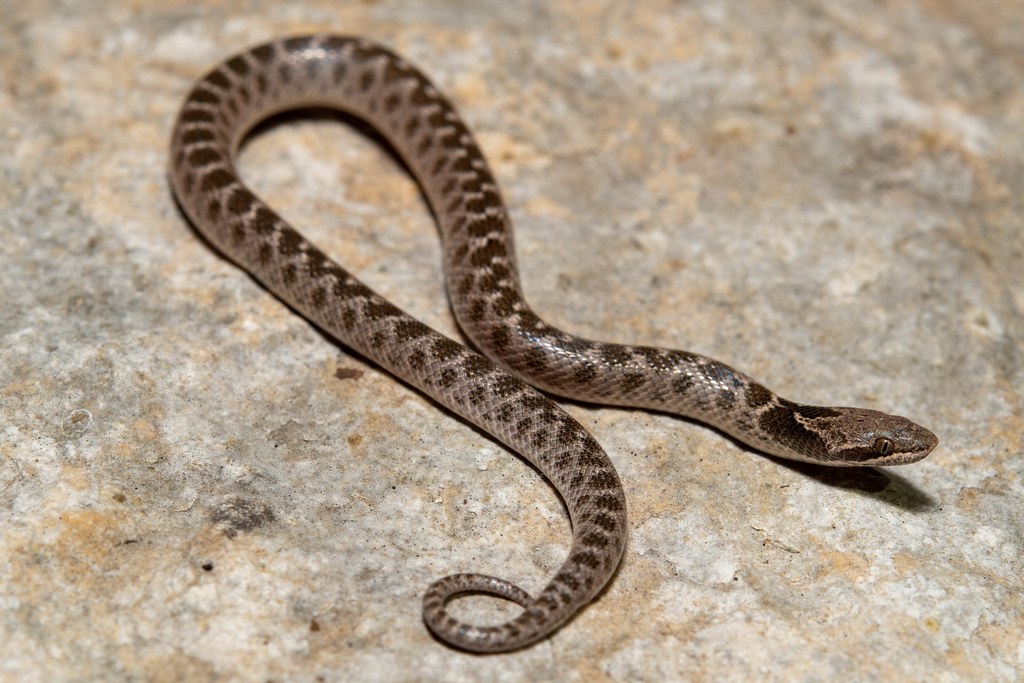
Chihuahuan Nightsnake (Hypsiglena jani) is the nightsnake to consider on the southern Colorado Plateau and below the Mogollon Rim in the southeast. It stays small, about 600 mm (23 inches) at most, with a smooth body built for slipping through rock cracks and cover.
Look for a gray or orange-tan snake with small dark gray-brown blotches, a dark collar on the neck, and a dark bar running from each eye toward the collar. It uses desert scrub, grassland, woodland, open rocky country, and montane forest, so the head-and-neck marks matter more than habitat alone.
It is strictly nocturnal and often seen on remote roads at night. It feeds mainly on lizards and small snakes, with reptile eggs, frogs, and insects also taken.
| Key detail | What to look for |
|---|---|
| Adult size | Small, reaching up to about 600 mm (23 inches) in total length |
| Fast ID cue | gray or orange-tan body with small dark gray-brown blotches; dark neck collar; dark bar from each eye to the collar; smooth scales |
| Typical Arizona habitat | desert scrub, grasslands, woodlands, montane conifer forest, open deserts, and rocky wooded slopes |
| Arizona range | Found across the southern portion of the Colorado Plateau (northeastern Arizona) and sub-Mogollon Rim (southeastern Arizona) |
| Bite / venom note | Nonvenomous nocturnal hunter; often found around rocks or washes |
43. Desert Nightsnake
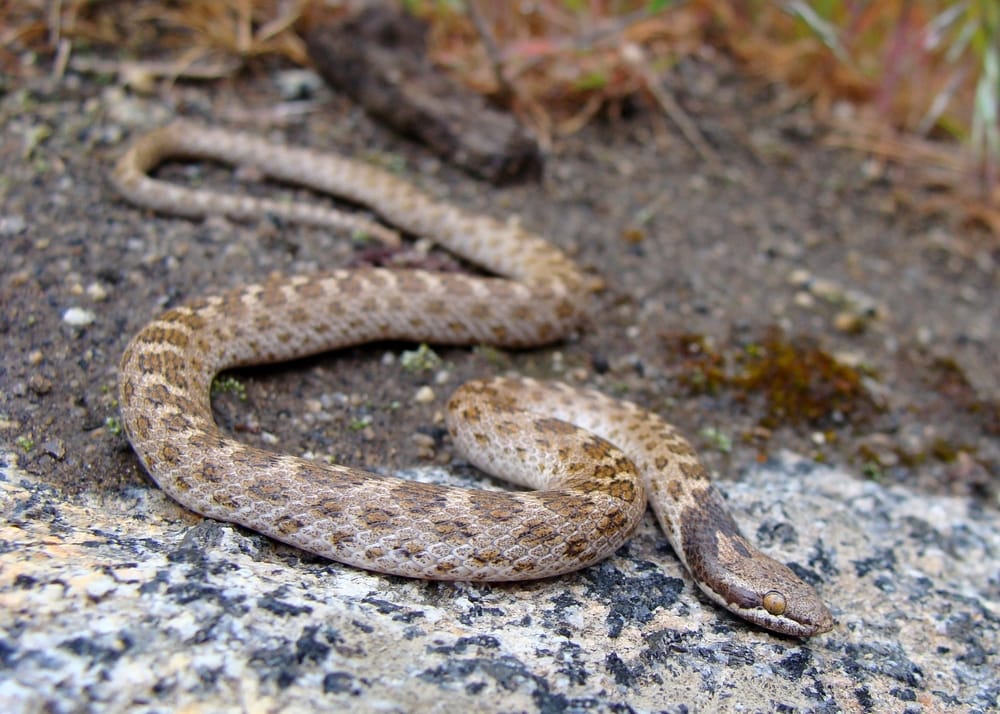
Desert Nightsnake (Hypsiglena chlorophaea) is the common nightsnake across much of the western and southern low country, with records reaching the northern borderlands. Adults stay small, around 598 mm (23 inches) at the upper end.
The body is gray or tan with small dark gray-brown blotches, often in a single row, plus a three-part dark neck collar and a dark bar behind each eye. It is most often a night-road or rocky-cover find in desert and borderland habitats, where it can overlap visually with other Hypsiglena nightsnakes.
It hunts lizards and small snakes, and may also take reptile eggs, frogs, and insects.
| Key detail | What to look for |
|---|---|
| Adult size | Small, reaching a maximum total length of approximately 598 mm (23 inches) |
| Fast ID cue | gray or tan body with small dark gray-brown blotches, often a single row; three-part dark neck collar; dark bar behind each eye |
| Typical Arizona habitat | Desert scrub, rocky washes, and borderland flats or slopes across the western and southern range |
| Arizona range | Distributed across most of western and southern Arizona, extending into the northern borderlands |
| Bite / venom note | Nonvenomous nocturnal hunter; often found around rocks or washes |
44. Hooded Nightsnake
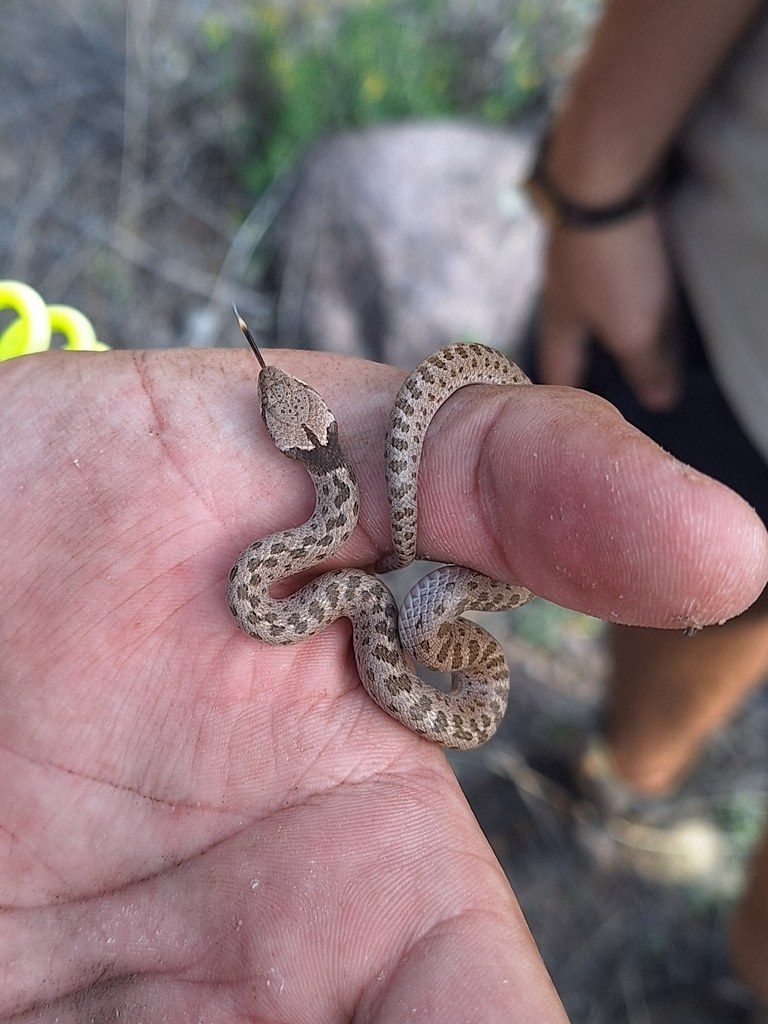
Hooded Nightsnake (Hypsiglena sp. nov) is a localized southeastern nightsnake from Cochise, Santa Cruz, and southeastern Pima counties. Adults remain small, about 600 mm (23 inches), and are usually found at night or under cover.
The hooded look comes from a broad neck collar, rounded along the rear edge, with a short mid-dorsal line running forward from the collar. Two rows of dark gray-brown blotches on a gray or tan body help separate it from the desert nightsnake.
It feeds on lizards, small snakes, reptile eggs, frogs, and insects.
| Key detail | What to look for |
|---|---|
| Adult size | Small, reaching a maximum total length of approximately 600 mm (23 inches) |
| Fast ID cue | gray or tan body with two rows of dark gray-brown blotches; broad rounded neck collar; short mid-dorsal line ahead of the collar |
| Typical Arizona habitat | Southeastern borderland scrub, rocky washes, canyon-edge cover, and grassland edges within its county range |
| Arizona range | Cochise and Santa Cruz counties, plus southeastern Pima County |
| Bite / venom note | Nonvenomous nocturnal hunter; often found around rocks or washes |
45. Sonoran Lyresnake
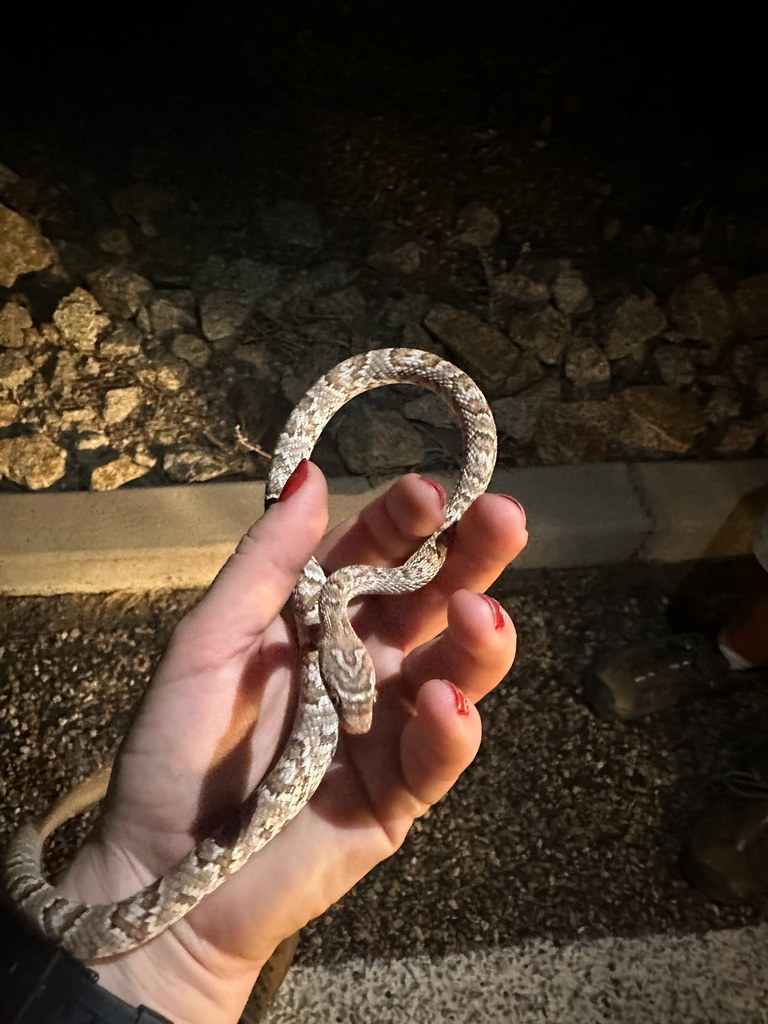
Sonoran Lyresnake (Trimorphodon lambda) is a southern rock-and-canyon snake, with records through much of the southern half and outliers in the lower Grand Canyon, Black Mountains, and Kofa Mountains. Adults reach about 1,026 mm (40 inches).
Look for a light gray-brown to gray body, a dark bar between the eyes, and the namesake lyre-shaped mark on the head. It is a nocturnal climber around cliffs, canyon walls, boulder piles, rocky slopes, and desert washes.
It subdues lizards, bats, birds, and small mammals with rear-fanged venom and constriction.
| Key detail | What to look for |
|---|---|
| Adult size | Medium-sized, reaching up to 1,026 mm (40 inches) in total length |
| Fast ID cue | light gray-brown to gray body; prominent dark brown “lyre-shaped” marking on the head; dark bar between the eyes |
| Typical Arizona habitat | Rocky canyons, cliffs, boulder slopes, desert washes, and arid foothills within the southern range |
| Arizona range | Found across nearly all of southern Arizona, with documented populations in the lower Grand Canyon, the Black Mountains (Mohave County), and the Kofa Mountains (Yuma County) |
| Bite / venom note | Rear-fanged nocturnal hunter; venom used mainly on prey |
Small, glossy, black-headed, and threadlike snakes
46. Chihuahuan Black-headed Snake
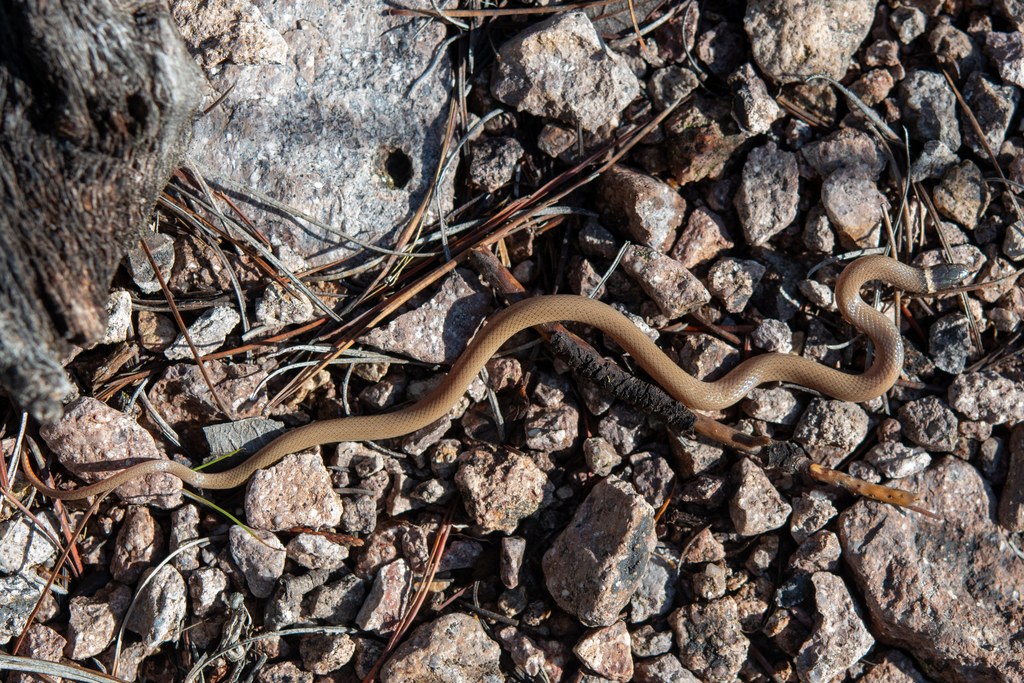
Chihuahuan Black-headed Snake (Tantilla wilcoxi) is a tiny woodland snake of the Santa Rita, Patagonia, and Huachuca mountains. Adults reach about 350 mm (14 inches), so it often looks more like a dark-headed pencil than a typical trail snake.
A light tan or cream body, dark gray-brown head, and pale collar crossing the back of the head and neck are the useful marks. It usually stays under rocks, logs, and leaf litter in Madrean evergreen woodland and Petran montane conifer forest.
It feeds on small invertebrates.
| Key detail | What to look for |
|---|---|
| Adult size | Small, reaching a maximum total length of approximately 350 mm (14″) |
| Fast ID cue | light tan or cream body with a dark gray-brown head; a pale collar crosses the back of the head and neck, specifically crossing the tips of the parietal scales |
| Typical Arizona habitat | Madrean evergreen woodland and Petran montane conifer forest |
| Arizona range | Found in southeastern Arizona, specifically within the Santa Rita, Patagonia, and Huachuca mountains |
| Bite / venom note | Nonvenomous tiny snake; usually under soil, logs, or leaf litter |
47. Glossy Snake
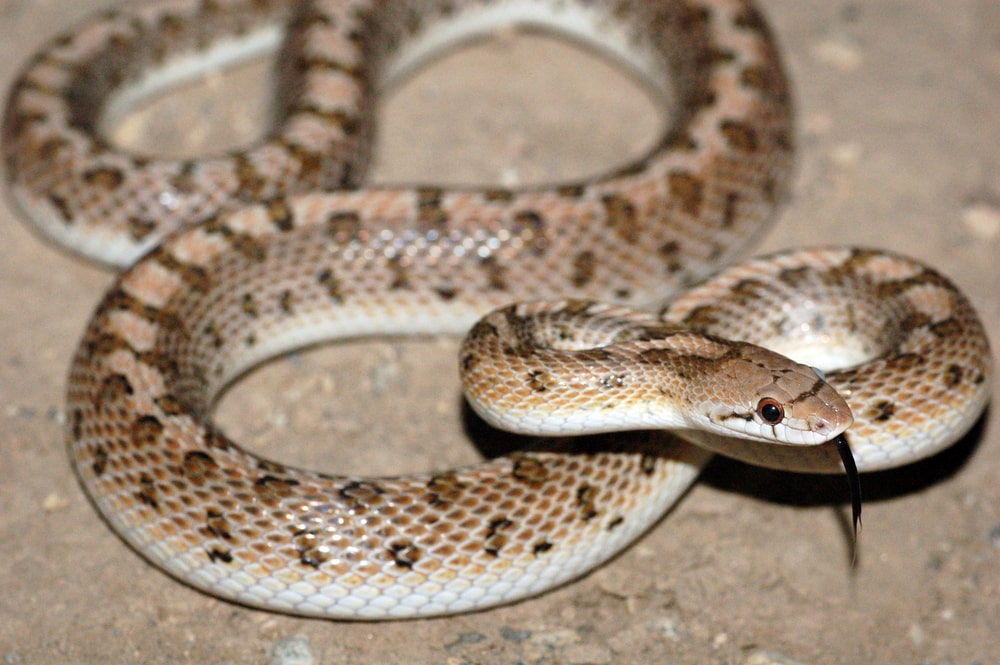
Glossy Snake (Arizona elegans) is a medium, smooth-scaled snake of the northeastern plateaus, western and southwestern deserts, and southeastern valleys. Adults can reach 1,055 mm (42 inches), though many are shorter and easy to mistake for pale gophersnakes at a glance.
The shine is real: smooth scales give the body a polished look. Look for tan, cream, pinkish, or gray ground color with tan, golden-brown, or olive-gray blotches edged darker, usually in flat, open, shrubby places with sandy or loamy soil.
It is a constrictor that hunts small mammals, lizards, snakes, and birds.
| Key detail | What to look for |
|---|---|
| Adult size | Medium-sized, reaching up to 1,055 mm (42 inches) in total length |
| Fast ID cue | glossy smooth scales; dark-edged tan, golden-brown, or olive-gray blotches on a tan, cream, pinkish, or gray body |
| Typical Arizona habitat | relatively flat, open, shrubby areas with sandy or loamy soil |
| Arizona range | Found across Arizona’s northeastern plateaus, southwestern/western deserts, and southeastern valleys |
| Bite / venom note | Nonvenomous constrictor; glossy pale gophersnake lookalike |
48. Groundsnake
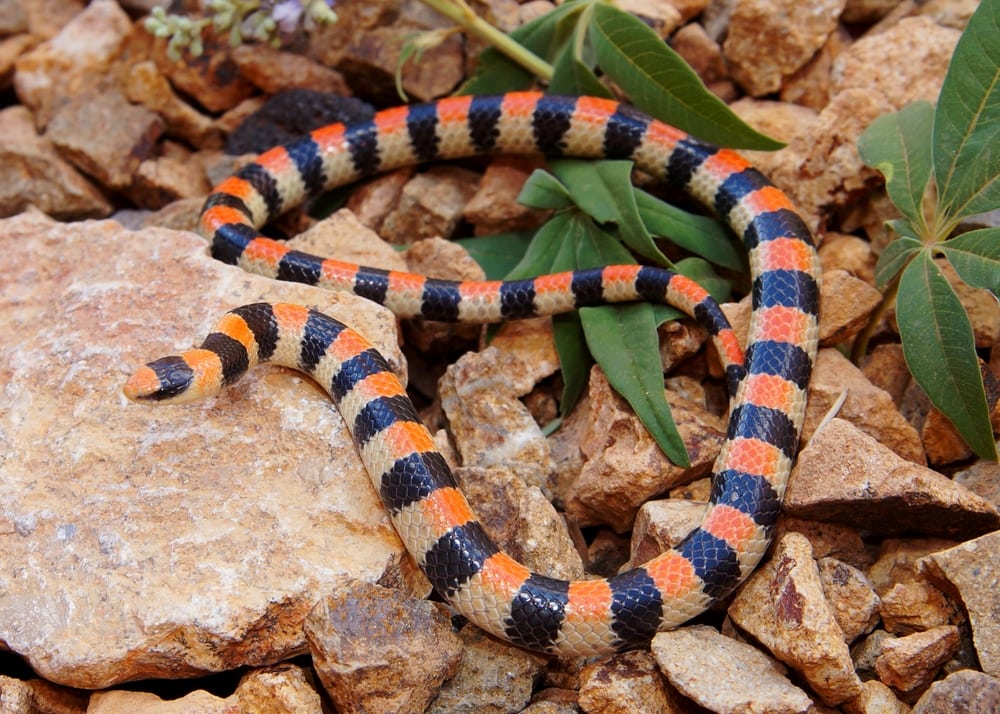
Groundsnake (Sonora semiannulata) is a small, shiny desert snake spread across the western and southern parts of the state. Adults reach up to 483 mm (19 inches), though many are much smaller.
Pattern varies from plain orange, red-brown, or tan to banded or saddled forms, so texture and scale are more reliable than color. Smooth glossy scales, round pupils, and a habit of hiding under rocks, boards, and desert cover help separate it from the tiny threadsnakes.
It eats insects, spiders, scorpions, centipedes, and lizards.
| Key detail | What to look for |
|---|---|
| Adult size | Small, reaching up to 483 mm (19 inches) in total length |
| Fast ID cue | small smooth shiny snake with round pupils; color may be plain, banded, or saddled |
| Typical Arizona habitat | Desert scrub, grassland edges, rocky washes, and other dry cover across the western and southern range |
| Arizona range | Distributed across western and most of southern Arizona |
| Bite / venom note | Nonvenomous ground-dweller; small, shiny, often under rocks or boards |
49. New Mexico Threadsnake
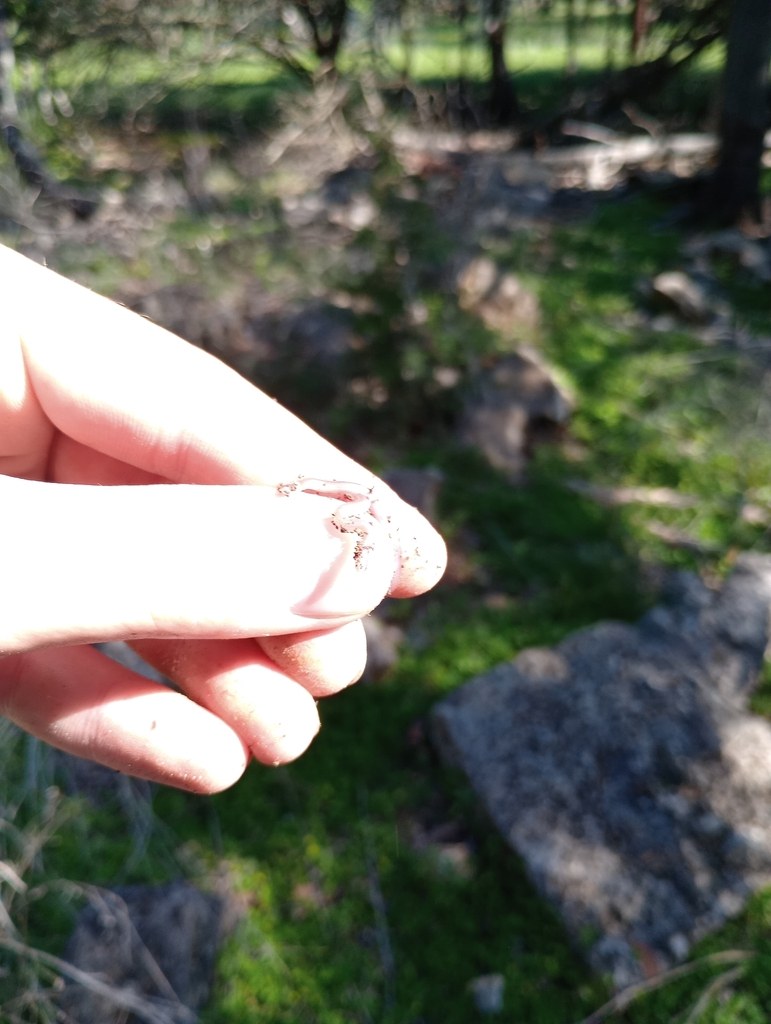
The New Mexico Threadsnake (Leptotyphlops dissectus) is a wormlike burrower from the southeastern corner of the state. Adults are tiny, up to 300 mm (12 inches), with a polished cylindrical body and a blunt head that can be hard to distinguish from the tail.
Think small, shiny, and subterranean rather than patterned. It turns up in loose soil, under rocks, and around ant and termite activity in Chihuahuan desert scrub or grassland-edge habitat within its narrow local range.
It forages underground for ants, termites, insects, and spiders by following ant scent trails.
| Key detail | What to look for |
|---|---|
| Adult size | Small, up to 300 mm (12″) in total length |
| Fast ID cue | tiny glossy wormlike body; blunt head; southeastern corner range; usually under soil or rocks |
| Typical Arizona habitat | Loose soil under rocks in Chihuahuan desert scrub and grassland-edge habitat within its small southeastern range |
| Arizona range | Southeastern corner of Arizona |
| Bite / venom note | Nonvenomous tiny snake; usually under soil, logs, or leaf litter |
50. Plains Black-headed Snake
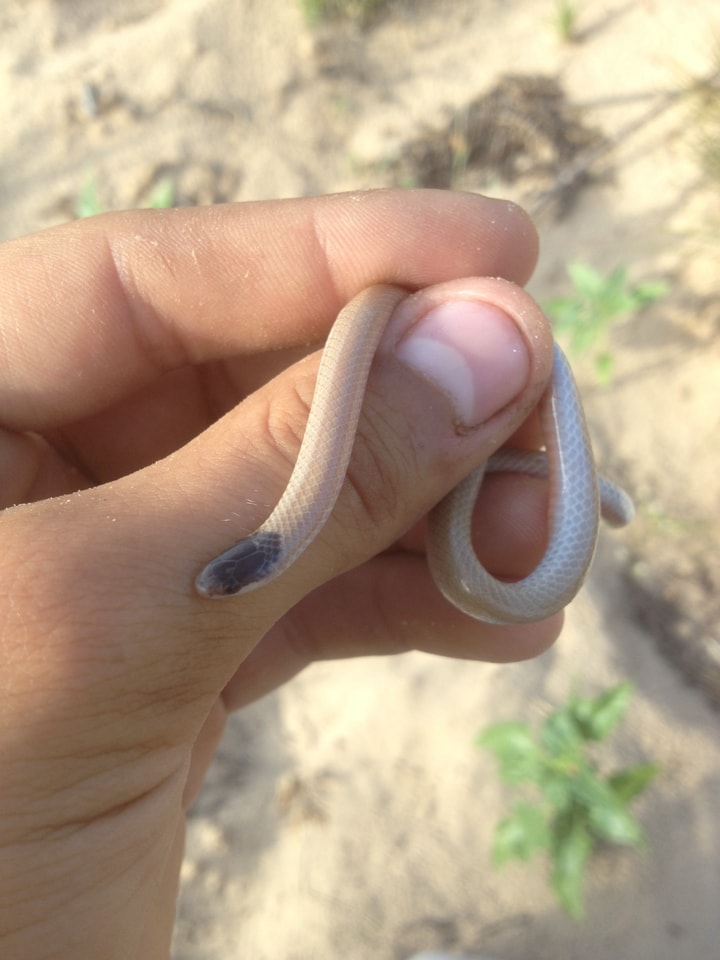
Plains Black-headed Snake (Tantilla nigriceps) is a small, slender Tantilla of southeastern valleys. Adults reach about 380 mm (15 inches) and are most often found under flat rocks or other cover, not crossing open trail in daylight.
The field mark is simple: a dark head on a slim pale-brown body, with the southeastern valley range doing much of the sorting from other black-headed snakes. Its secretive habits and tiny size make it easy to miss.
Plains Black-headed Snake hunts small invertebrates, especially centipedes, scorpions, beetle larvae, and other insects.
| Key detail | What to look for |
|---|---|
| Adult size | Small, slender; up to 380 mm (15″) in total length |
| Fast ID cue | small, slender body, dark head, and southeastern Arizona range |
| Typical Arizona habitat | Southeastern valley grassland and desert-scrub cover, especially under rocks and surface debris |
| Arizona range | Found in the valleys of southeastern Arizona |
| Bite / venom note | Nonvenomous tiny snake; usually under soil, logs, or leaf litter |
51. Ring-necked Snake
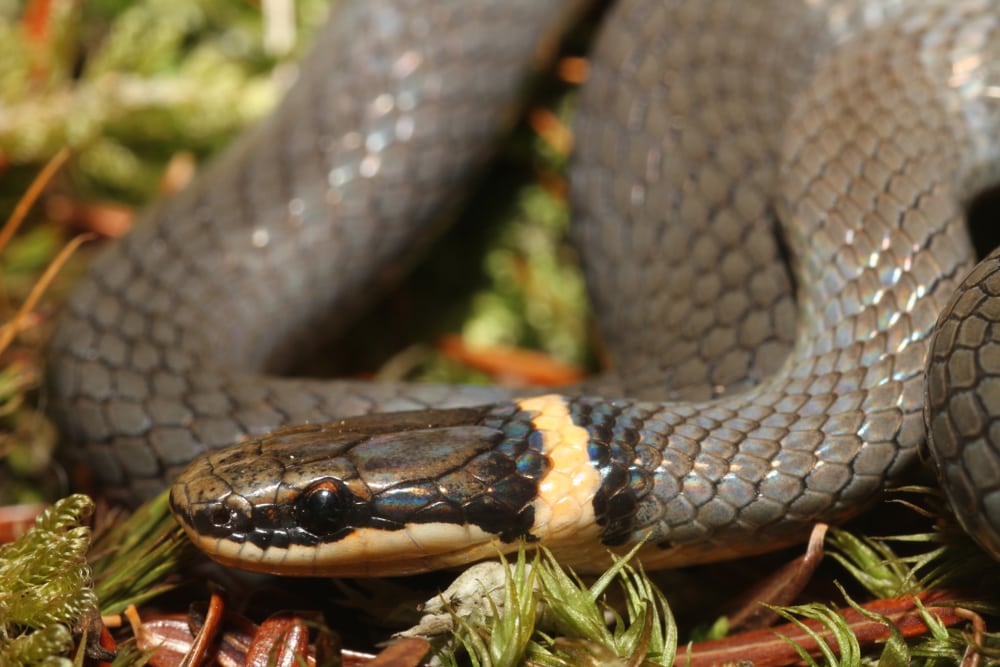
Ring-necked Snake (Diadophis punctatus) is one of Arizona’s small nonvenomous snakes, found across much of the central and southeastern part of the state. Adults are small to medium; up to 857 mm (34 inches) in total length.
Use small to medium body, a pale neck ring, and contrasting belly color when visible as the first cue, but pair it with habitat: a diverse range, including Mohave and Sonoran desert scrub and Petran montane conifer forest.
Primarily diurnal and crepuscular; most active in mid-morning or near dusk. Feeds on insects, lizards, and other snakes.
| Key detail | What to look for |
|---|---|
| Adult size | Small to medium; up to 857 mm (34 inches) in total length |
| Fast ID cue | small to medium body, a pale neck ring, and contrasting belly color when visible |
| Typical Arizona habitat | Diverse settings from Mohave and Sonoran desert scrub to Petran montane conifer forest |
| Arizona range | Found across most of central and southeastern Arizona |
| Bite / venom note | Nonvenomous small snake; pale neck ring and bright belly are key cues |
52. Smith’s Black-headed Snake
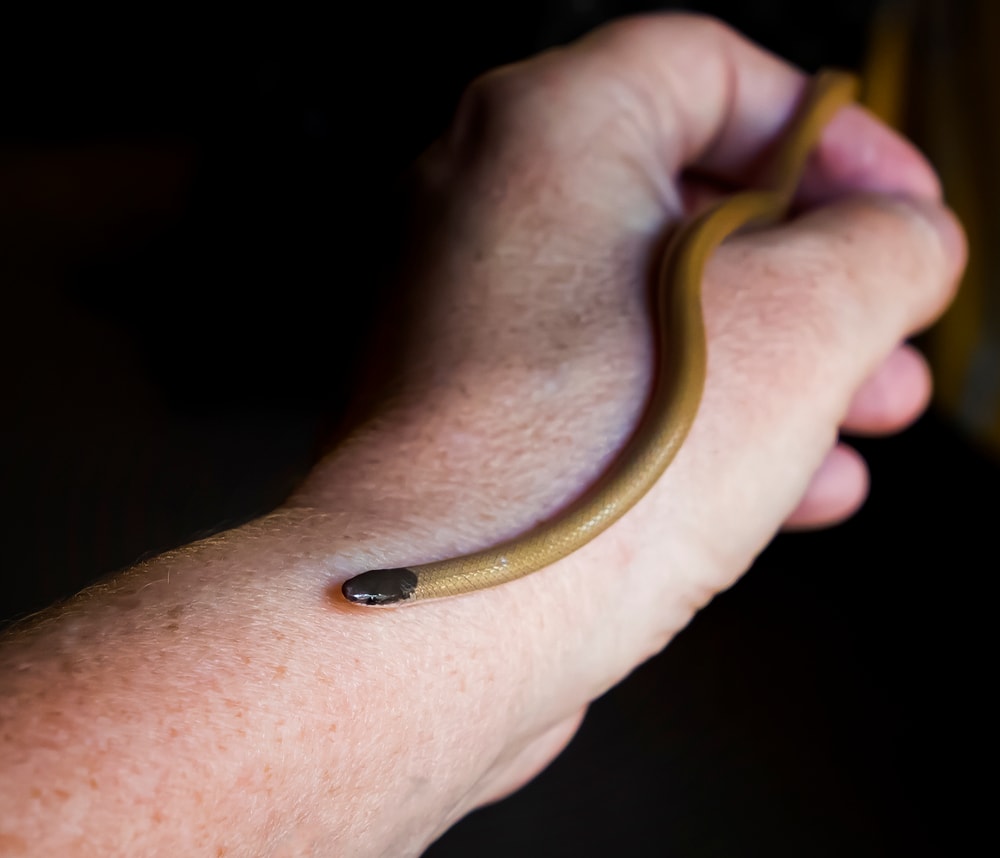
Smith’s Black-headed Snake (Tantilla hobartsmithi) is a tiny black-headed snake of the southeast and central country below the Mogollon Rim. Adults reach only about 313 mm (12 inches), with a slim body built for life under stones and leaf litter.
Look for the dark head, pale slender body, and southeastern-to-central range. It overlaps the general “tiny dark-headed snake” look of several Tantilla species, so locality matters as much as color.
Smith’s Black-headed Snake is another tiny invertebrate hunter, taking centipedes, scorpions, beetle larvae, and other insects under cover.
| Key detail | What to look for |
|---|---|
| Adult size | Small, slender, reaching up to 313 mm (12″) in total length |
| Fast ID cue | small, slender body, dark head, and southeastern to central Arizona range |
| Typical Arizona habitat | Dry to wooded cover under rocks, logs, and leaf litter in southeastern and sub-Mogollon Rim central ranges |
| Arizona range | Found across southeastern Arizona and sub-Mogollon Rim central Arizona |
| Bite / venom note | Nonvenomous tiny snake; usually under soil, logs, or leaf litter |
53. Western Threadsnake
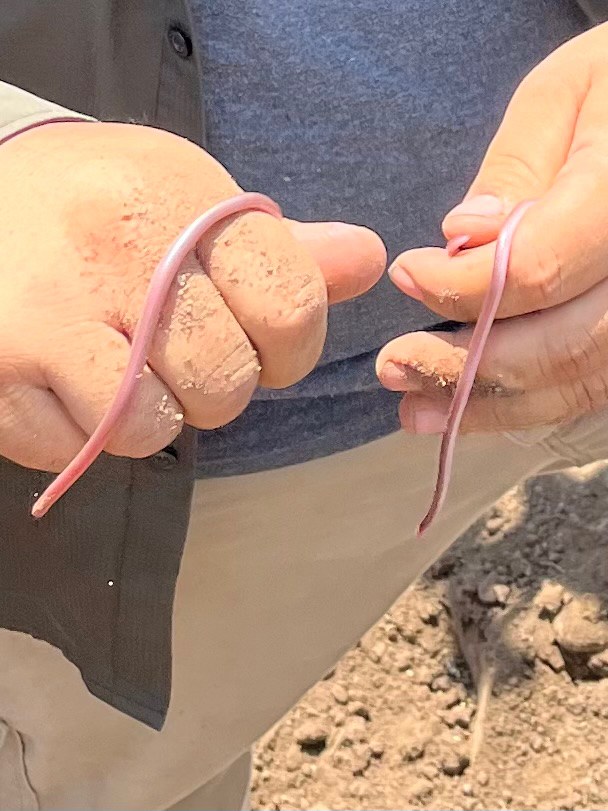
Western Threadsnake (Leptotyphlops humilis) is the widespread threadsnake across western and southern parts of the state. Adults are small, up to 389 mm (15 inches) in total length.
The strongest ID clues are thin, shiny, worm-like body; pink, gray, or mauve color; one scale between the oculars on top of the head. Habitat helps confirm the call: desert scrub, semidesert grasslands, interior chaparral, lower woodlands, foothills, canyon bottoms, and bajadas below steep terrain.
Primarily nocturnal and crepuscular; spends most of its life underground. Forages underground for ants, termites, centipedes, spiders, and other small invertebrates.
| Key detail | What to look for |
|---|---|
| Adult size | Small, up to 389 mm (15 inches) in total length |
| Fast ID cue | thin, shiny, worm-like body; pink, gray, or mauve color; one scale between the oculars on top of the head |
| Typical Arizona habitat | desert scrub, semidesert grasslands, interior chaparral, lower woodlands, foothills, canyon bottoms, and bajadas below steep terrain |
| Arizona range | Found across western and southern Arizona |
| Bite / venom note | Nonvenomous tiny snake; usually under soil, logs, or leaf litter |
54. Yaqui Black-headed Snake
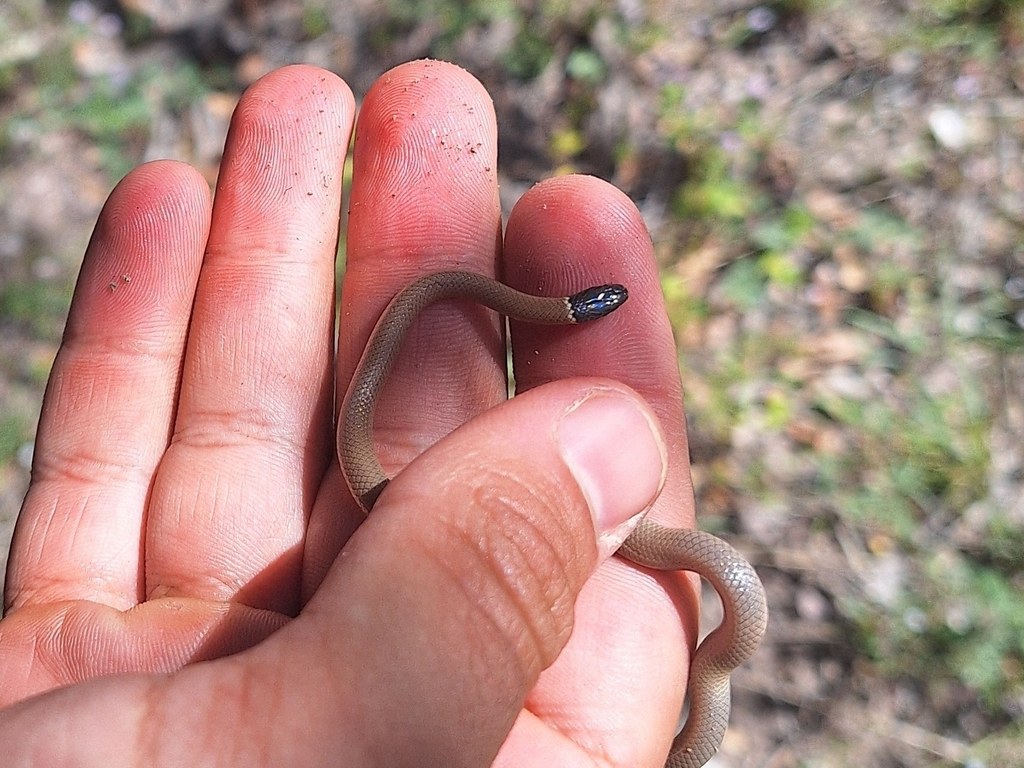
Yaqui Black-headed Snake (Tantilla yaquia) is a tiny southeastern Tantilla from the Canelo Hills and several borderland ranges, including the Pajarito, Atascosa, Santa Rita, Mule, Chiricahua, Swisshelm, Pedregosa, and Pelon. Adults reach about 325 mm (13 inches).
Look for a gray or tan body, dark gray head cap, thin white or cream collar, and a small white cheek patch behind each eye. Rocky wooded canyons and adjacent Madrean evergreen woodland or semidesert grassland slopes are the setting to match.
It is secretive and nocturnal, foraging for invertebrates under rocks and leaf litter.
| Key detail | What to look for |
|---|---|
| Adult size | Small, reaching a maximum total length of approximately 325 mm (13″) |
| Fast ID cue | gray or tan body with a dark gray head cap; a thin white or cream collar borders the posterior edge of the head cap; a white patch marks each cheek behind the eye |
| Typical Arizona habitat | Madrean evergreen woodland and semidesert grassland communities; typically found in rocky, wooded canyons and adjacent slopes |
| Arizona range | Southeastern Arizona: Canelo Hills and the Pajarito, Atascosa, Santa Rita, Mule, Chiricahua, Swisshelm, Pedregosa, and Pelon ranges |
| Bite / venom note | Nonvenomous tiny black-headed snake; usually under rocks or leaf litter |
How to identify an Arizona snake
Start with the habitat and region. A snake in a sandy Lower Colorado River Valley wash gives you a different shortlist than a snake in a wet sky island canyon or a high-elevation pine forest.
Next, compare shape and pattern. Rattlesnakes are heavy-bodied pit vipers with a broad head and often a rattle, but a rattlesnake may stay quiet when surprised. Coralsnakes are small, ringed, and secretive. Gartersnakes are usually slimmer and often show stripes. Kingsnakes and milksnakes are smoother-bodied and often banded, while many desert specialists have shovel-shaped snouts or pale sandy colors.
A useful ID photo shows the whole snake, the head if visible, and a bit of surrounding habitat.
Where snakes live in Arizona
Arizona snakes are not spread evenly across the state. Sonoran and Mohave desert flats favor shovel-nosed snakes, sandsnakes, sidewinders, glossy snakes, and patch-nosed snakes. Riparian corridors and wet canyons are better places for gartersnakes and other waterside hunters. Mountain forests and sky islands add rattlesnakes, kingsnakes, and cool-country specialists that a low desert visitor may never see.
Backyards, trails, roadsides, washes, woodpiles, and irrigation edges can all bring people and snakes into the same space. That is why habitat notes matter: the setting often narrows the list before color does.
Quick Arizona snake questions
How many snakes are in this Arizona guide?
This guide profiles 54 native Arizona snakes. The exact count can shift when taxonomists revise names or when state and herpetology references update their lists.
Which Arizona snakes should I recognize first?
Recognize the venomous group first: the Sonoran Coralsnake and Arizona rattlesnakes. After that, range, habitat, body shape, and pattern usually narrow the rest of the list.
Are most Arizona snakes venomous?
No. Most snakes in this guide are nonvenomous. Arizona is famous for rattlesnake diversity, but the full snake fauna also includes boas, kingsnakes, gartersnakes, racers, patch-nosed snakes, leaf-nosed snakes, black-headed snakes, and threadsnakes.
Why do some scientific names differ between sources?
Snake taxonomy changes over time. This guide uses names from current Arizona and herpetology references, and we update names when those references change.