
Colorado mammals

American Hog-nosed Skunk in Colorado

Conepatus leuconotus

Native to Colorado S1 Critically Imperiled in Colorado

Not listed as nonindigenous in Colorado by USGS NAS; native to its Colorado range.

IUCN Red List status

  1. LC
  2. NT
  3. VU
  4. EN
  5. CR
  6. EW
  7. EX

LC – Least Concern

Widespread and abundant; not at risk.

American Hog-nosed Skunk in Colorado, by the numbers

Rare in Colorado 133rd most recorded of 154 mammals logged in Colorado

15 occurrence records
2 with iNaturalist photos
Oct 15, 2025 Last seen in Colorado

Records from 2000–2026.

When to look for the American Hog-nosed Skunk in Colorado

Most sightings fall in January.

15 Colorado occurrence records (iNaturalist and GBIF) by month of year, 2000–2026. Shows when the species is recorded, not a guarantee of presence. Based on a small number of dated records; the seasonal pattern may not be representative.

Monthly Colorado records (table)
MonthRecords
January6
February1
March1
April0
May0
June1
July0
August0
September1
October1
November1
December3

Monthly american hog-nosed skunk occurrence records (iNaturalist and GBIF) in Colorado, 2000–2026.

Seasonality

Year-round in Colorado, with recorded sightings peaking in January.

Occurrence map

Where American Hog-nosed Skunk has been recorded in Colorado

15 records mapped · zoom and drag to explore

15 Colorado records mapped

Where it's recorded in Colorado

CountyRecords
Baca County 10
Las Animas County 1
Teller County 1
Custer County 1
Fremont County 1
El Paso County 1

The complete county distribution, spread across 6 Colorado counties. Every occurrence record falls in one county, so these sum to the total. Counties from GBIF and US Census boundaries.

The American hog-nosed skunk is one of Colorado’s least-recorded mammals. Open occurrence databases hold just 15 records for it here, nearly all from the arid southeastern corner, where the animal reaches the far northern edge of a mostly Mexican and southwestern range.

A digger of the southeastern grasslands

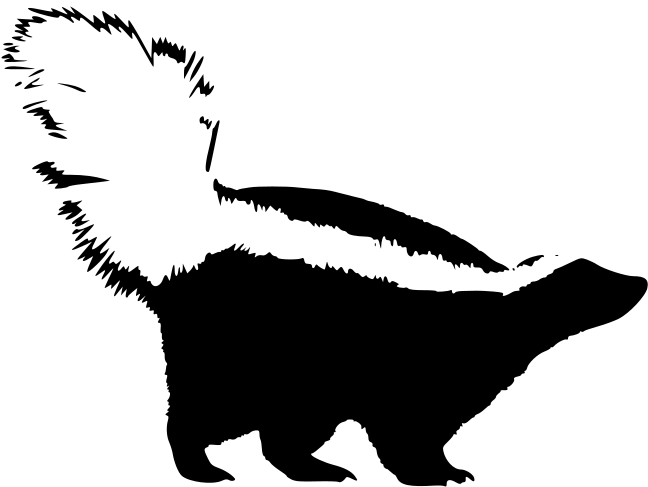
Larger than the familiar striped skunk, this animal wears a single broad band of white running the length of its otherwise black back and carries a long, hairless, pig-like snout that it uses to root and plow through soil for grubs and insects. It favors rocky canyon country and shrubby grassland, and in Colorado the scattering of records centers on Baca County and the Comanche National Grassland, with a few outliers along the southern foothills.

At the edge of its range

The few reports are spread thinly across the year with no clear seasonal shape, which is what a tiny sample of a nocturnal, burrowing animal tends to look like. Hog-nosed skunks forage after dark and shelter by day, so they are rarely seen even where they occur, and Colorado sits at the very limit of where they can persist. NatureServe ranks the species S1, critically imperiled, in the state, a mark of just how few confirmed animals there are.

Common questions

How is it told from a striped skunk? By the single wide white back and the long bare snout; it also lacks the white forehead spot that other skunks show.

Where does it occur in Colorado? Mainly the arid southeastern plains and canyon country near the New Mexico and Oklahoma lines.
More mammals in Colorado in the atlas

Data & sources

The data and visualizations on this page draw on these open sources:

  • GBIFCC-BY 4.0occurrence records behind the range map, elevation, and record counts
  • iNaturalistCC0 / CC-BY / CC-BY-SAobservations, photos, and audio recordings
  • NatureServe ExplorerCC-BYthe state conservation rank
  • IUCN Red Listattributed factthe global conservation status
  • USGS NASpublic domainnative / introduced status
  • Natural Earthpublic domainthe relief basemap
  • USFSpublic domainnational-forest boundaries




