
Brush-tailed Rock Wallaby

Petrogale penicillata

Also known as: Western Rock Wallaby, Brush-tailed Rock-wallaby

VUVulnerable

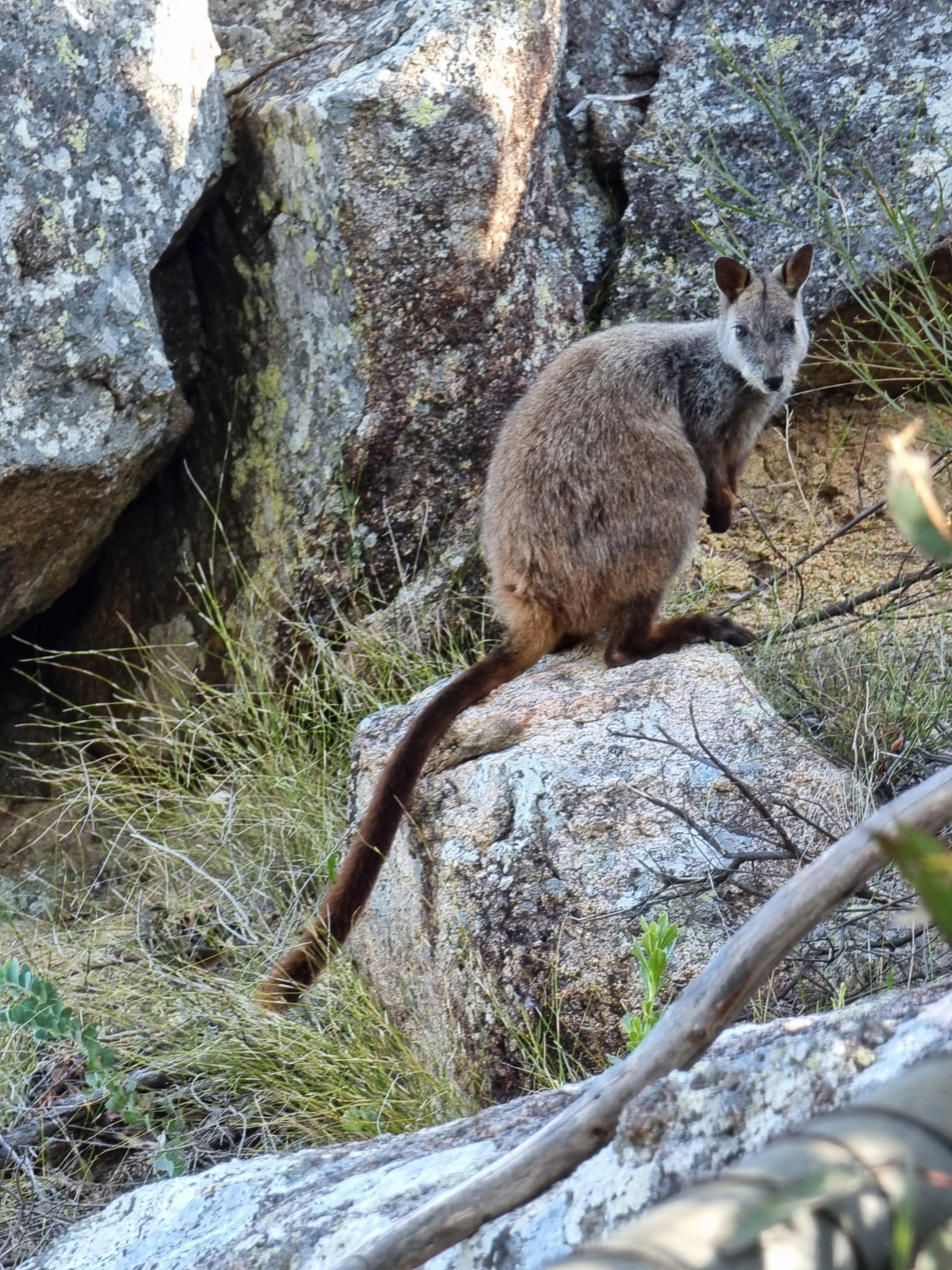
The brush-tailed rock-wallaby is built for cliffs, not open ground: a compact, powerfully built marsupial with grippy hind feet and a long, black-brushed tail that acts as a counterweight while it leaps between boulders and rock ledges. It's native to eastern Australia, not the United States, but a small colony descended from decades-old zoo escapees still lives wild in a single Hawaii valley today. The records below trace that unusual, isolated population, the only wild brush-tailed rock-wallabies anywhere in the US.

US Range

IUCN Red List status

  1. LC
  2. NT
  3. VU
  4. EN
  5. CR
  6. EW
  7. EX

VU – Vulnerable

High risk of extinction in the wild.

SizeBrush-tailed Rock Wallaby beside a 1.8 m adult, drawn to scale
Created by potrace 1.16, written by Peter Selinger 2001-2019 Created by potrace 1.16, written by Peter Selinger 2001-2019
Body length
80–80 cm2 ft 7 in–2 ft 7 in
Weight
6.5–6.5 kg14–14 lb

Silhouettes drawn to scale against a 1.8 m5 ft 11 in adult.

Observation peakJanuary485 records

Seasonality from research-grade observation dates across the US (485 records, all years). Reflects when the species is recorded, not a guarantee of presence.

Best encounter

Where and when to see a Brush-tailed Rock Wallaby

Your best chance: Hawaii, in January.

Where
HawaiiHI
When
January
Trophic relationshipsFood web What a Brush-tailed Rock Wallaby eats, and what eats it.
This speciesBrush-tailed Rock Wallaby

Grazes on plants

Eats

A sample of documented feeding relationships, filtered to species that also occur in the US. Diet and predators vary by region and season, and this is not a complete list, many animals eat, and are eaten by, more than what has been formally recorded here.

Life history

The Brush-tailed Rock Wallaby (6.5 kg14.3 lb) is a herbivore that first breeds around 1.5 years, carries a 30-day gestation, and bears about 1 young per litter. Maximum recorded longevity is 14.3 years.

Life cycle

  1. Gestation30 days
  2. Birthlitter of 1 young
  3. Sexual maturity1.5 yr (female) · 1.6 yr (male)
  4. Typical lifespan14.3 years
  5. Maximum recorded longevity14.3 years

Reproduction

Gestation
30days
Litter size
1youngaverage
Litters / year
1.48litters
Age at first breeding
1.5years♀ 1.5 · ♂ 1.6 yr

Diet composition

Herbivore

By foraging composition: 70% plant material, 20% fruit, 10% seeds & grain.

  • Plant material70%
  • Fruit20%
  • Seeds & grain10%

Most active at night.

Typical values for the species, not local measurements. Maximum longevity is the longest lifespan on record; most individuals live far less.

A rock-hopper built for cliffs, not open ground

A brush-tailed rock-wallaby looks like a compact, muscular kangaroo relative scaled down for climbing rather than covering open ground. Its hind feet carry rough, grippy pads instead of the smooth soles of a plains-dwelling kangaroo, and a long tail tipped with a dark, bushy brush helps it balance while leaping across broken rock. That build lets it move confidently over boulders, cliff ledges, and steep gullies most other macropods would avoid entirely. Color runs brown to gray-brown above with a paler belly, and a dark stripe often runs down the back between the shoulders.
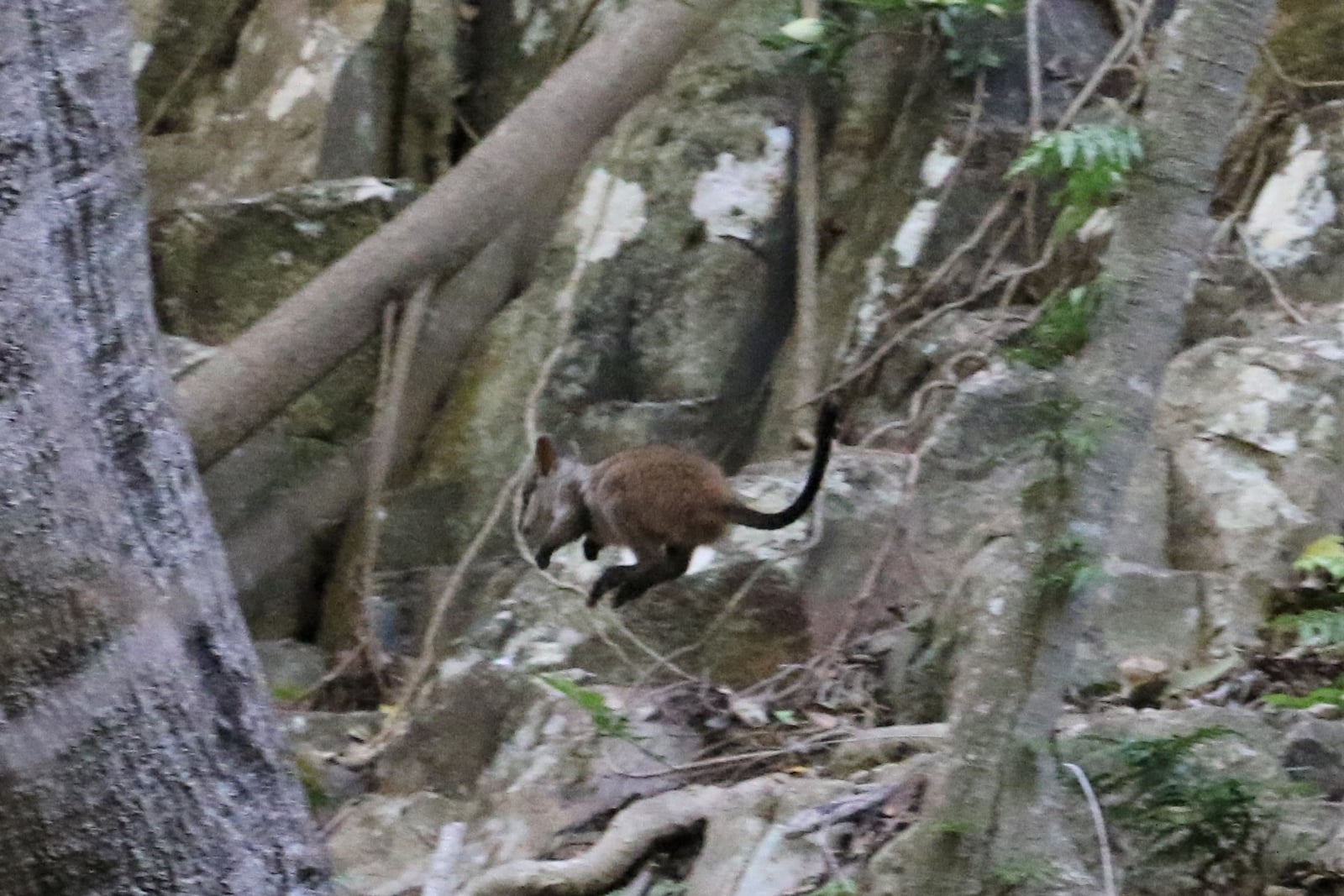
Brush-tailed rock-wallaby leaping among boulders in forest
Photo: Greg Tasney, CC BY-SA 4.0.

Native to Australia, but Hawaii’s odd outlier population

This species’ real range is Australia, along cliff lines and rocky outcrops of the Great Dividing Range from southern Queensland down into Victoria. It has no natural business being anywhere in the United States. A small colony living wild today in Oahu’s Kalihi Valley traces back to animals that escaped a private zoo early in the 20th century and simply never left, holding on in the valley’s cliffs and gulches ever since. Documented sightings there remain few, and the colony stays confined to a small patch of steep terrain rather than spreading across the island.
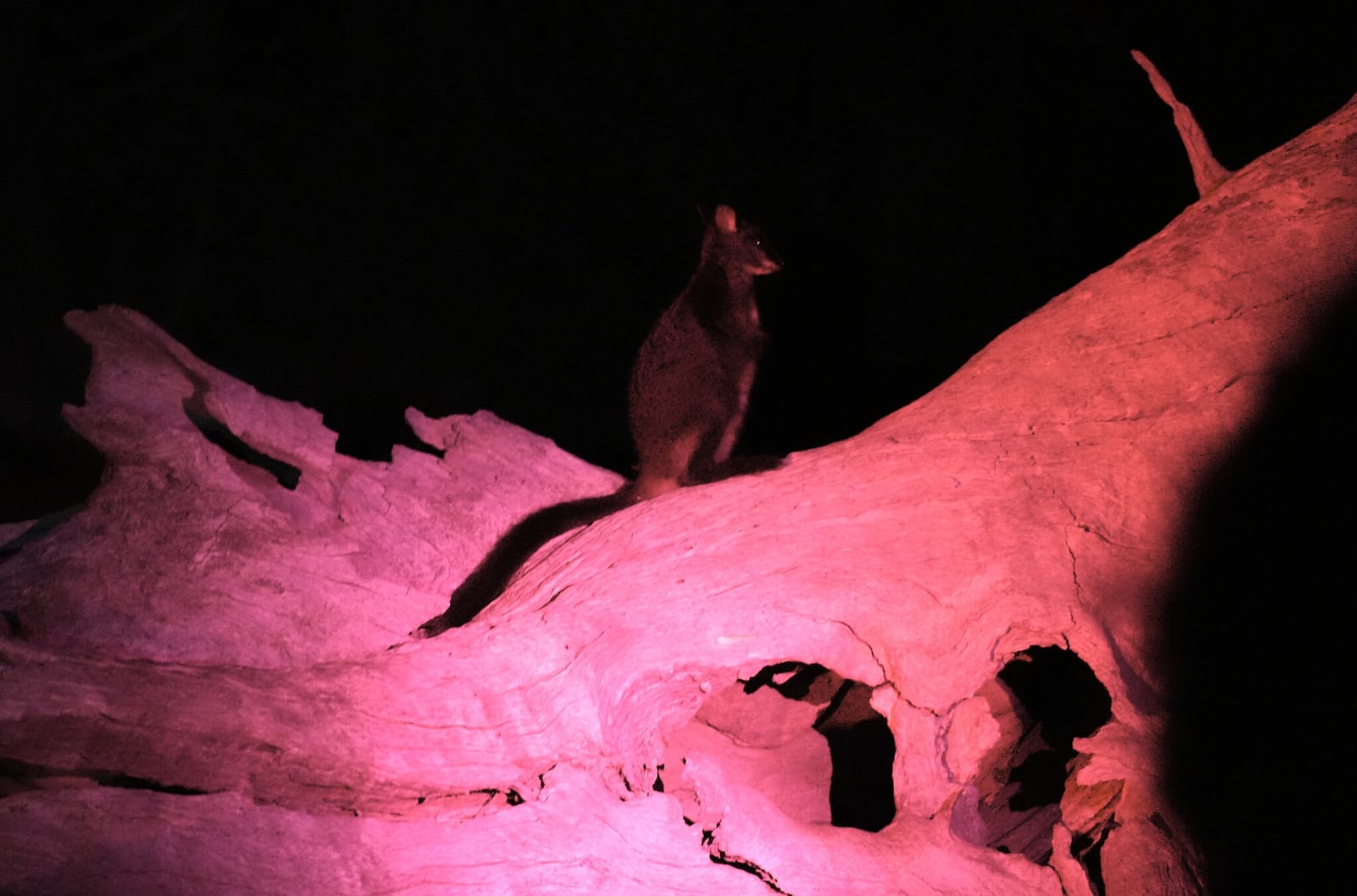
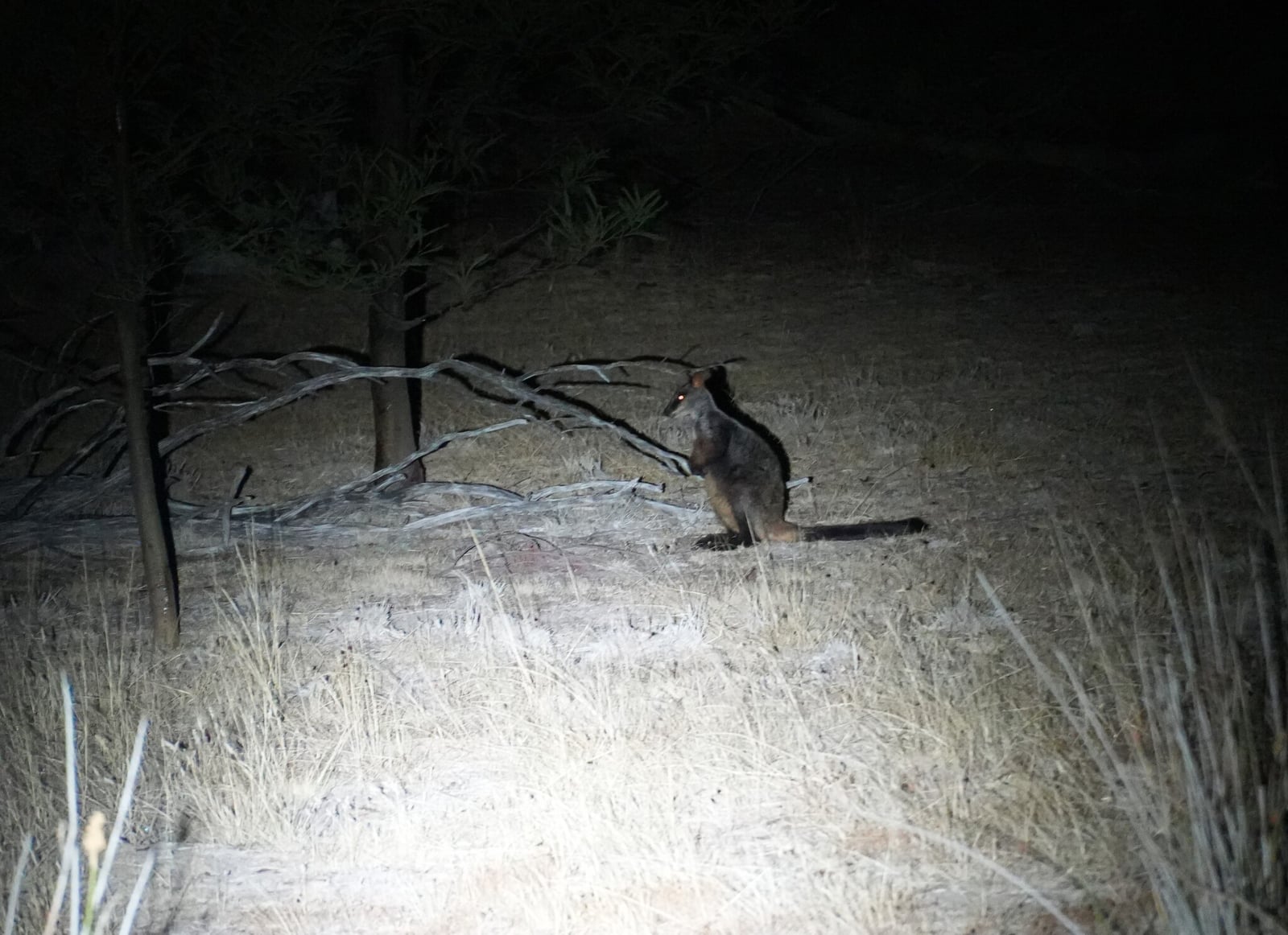
Brush-tailed rock-wallaby standing on a log at night under spotlight
Photo: Terra Occ, CC BY 4.0.

A browser and grazer of ledges and gullies

Brush-tailed rock-wallabies eat mostly plant material, grazing on grasses and browsing leaves, with fruit and seeds filling out the rest of the diet. That flexible, mostly herbivorous menu suits an animal that forages on narrow ledges and rocky slopes, where a picky, specialized diet would be a liability. They tend to feed at night and rest by day in caves, rock crevices, or dense cover near their cliffs, rarely venturing far from the rocky refuge that gives the whole family its name.

Fast breeding, but squeezed by introduced predators

A female can raise more than one joey a year, with a short pregnancy typical of marsupials followed by months of pouch development before a joey is ready to leave. That reproductive pace helps the species recover from losses, but it hasn’t been enough to offset the biggest threat across its Australian range. Introduced red foxes prey on rock-wallabies heavily enough to have wiped out entire colonies in places. Feral cats add to that pressure, both in Australia and, on a smaller scale, around Hawaii’s isolated colony.

Vulnerable in its real range, an accident everywhere else

The IUCN lists the brush-tailed rock-wallaby as Vulnerable, reflecting population declines and fragmentation across its native Australian range. Hawaii’s Kalihi Valley colony isn’t a conservation stronghold. It’s a curiosity, a handful of animals persisting far outside the species’ real range, with no bearing on the fate of the wider, genuinely threatened Australian population. For a species this tied to real rock and real cliffs, Oahu’s steep, sheltered valley turned out to be just enough habitat to let a small accidental population hang on.


Data & sources

The data and visualizations on this page draw on these open sources:

  • GBIFCC-BY 4.0occurrence records behind the range map, elevation, and record counts
  • iNaturalistCC0 / CC-BY / CC-BY-SAobservations, photos, and audio recordings
  • PhyloPicCC0 / CC-BY per itemthe to-scale silhouettesLani Mohan (Petrogale penicillata) · Andrew A. Farke (human silhouette, CC-BY 3.0)
  • AnAge (HAGR)CC-BY 3.0longevity, maturity, and gestation figures
  • IUCN Red Listattributed factthe global conservation status
  • Global Biotic Interactions (GloBI)CC0 · public domainthe food web
  • Amniote Life-History DatabaseCC0 · public domainreproduction figures
  • EltonTraitsCC0 · public domaindiet and foraging-activity data


