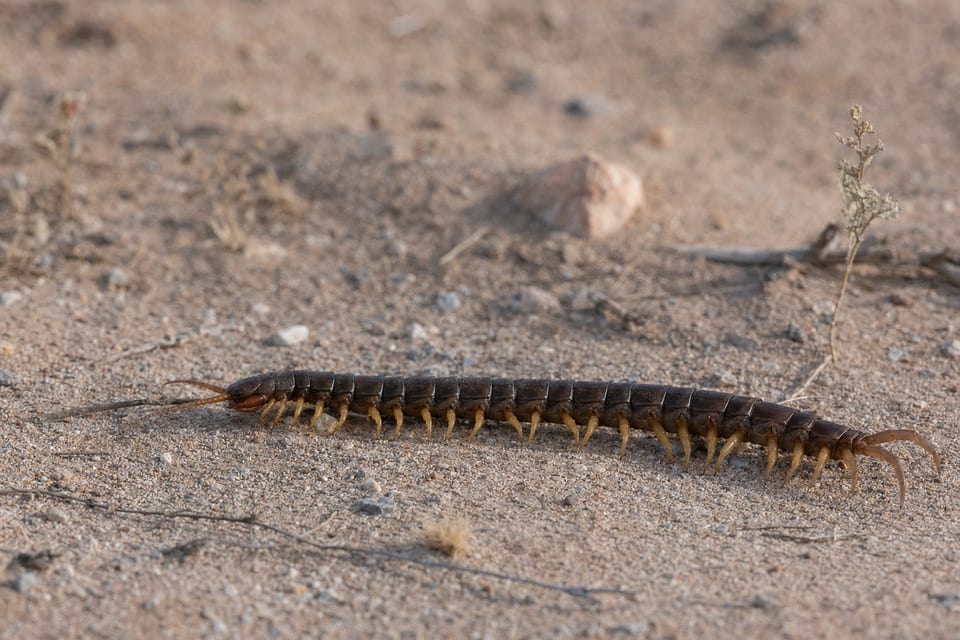
Centipedes sort into five living orders, Scutigeromorpha, Lithobiomorpha, Craterostigmomorpha, Scolopendromorpha and Geophilomorpha, spread across about 3,500 described living species. Chances are you have already met one in a damp basement or under a rotting log, and when you did you probably worked out that the name is a misnomer.
No centipede has exactly 100 legs. Leg pairs always come in odd numbers, and the known range runs from 15 to 191 pairs, depending on the species and, in some groups, on how old the animal is. What separates the five orders is how many of those pairs they carry, how they grow into them, and where they live.
Below are 14 species, grouped by order, from a centipede that lives in bathrooms around the world to one that catches bats in a Venezuelan cave. After them comes a short field key for the question most people arrive with: centipede or millipede, and is it going to hurt?
The five groups of centipedes
Globally, there are five orders in the class Chilopoda, and Missouri alone holds four of them. The fifth, Craterostigmomorpha, lives nowhere but Tasmania and New Zealand.
| Group (order) | Leg pairs | Typical adult size | Where you find them | Example in this guide |
|---|---|---|---|---|
| Scutigeromorpha (house centipedes) | 15 | 25 to 35 mm | Buildings, drains, basements, leaf litter | House centipede |
| Lithobiomorpha (stone centipedes) | 15 | 18 to 30 mm | Under stones and logs in gardens and woodland | Brown centipede |
| Craterostigmomorpha | 15 | Up to 50 mm | Tasmanian and New Zealand woodland only | Craterostigmus tasmanianus |
| Scolopendromorpha (bark centipedes and tropical giants) | 21 or 23, depending on family | 20 mm to about 30 cm | Warm regions worldwide, under bark, rocks and logs | Amazonian giant centipede |
| Geophilomorpha (soil centipedes) | 27 to 191 | Thread thin; the smallest are under 1 cm | Burrowed in soil, leaf litter, potted plants | Hoffman’s dwarf centipede |
The orders also grow their legs in two different ways. Scutigeromorpha, Lithobiomorpha and Craterostigmomorpha are anamorphic: they hatch with a partial set and add pairs as they molt. Scolopendromorpha and Geophilomorpha are epimorphic, meaning all pairs of legs are developed in the embryonic stages, so a hatchling already carries the adult count.
All 14 species at a glance
| Name | Scientific name | Group | Size | Key field mark | Range |
|---|---|---|---|---|---|
| House centipede | Scutigera coleoptrata | Scutigeromorpha | 25 to 35 mm | Three dark stripes, very long banded legs | Worldwide in buildings, native to the Mediterranean |
| Brown centipede | Lithobius forficatus | Lithobiomorpha | 18 to 30 mm | Chestnut brown, legs without stripes | Europe, North America, Hawaii |
| No settled common name | Craterostigmus tasmanianus | Craterostigmomorpha | Up to 50 mm | 15 leg pairs but 21 back plates, one eye on each side | Tasmania and nearby islands |
| Common desert centipede | Scolopendra polymorpha | Scolopendromorpha | 100 to 180 mm | One dark stripe per segment, color highly variable | Southwestern USA and northern Mexico |
| Giant redheaded centipede | Scolopendra heros | Scolopendromorpha | Usually up to 165 mm, can reach 200 mm | Missouri form: black body, rusty red head, yellow legs | Southwestern USA to Louisiana, northern Mexico |
| Amazonian giant centipede | Scolopendra gigantea | Scolopendromorpha | 26 to 30 cm | Largest centipede on Earth, yellow legs | Northern South America and the southern Caribbean |
| Vietnamese centipede | Scolopendra subspinipes | Scolopendromorpha | Up to 20 cm | Red to reddish brown body, yellow to orange legs | Asia, Indian Ocean, Pacific islands |
| Waterfall centipede | Scolopendra cataracta | Scolopendromorpha | Up to 20 cm | Greenish black, dives into streams and swims | Laos, Thailand, Vietnam |
| Common cryptops | Cryptops hortensis | Scolopendromorpha | 20 to 30 mm | Reddish to pale brown, no eyes, 21 leg pairs | Europe, introduced to North American cities and Tasmania |
| Eastern red centipede | Scolopocryptops sexspinosus | Scolopendromorpha | Up to 69 mm | Red to rust colored, blind, 23 leg pairs | Eastern North America |
| Western fire centipede | Scolopocryptops gracilis | Scolopendromorpha | About 45 mm (measured adults) | Blind, 23 leg pairs | Western USA and Baja California |
| Minor blue leg centipede | Rhysida longipes | Scolopendromorpha | 60 to 80 mm | Olive brown body, reddish orange head and tail end | Tropics worldwide, established in South Florida |
| Feather tail centipede | Alipes grandidieri | Scolopendromorpha | 100 to 150 mm | Flattened, feather shaped final legs | Kenya, Tanzania, Uganda |
| Hoffman’s dwarf centipede | Nannarrup hoffmani | Geophilomorpha | About 10 mm | Guinness’s smallest centipede, 41 leg pairs | Central Park, New York, probably from East Asia |
Scutigeromorpha: the house centipedes
Scutigeromorphs are fast, long legged and, unusually for centipedes, have compound eyes. The one you are likely to meet is also, in the University of Kentucky’s words, “the only species of centipede that can survive inside of structures.”
1. House centipede (Scutigera coleoptrata)
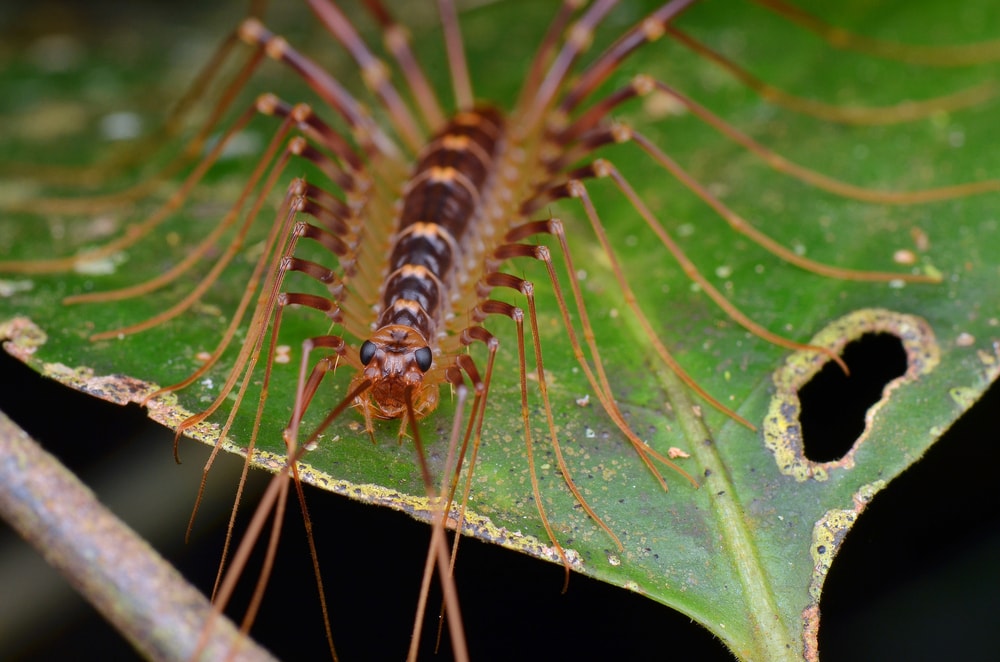
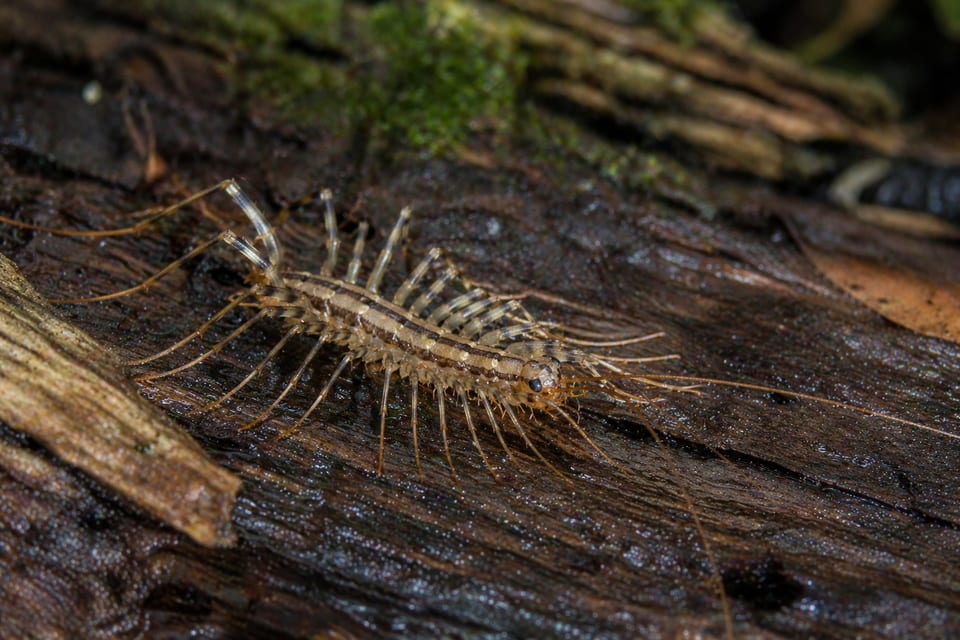
Penn State Extension describes the body as “a dirty yellow with three longitudinal, dark stripes” and the 15 pairs of legs as “banded light and dark”. The legs are what you notice. The body is only an inch or so long, but with legs and antennae the animal looks three to four inches from end to end, which is why one sprinting across a bathroom wall gets such a reaction.
It comes from the Mediterranean, was first recorded in Pennsylvania in 1849, and is now found worldwide. By day it hides somewhere dark and damp; at night it hunts silverfish, firebrats, carpet beetle larvae, cockroaches and spiders, which makes it a nocturnal ally more than a pest. Kentucky’s entomologists rate the bite hazard as minimal, because its forcipules are so small that it has trouble getting through human skin at all.
Size body 25 to 35 mm · Legs 15 pairs · Bite seldom breaks the skin
Lithobiomorpha: the stone centipedes
These are the centipedes that scatter when you lift a garden paving stone. The order holds more than 2,000 estimated species in two families. They end up with 15 pairs of legs, like house centipedes, but much shorter ones, and they grow the same way, adding segments as they molt: a hatchling has just seven, an adult 18.
2. Brown centipede (Lithobius forficatus)
This is the stone centipede most people turn up without ever learning its name. NatureSpot describes a rich chestnut brown animal 18 to 30 mm long and up to 4 mm broad, very common and widespread across Britain and active all year. It also lives across North America and in Hawaii. The quickest giveaway is behavior: uncovered, it runs for cover faster than most of its relatives.
Its legs are plain, which separates it from the striped centipede, Lithobius variegatus. It eats insects, spiders, slugs and worms, can live five or six years, and does people no harm; a bite rarely breaks the skin and causes brief local pain at most.
Size 18 to 30 mm · Legs 15 pairs · Lookalike Lithobius variegatus, which has striped legs
Craterostigmomorpha: the rarest order
Craterostigmomorpha is the least diverse centipede clade, with only two living species, both in the genus Craterostigmus: one in Tasmania and one in New Zealand. Its intermediate position in centipede evolution, and the fact that so few species survive, have led to comparisons with the platypus.
3. Craterostigmus tasmanianus
This slow moving, greenish or yellowish brown centipede grows to 50 mm and carries the mismatch that defines its order: 15 pairs of legs but 21 tergites, the plates along its back. It has a single eye on each side of the head. Reginald Innes Pocock described it in 1902 from Mount Rumney, just outside Hobart. New Zealand’s species, C. crabilli, was not named until 2008.
C. tasmanianus is widespread across Tasmania and nearby islands, especially in the west, from sea level to about 1,300 m, but only in woodland. Females lay 44 to 77 eggs and coil around them, then guard the young, which hatch with 12 pairs of legs and gain the last three in a single molt. What it eats in the wild is still unknown.
Size up to 50 mm · Legs 15 pairs on 21 tergites · Range Tasmania and nearby islands
Scolopendromorpha: the bark centipedes and tropical giants
Ten of the 14 species here belong to this order, including every centipede with a bite worth worrying about. Scolopendromorphs carry 21 or 23 pairs of legs, varying with family: 21 in the Scolopendridae, which takes in every Scolopendra, and 23 in the Scolopocryptopidae. They hatch with the full adult set, and most have four simple eyes, though some have none.
4. Common desert centipede (Scolopendra polymorpha)
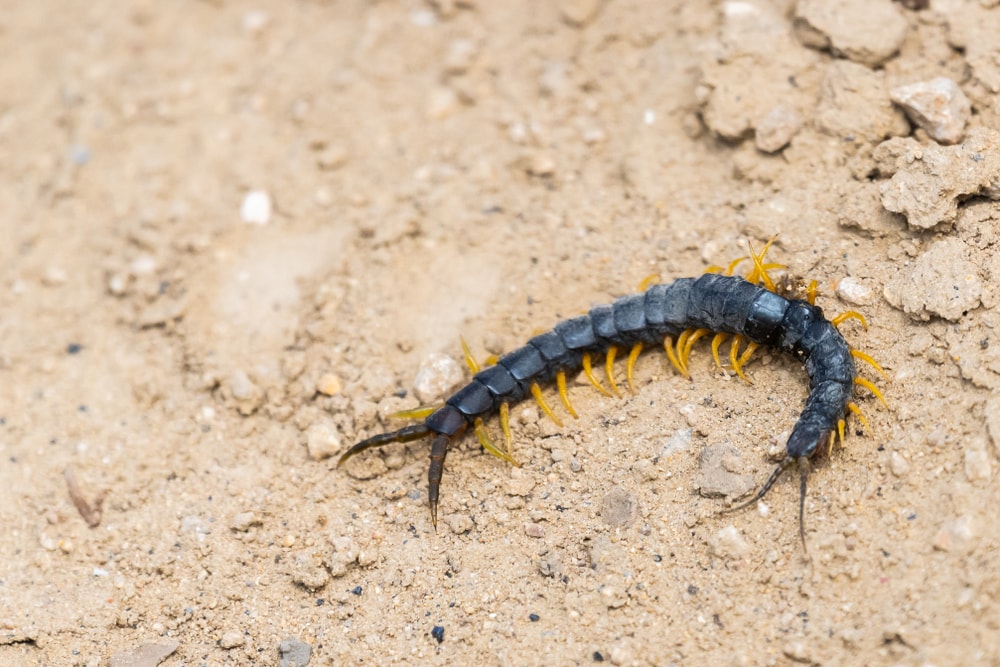
Color makes this one tricky. Most common desert centipedes have a darker brown, red or orange head over tan to orange segments and yellow legs, with one dark stripe on each segment that earns them the name tiger centipede. Some Southern California populations are pale blue with indigo stripes and turquoise legs instead. The species name, polymorpha, means “many forms”. Size is steadier: bodies generally reach 10 to 18 cm.
It lives in desert, dry grassland and forest across the Southwest and northern Mexico, and reaches farther north than its name suggests, with records from the plains of Big Horn, Rosebud and Treasure counties in Montana. It spends much of the year underground and is most active at night in the cooler months and during the summer monsoon. Lab work on its venom has turned up an antimicrobial peptide, SPC13, that acts against Staphylococcus aureus.
Size 100 to 180 mm · Legs 21 pairs · Range southwestern USA and northern Mexico, north to the Montana plains
5. Giant redheaded centipede (Scolopendra heros)
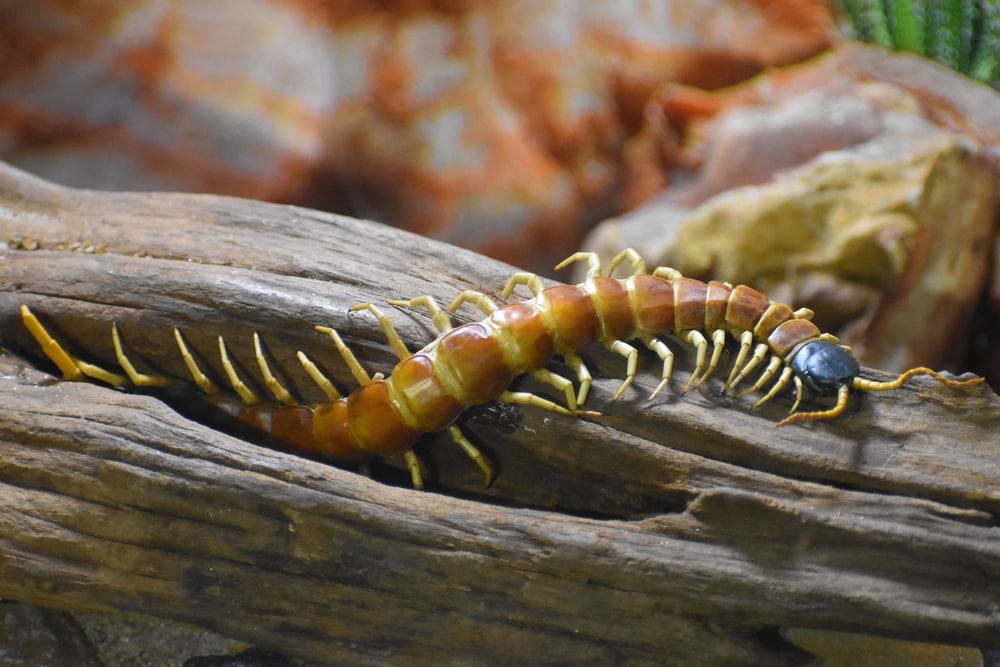
North America’s largest centipede goes by half a dozen names, from Arizona desert centipede to Texas redheaded centipede, and its coloring varies almost as much. In Missouri, where it reaches only a few southern counties, MDC describes a black body, bright yellow legs, and a rusty red head and first segment, a warning pattern aimed at predators. MDC gives the length as “usually up to 6½ inches, but may reach 8 inches” and counts 21 pairs of legs, the last pair pointing backward like tails.
It hunts at night, taking arthropods along with newborn mice, small snakes and small amphibians, and uses the same venom on anything that bothers it. A bite is intensely painful and swells, but MDC’s assessment is that for a healthy adult it is “usually no worse than a wasp or scorpion sting”. The agency adds that infants, the elderly and people in poor health could be harmed, and that an allergic reaction needs immediate medical care.
Size usually up to 165 mm, can reach 200 mm · Legs 21 pairs · Range Arizona east to Louisiana, plus northern Mexico
6. Amazonian giant centipede (Scolopendra gigantea)
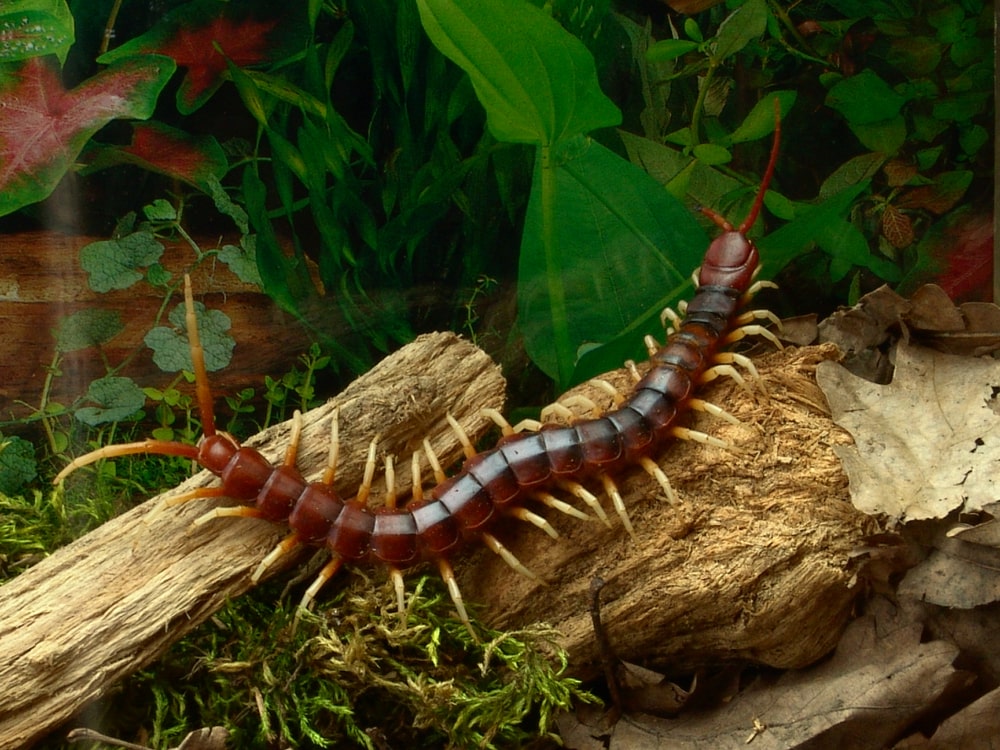
The world’s largest centipede is hard to pin to one number. The Australian Museum calls it a 30 centimetre centipede, while Guinness World Records lists the species at 26 cm. Either way it is big enough to kill vertebrates: mice, lizards, frogs, small snakes and, in at least one Venezuelan cave, bats. Guinness describes that population hanging upside down from the cave roof to feed. Large individuals can hold on to the ceiling with only a few legs while they deal with the heavier prey.
Verified museum specimens come from Aruba, Brazil, Curaçao, Colombia, Venezuela and Trinidad. Records from Mexico, Puerto Rico, Hispaniola and Honduras are thought to be accidental introductions or labeling errors.
Size about 26 to 30 cm · Legs 21 pairs · Range northern South America and the southern Caribbean
7. Vietnamese centipede (Scolopendra subspinipes)
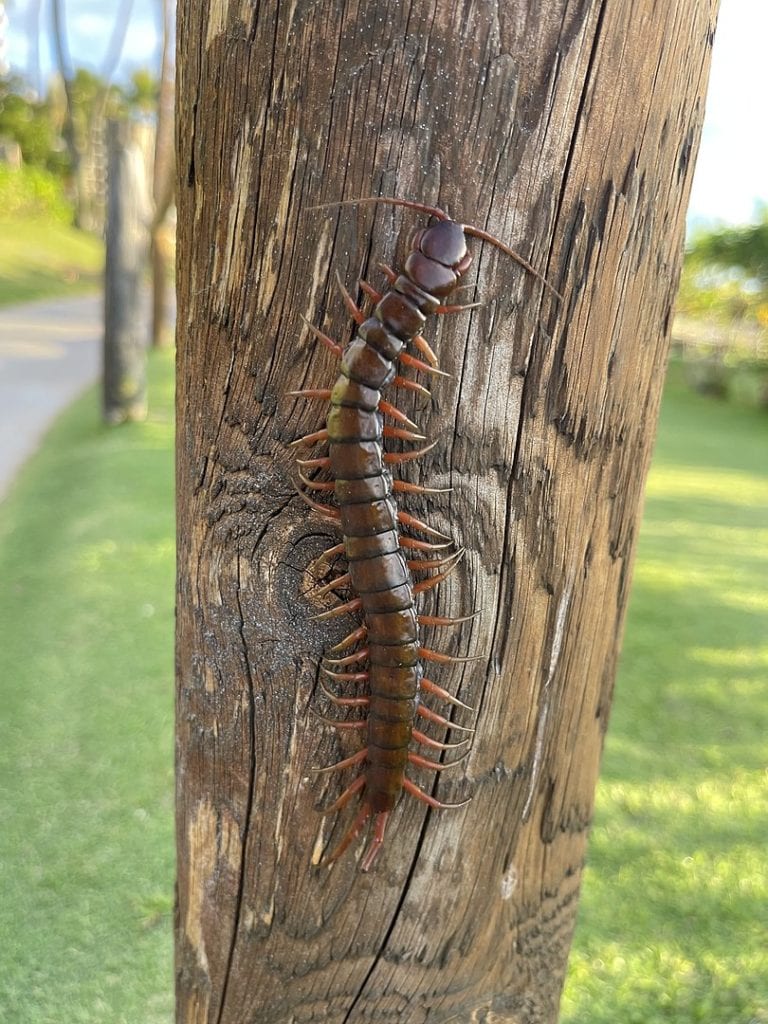
This is one of the most widespread species of Scolopendra, found across tropical and subtropical Asia, around the Indian Ocean and on Pacific islands. Nobody is sure how much of that range is natural, and the common names have piled up to match. A clinical review from Hawaii lists Giant Centipede, Jungle Centipede, Vietnamese Centipede and Chinese Red Head, and calls it the only clinically significant centipede in the islands. It grows to about 20 cm, usually red to reddish brown with yellow or orange legs, and hunts spiders, scorpions and vinegaroons as well as mice and small reptiles.
Its bite is why doctors write about it: “immediate and often excruciating burning pain”, swelling and redness, and sometimes dead tissue around the puncture marks. Pain and swelling usually settle within a week, though they can last up to three.
Size up to 20 cm · Legs 21 pairs · Bite severe local pain and swelling
8. Waterfall centipede (Scolopendra cataracta)
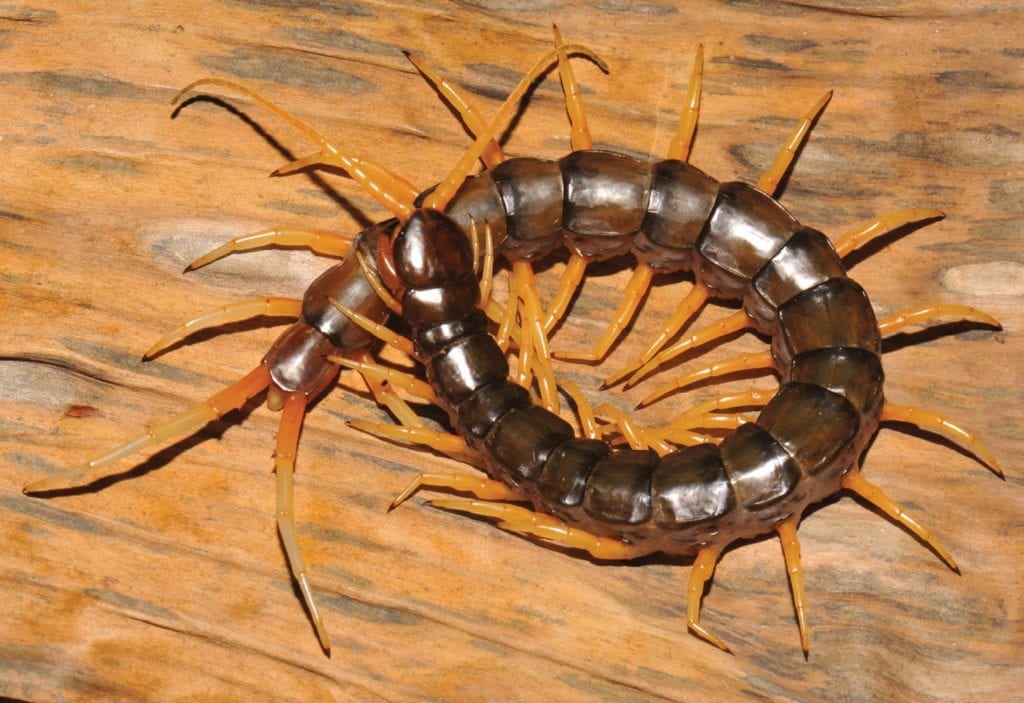
Most centipedes bolt for cover when you lift their rock. Guinness World Records tells how George Beccaloni of London’s Natural History Museum turned one over beside a stream in Thailand in 2001, and the animal underneath dived into the water instead. It swam “powerfully like an eel, via horizontal undulations of its body”, and when he took it out, the water rolled straight off.
Naming it took another 15 years. Two more specimens came from waterfalls in Laos, and a fourth turned up in the museum’s drawers, collected in Vietnam in 1928 and misfiled as a more common species. Siriwut and colleagues described it in ZooKeys in May 2016, naming it for the Latin word for waterfall. It is greenish black, reaches about 20 cm, and probably enters streams at night to hunt.
Size up to 20 cm · Legs 21 pairs · Range Laos, Thailand and Vietnam
9. Common cryptops (Cryptops hortensis)
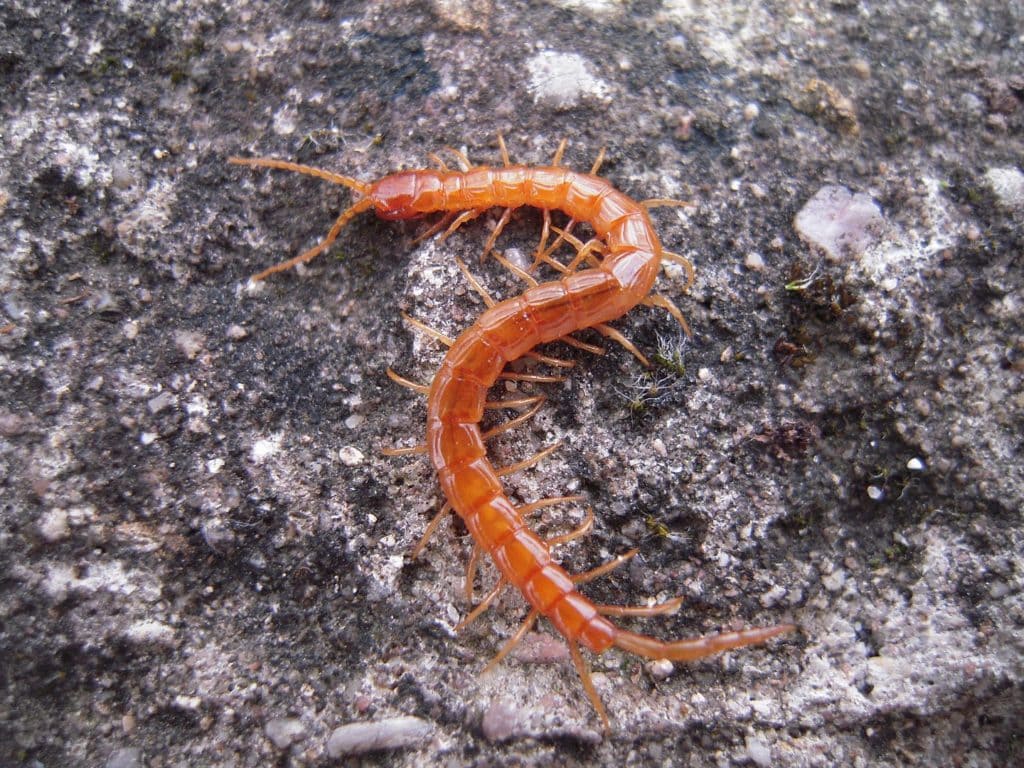
You could take it for a stone centipede until you count the legs. It has 21 pairs, which puts it in Scolopendromorpha, against the 15 of a Lithobius. At 20 to 30 mm long and about 1 mm wide, reddish to pale brown and with no eyes, it fits its genus name, which means hidden face. Native to Europe, it has been widely introduced in North American cities, according to MDC, and has reached Tasmania too. Look under stones and logs in gardens and woodland, in the same damp layer that shelters woodlice and snails.
Size 20 to 30 mm · Legs 21 pairs · Eyes none
10. Eastern red centipede (Scolopocryptops sexspinosus)
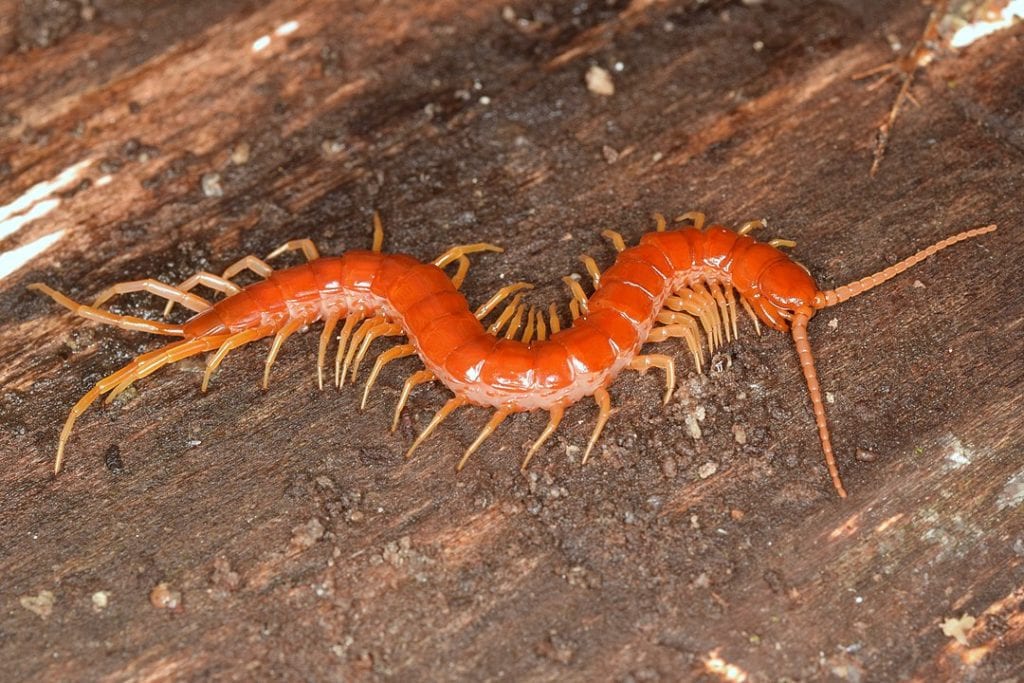
The eastern red is red or rust colored from head to legs, with 23 pairs of legs and no eyes at all. It reaches about 69 mm and ranges from Florida and the Gulf Coast north into Ontario and west to eastern Texas and Nebraska, from sea level to 1,950 m. Thomas Say described it in 1821 as a Cryptops; George Newport moved it to Scolopocryptops in 1845. It is quick on its feet and can give a painful bite.
Size up to 69 mm · Legs 23 pairs · Eyes none
11. Western fire centipede (Scolopocryptops gracilis)
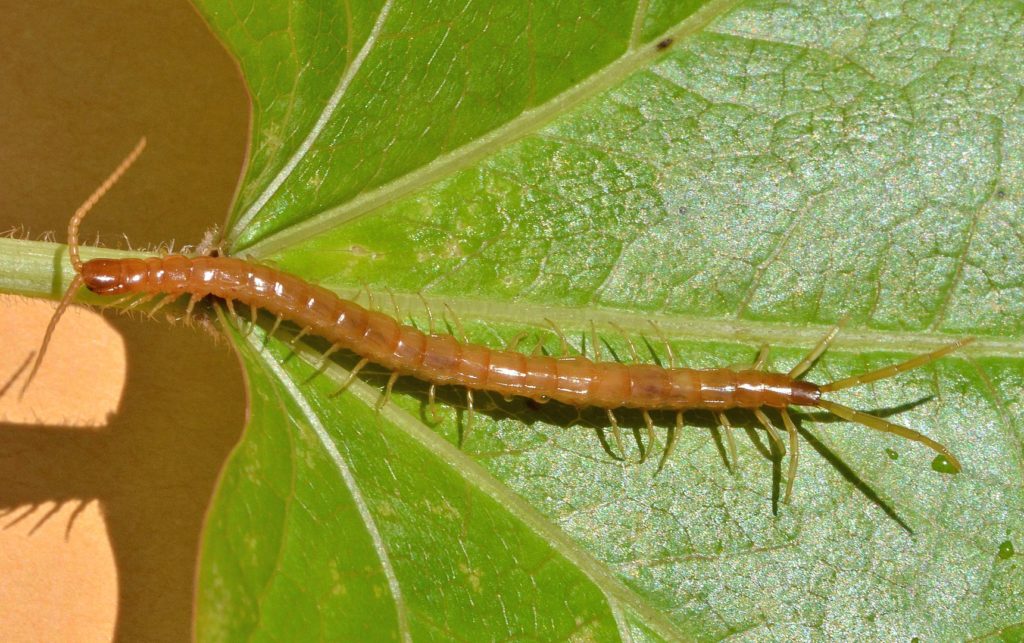
It is the western counterpart of the eastern red: same family, 23 pairs of legs, no eyes. iNaturalist lists it as the Western Fire Centipede. Its range comes in three separate pieces west of the Rockies, as the specialist Rowland Shelley mapped it: a northern pocket in southeastern Washington, northeastern Oregon and north central Idaho; a main range from northern California south to Ensenada in Baja California, with a branch through the Mojave into southwestern Utah and northwestern Arizona; and an isolated site in Salt Lake County, Utah. A 1999 find west of Missoula added Montana.
There is no published size range for the species. The two adults from that Montana record measured 42.5 and 45 mm.
Size about 45 mm in measured adults · Legs 23 pairs · Eyes none
12. Minor blue leg centipede (Rhysida longipes)
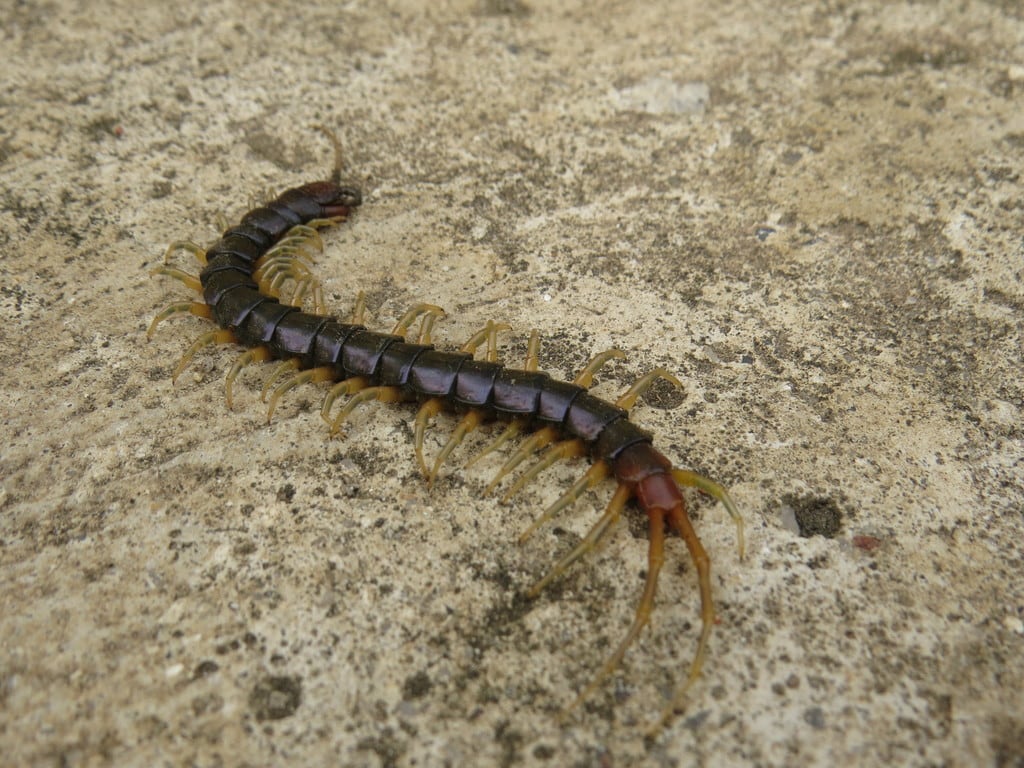
It is sometimes called the minor blue leg and kept as a pet, though the animals Florida State University biologists collected in the Keys were olive brown above with scattered green markings, reddish orange on the head and last few segments, with straw yellow walking legs, and mostly 60 to 80 mm long.
The species turns up across the tropics, with records from Asia, Africa and the Americas. In South Florida it had been documented only four times since 1956, almost always as a single animal, until a December 2014 search on Upper Matecumbe Key found more than 30 centipedes of several sizes under logs, limestone boulders and discarded carpet. That was the first evidence of a breeding population there, published in Florida Entomologist in 2015.
Size mostly 60 to 80 mm · Legs 21 pairs · US status established on Upper Matecumbe Key, Florida
13. Feather tail centipede (Alipes grandidieri)
Its last pair of legs ends in long, flattened pads that look more like feathers than legs. When threatened it shakes them and makes a hissing sound, which is what the video above captures. Hippolyte Lucas described the species from Zanzibar in 1864; today it is known from Kenya, Tanzania and Uganda.
Size 10 to 15 cm · Legs 21 pairs · Range Kenya, Tanzania and Uganda
Geophilomorpha: the soil centipedes
The order with the most legs, and the one you almost never see, because these animals live in the soil rather than under things lying on it. MDC describes soil centipedes as narrow, tan or pale and eyeless, with 27 to 191 pairs of legs. They move slowly, like worms, and can burrow nearly 30 inches down. The smallest centipedes known belong here.
14. Hoffman’s dwarf centipede (Nannarrup hoffmani)
Guinness World Records lists it as the world’s smallest centipede, 10.3 mm long with 41 pairs of legs, and it was found in Manhattan. In 1998 a team from the American Museum of Natural History, surveying Central Park’s leaf litter for the park’s conservancy, sent its myriapods to Richard Hoffman at the Virginia Museum of Natural History. Hoffman passed this one to specialists in Italy, who described it in 2003 as a new genus and species and named it for him. It was the first new species found in the park in more than a century.
It is almost certainly not a native New Yorker. Its closest relatives live in East Asia, and the likeliest route to Central Park is potting soil that arrived with imported plants. That idea got stronger in 2022, when Japanese researchers described two more Nannarrup species. One of them, N. oyamensis, was described from a specimen just 8.6 mm long, so the Guinness record may not be the last word on the smallest centipede.
Size 10.3 mm · Legs 41 pairs · Range Central Park, New York, probably from East Asia
How to identify a centipede in the field
Two questions settle almost every centipede identification. Work through them in order.
Centipede or millipede?
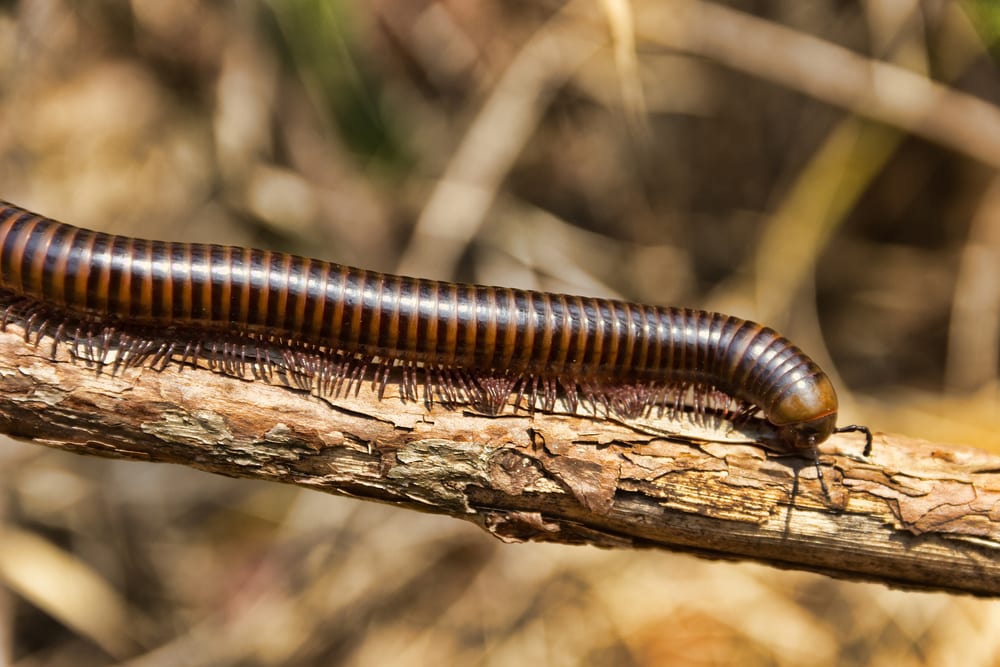
| Feature | Centipede (Chilopoda) | Millipede (Diplopoda) |
|---|---|---|
| Legs per body segment | One pair | Two pairs on most segments |
| Body in cross section | Flattened | Round |
| Speed | Fast, runs for cover | Slow, coils when disturbed |
| Mouthparts | Venomous forcipules under the head | No venom, simple chewing mouthparts |
| Diet | Predator on insects and worms | Detritivore on rotting leaves |
| Antennae | Long and straight | Short and elbowed |
Body shape is the quickest check: centipedes have “flattened bodies”, while most millipedes are rounded. Then look at the legs. Two pairs on most body segments means a millipede, and so do elbowed antennae. If it curls into a coil when you touch it, you have your answer.
House centipede, or something else?
Work down this checklist:
- Legs far longer than the body is wide, and the animal is indoors. House centipede, Scutigera coleoptrata. It is the only centipede that survives inside a building long term.
- Stubby chestnut body, 15 leg pairs, found under a garden stone. A stone centipede, almost certainly Lithobius.
- Thread thin, pale, coming out of soil or a plant pot. A soil centipede, order Geophilomorpha. Count 27 or more leg pairs and you are certain.
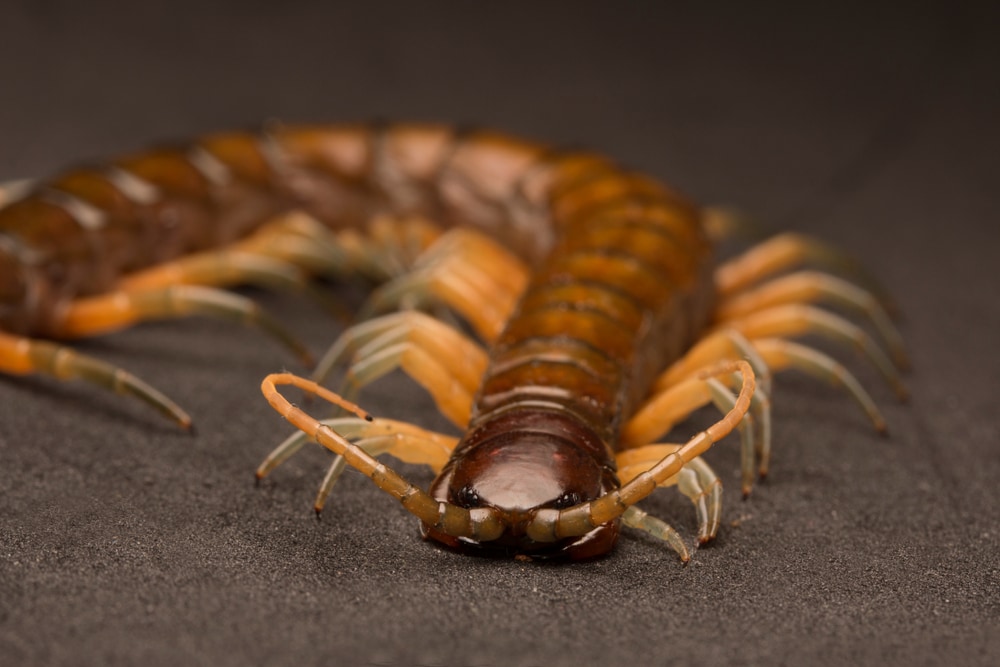
- Heavy bodied, over 5 cm, 21 or 23 leg pairs, in a warm climate. A scolopendromorph. Treat it with respect and do not handle it.
- No eyes visible at all. Soil centipedes lack eyes entirely, and so does the whole family Scolopocryptopidae, which includes the eastern red and western fire centipedes above.
Check the last pair of legs too. On most centipedes it points backward, and according to MDC it works like a second pair of antennae: its basic function is sensory. On a resting house centipede, head and tail are hard to tell apart.
Are centipedes dangerous?
Mostly not. Every centipede is venomous: under the head sits a pair of venomous, forward-bending, pincerlike claws, the forcipules, which are modified legs rather than mouthparts. Nearly all of them are too small to deliver a meaningful dose to a person.
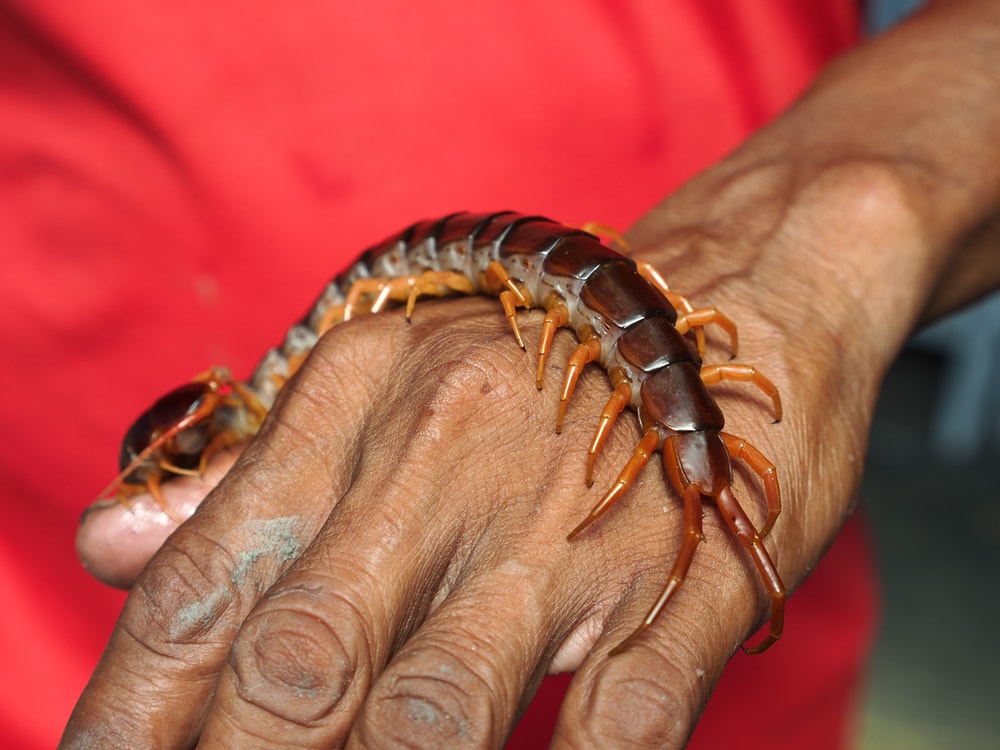
UC IPM’s assessment is that “when provoked, some large centipedes can inflict a painful bite that may cause localized swelling, discoloration, and numbness”, and that centipedes generally “play a beneficial role in the garden”. For temperate species, that covers it. Our companion piece on whether centipedes are poisonous goes further into the venom itself.
The tropical giants are the exception. Fenderson’s review of centipede bites in Hawaii describes severe local reactions to Scolopendra subspinipes and finds only one well authenticated death: a 1932 report of a seven year old girl in the Philippines who died shortly after being bitten on the head. Other deaths, the review notes, have been reported but not substantiated. Separately, a four year old in Venezuela died in 2014 after a bite from a centipede that researchers later identified as Scolopendra gigantea.
Peppermint and lavender oil come up a lot as centipede repellents, but none of the extension guides cited here recommend them. They recommend moisture control instead. Centipedes and millipedes are “very sensitive to moisture loss”, and most that wander indoors “die shortly after entering a structure due to the lack of moisture”. Dry out the basement, seal the gaps, clear leaf litter away from the foundation, and the problem mostly takes care of itself.
Frequently asked questions
What is the most harmful centipede?
Large tropical Scolopendra are the ones that matter medically. In Hawaii and the Pacific, Scolopendra subspinipes causes immediate and often excruciating burning pain, swelling, and sometimes tissue necrosis at the puncture sites. Deaths are very rare. The best authenticated case is a 1932 report of a seven year old girl in the Philippines.
Are house centipedes harmful?
No. The house centipede, Scutigera coleoptrata, has forcipules so small that it struggles to pierce human skin, and University of Kentucky entomologists rate it a minimal bite hazard. It hunts silverfish, firebrats, carpet beetle larvae, cockroaches and spiders, which makes it free pest control rather than a pest.
What kind of bug can be mistaken for a centipede?
Millipedes, almost always. Both are long and many legged, but a millipede is round in cross section and carries two pairs of legs on most segments, while a centipede is flattened and carries one pair per segment. Millipedes also move slowly, coil when disturbed, and eat rotting leaves.
Should you avoid killing centipedes?
Generally yes. University of California IPM describes centipedes as predators that play a beneficial role in the garden, and most species that wander indoors die quickly because the air is too dry for them. Sealing gaps and drying out damp spots does more than killing the ones you see.
What are the little tiny centipedes in my house?
Usually immature house centipedes. They hatch with four pairs of legs and add more at each molt until they reach 15, so young ones look nothing like the 25 to 35 mm adult. Thread thin soil centipedes also turn up in potting soil. Neither is dangerous.
Related articles