
Texas mammals

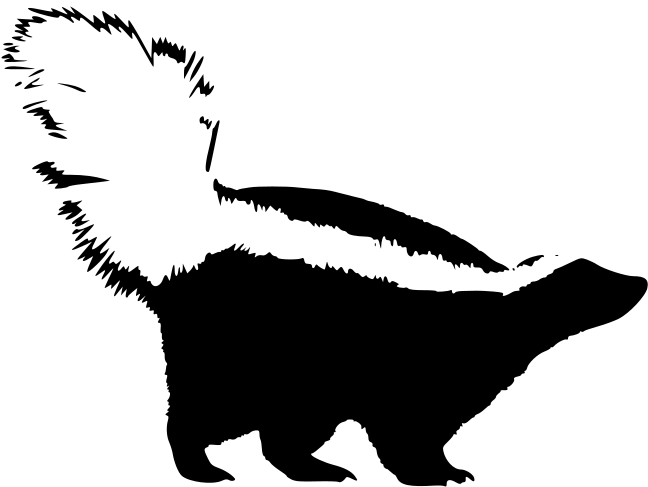
American Hog-nosed Skunk in Texas

Conepatus leuconotus

Native to Texas S4 Apparently Secure in Texas

Not listed as nonindigenous in Texas by USGS NAS; native to its Texas range.

IUCN Red List status

  1. LC
  2. NT
  3. VU
  4. EN
  5. CR
  6. EW
  7. EX

LC – Least Concern

Widespread and abundant; not at risk.

American Hog-nosed Skunk in Texas, by the numbers

Common in Texas 42nd most recorded of 197 mammals logged in Texas

684 occurrence records
340 with iNaturalist photos
Jun 1, 2026 Last seen in Texas

Records from 2000–2026.

684 total records count every Texas occurrence from GBIF and iNaturalist; the map plots a georeferenced sample of 300; the monthly chart covers the 665 records with a full observation date.

When to look for the American Hog-nosed Skunk in Texas

Recorded year-round, with no strong seasonal peak.

665 Texas occurrence records (iNaturalist and GBIF) by month of year, 2000–2026. Shows when the species is recorded, not a guarantee of presence.

Monthly Texas records (table)
MonthRecords
January57
February61
March65
April58
May40
June44
July37
August56
September52
October65
November71
December59

Monthly american hog-nosed skunk occurrence records (iNaturalist and GBIF) in Texas, 2000–2026.

Seasonality

Year-round in Texas, with no strong seasonal peak in observations.

Occurrence map

Where American Hog-nosed Skunk has been recorded in Texas

300 records mapped · zoom and drag to explore

300 Texas records mapped

Notable places to look

Park, forest, or monumentiNaturalist records
Big Bend National Park 6
Devils River State Natural Area 2
Fort Mckavett State Historic Site 2
San Angelo State Park 1
Permanent University Fund 1
Bentsen - Rio Grande Valley State Park 1
Elephant Mountain Wildlife Management Area 1
Guadalupe Mountains National Park 1

Protected places with the most american hog-nosed skunk sightings, from the USGS Protected Areas Database plus named mountain ranges, good spots to look, not a full breakdown, so they don't sum to the total.

Where it's recorded in Texas

CountyRecords
Tom Green County 146
Val Verde County 67
Concho County 35
Brewster County 31
Irion County 30
Gillespie County 19
Jeff Davis County 19
Kerr County 19
Kimble County 19
Coke County 19
Crockett County 17
Edwards County 16
48 other counties 247

The complete county distribution, spread across 60 Texas counties. Every occurrence record falls in one county, so these sum to the total. Counties from GBIF and US Census boundaries.

Hog-nosed skunks are a Hill Country and Edwards Plateau species, and the record cluster around San Angelo State Park, the Colorado River corridor, and Devils River State Natural Area follows that limestone canyon country closely. NatureServe rates it S4, Apparently Secure, in Texas, even though records here are thinner than for many of the state’s mammals.

Records spread fairly evenly across the year, with a modest bump in November and no sharp single-season peak, an honest reflection of a species active year-round rather than a real gap in observer effort. Only about half of the state’s 684 records come from iNaturalist photographs, with the rest from GBIF-linked survey data, consistent with a shy, mostly nocturnal digger that people are more likely to trap or track than photograph. The pattern overall reads as a species genuinely present across its Hill Country range but not one many people run into.
Occurrence data from iNaturalist and GBIF.

More mammals in Texas in the atlas

Data & sources

The data and visualizations on this page draw on these open sources:

  • GBIFCC-BY 4.0occurrence records behind the range map, elevation, and record counts
  • iNaturalistCC0 / CC-BY / CC-BY-SAobservations, photos, and audio recordings
  • NatureServe ExplorerCC-BYthe state conservation rank
  • IUCN Red Listattributed factthe global conservation status
  • USGS NASpublic domainnative / introduced status
  • Natural Earthpublic domainthe relief basemap
  • USFSpublic domainnational-forest boundaries
  • USGS Protected Areas Databasepublic domainthe named parks, forests, and refuges behind "notable places to look"




