
Muskox

Ovibos moschatus

Also known as: Musk Ox

LCLeast Concern

The musk ox is an Ice-Age survivor, a shaggy grazer of the Arctic tundra that outlasted the mammoths it once shared the cold with. Despite the name and the heavy build, it isn't an ox at all: it's a close relative of sheep and goats. Hunted out of Alaska more than a century ago and later brought back, it now lives in the United States only across Alaska's far north, where the records below trace where and when it turns up.

Range through the year

Where Muskox is seen

Muskox is recorded in 2 US states from 494 occurrence records, most heavily in Alaska (493 records) and Washington (1).

Current range494 records · 2 states
AlabamaArizonaArkansasCaliforniaColoradoConnecticutDelawareDistrict of ColumbiaFloridaGeorgiaIdahoIllinoisIndianaIowaKansasKentuckyLouisianaMaineMarylandMassachusettsMichiganMinnesotaMississippiMissouriMontanaNebraskaNevadaNew HampshireNew JerseyNew MexicoNew YorkNorth CarolinaNorth DakotaOhioOklahomaOregonPennsylvaniaRhode IslandSouth CarolinaSouth DakotaTennesseeTexasUtahVermontVirginiaWashington · 1 recordsWest VirginiaWisconsinWyomingAlaska · 493 records · view state pageAKHawaiiHIPuerto RicoPR
Occurrence data by state and month
Muskox – occurrence records by US state and month (494 total across 2 states)
StateJanFebMarAprMayJunJulAugSepOctNovDecYear
Alaska·7225925179573123·493
Washington1···········1

Based on 733 georeferenced US records. Shading is observation density (where people record sightings), not true abundance. Alaska, Hawaii & Puerto Rico shown as insets.

Explore by state

Muskox across 1 state

Occurrence records, conservation status, and the places it turns up, state by state. Open a state for detail, or visit its full page.

  • AlaskaNativeCommon733 records

    State rankApparently Secure

    Notable placesJames Dalton Highway Corridor · the North Slope · State Tentatively Approved (tad) · Gates of the Arctic National Park

    Countiesrecorded in 9

    Year-round in Alaska, with recorded sightings peaking in June.

IUCN Red List status

  1. LC
  2. NT
  3. VU
  4. EN
  5. CR
  6. EW
  7. EX

LC – Least Concern

Widespread and abundant; not at risk.

SizeMuskox beside a 1.8 m adult, drawn to scale
Created by potrace 1.16, written by Peter Selinger 2001-2019 Created by potrace 1.16, written by Peter Selinger 2001-2019
Body length
1.1–1.5 m3 ft 7 in–4 ft 11 in
Weight
180–400 kg397–882 lb

Silhouettes drawn to scale against a 1.8 m5 ft 11 in adult.

Observation peakJune1,130 records

Seasonality from research-grade observation dates across the US (1,130 records, all years). Reflects when the species is recorded, not a guarantee of presence.

Daily activity clockCathemeral– active in irregular bursts, day and night

593 muskox observations logged by hour of day. Activity is cathemeral (active in irregular bursts, day and night), peaking around 11 AM.

12 AM: 6 observations1 AM: 6 observations2 AM: 3 observations3 AM: 2 observations4 AM: 2 observations5 AM: 5 observations6 AM: 10 observations7 AM: 17 observations8 AM: 21 observations9 AM: 32 observations10 AM: 33 observations11 AM: 60 observations12 PM: 41 observations1 PM: 46 observations2 PM: 36 observations3 PM: 44 observations4 PM: 31 observations5 PM: 39 observations6 PM: 30 observations7 PM: 35 observations8 PM: 26 observations9 PM: 18 observations10 PM: 27 observations11 PM: 23 observations12 AM6 AM12 PM6 PM

Based on 593 records (all years). Reflects when people record sightings, not only when the animal is active.

Hourly observation counts: 12 AM 6, 1 AM 6, 2 AM 3, 3 AM 2, 4 AM 2, 5 AM 5, 6 AM 10, 7 AM 17, 8 AM 21, 9 AM 32, 10 AM 33, 11 AM 60, 12 PM 41, 1 PM 46, 2 PM 36, 3 PM 44, 4 PM 31, 5 PM 39, 6 PM 30, 7 PM 35, 8 PM 26, 9 PM 18, 10 PM 27, 11 PM 23.

Best encounter

Where and when to see a Muskox

Your best chance: Alaska, in June, during the day.

Where
AlaskaAK
When
June
Time
During the daycathemeral
Trophic relationshipsFood web What a Muskox eats, and what eats it.
This speciesMuskox
Least WillowSalix herbaceaLingonberryVaccinium vitis-idaea
Eats2

A sample of documented feeding relationships, filtered to species that also occur in the US. Diet and predators vary by region and season, and this is not a complete list, many animals eat, and are eaten by, more than what has been formally recorded here.

Life history

The Muskox (180–400 kg396.8–881.8 lb) is a herbivore that first breeds around 3 years, carries a 258-day gestation, and bears about 1 young per litter. Maximum recorded longevity is 27.4 years.

Life cycle

  1. Gestation258 days (≈8.5 months)
  2. Birthlitter of 1 young
  3. Sexual maturity3 yr (female) · 3.5 yr (male)
  4. Typical lifespan27.4 years
  5. Maximum recorded longevity27.4 years

Reproduction

Gestation
258days≈8.5 months
Litter size
1youngaverage
Litters / year
0.8littersabout one every 1.3 years
Age at first breeding
3years♀ 3 · ♂ 3.5 yr

Diet composition

Herbivore

By foraging composition: 90% plant material, 10% fruit.

  • Plant material90%
  • Fruit10%

Most active during the day and at dawn and dusk.

Typical values for the species, not local measurements. Maximum longevity is the longest lifespan on record; most individuals live far less.

Commonly confused with

Animals people sometimes mistake for the muskox, and how to tell them apart.

Surviving the Arctic

The musk ox lives where few large animals can. In the United States that means Alaska’s tundra: open ground, river valleys, and windswept ridges above the tree line. It’s a true Ice-Age holdover, a grazer that shared the cold with mammoths and outlasted them. Almost everything about its body is built to hold heat and save energy through a long, frozen, dark winter.

It doesn’t head south when the cold comes. Instead it stays put and eats what the tundra offers: grasses, sedges, low willows, and lichens. In winter it sweeps snow off frozen plants with its head and hooves, favoring wind-scoured slopes where the snow lies thin. Moving as little as possible is part of the plan, because every burst of effort burns calories that are hard to replace up there.

Reports of musk oxen climb through the short Arctic summer and thin out in winter. That pattern says more about people than about the animals. Endless summer daylight opens the only real window when observers can reach the tundra, so that’s when sightings get logged. The herds are on the same ground in January, just harder to find and reach.

The warmest coat in the animal world

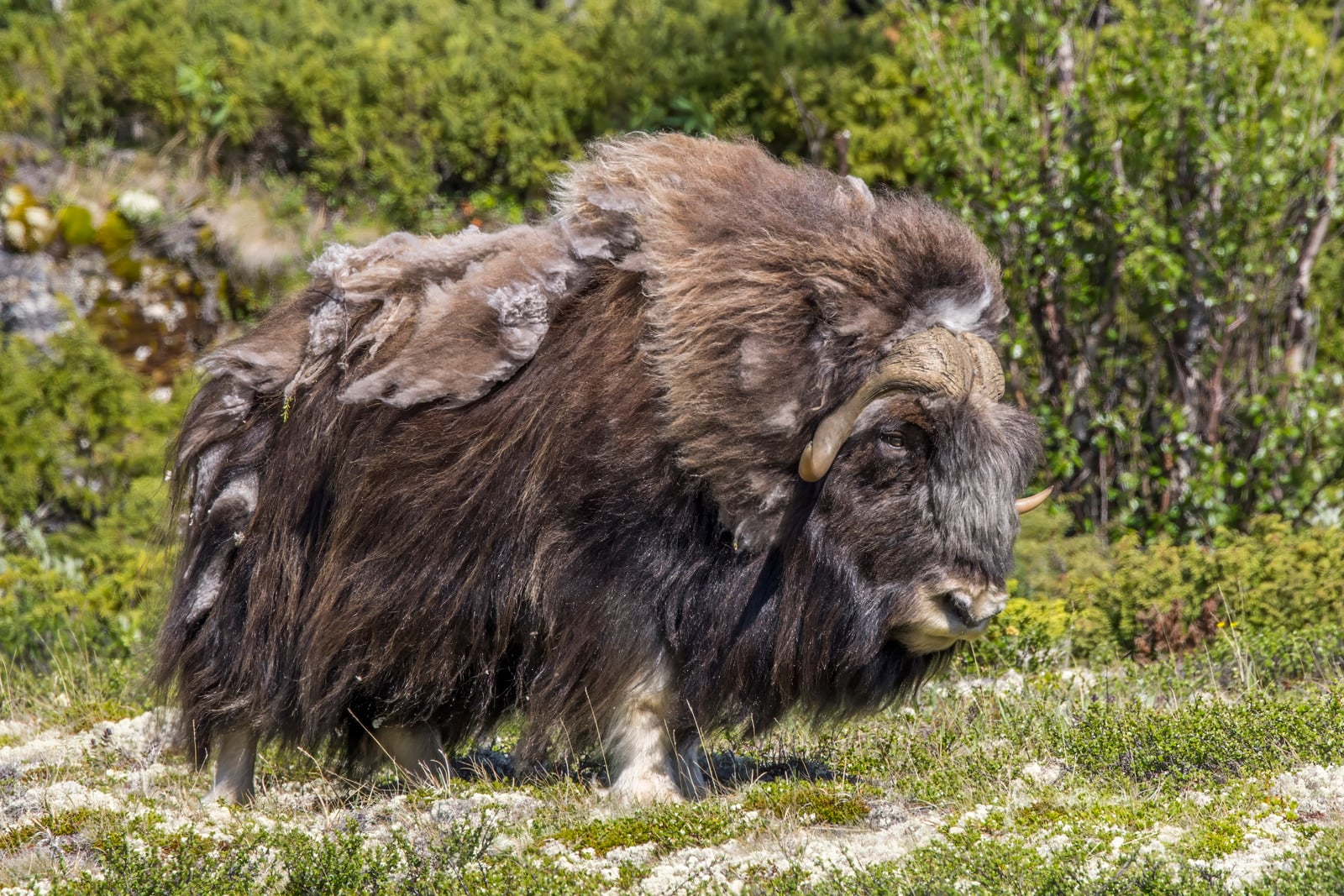
A musk ox wears two coats at once. The long, coarse outer hair that hangs almost to the ground sheds wind and rain. Underneath lies qiviut, a fine underwool that ranks among the warmest natural fibers known. For its weight it beats sheep’s wool for warmth, and it’s softer than cashmere. That hidden layer is what lets the animal stand in a blizzard and barely feel it.

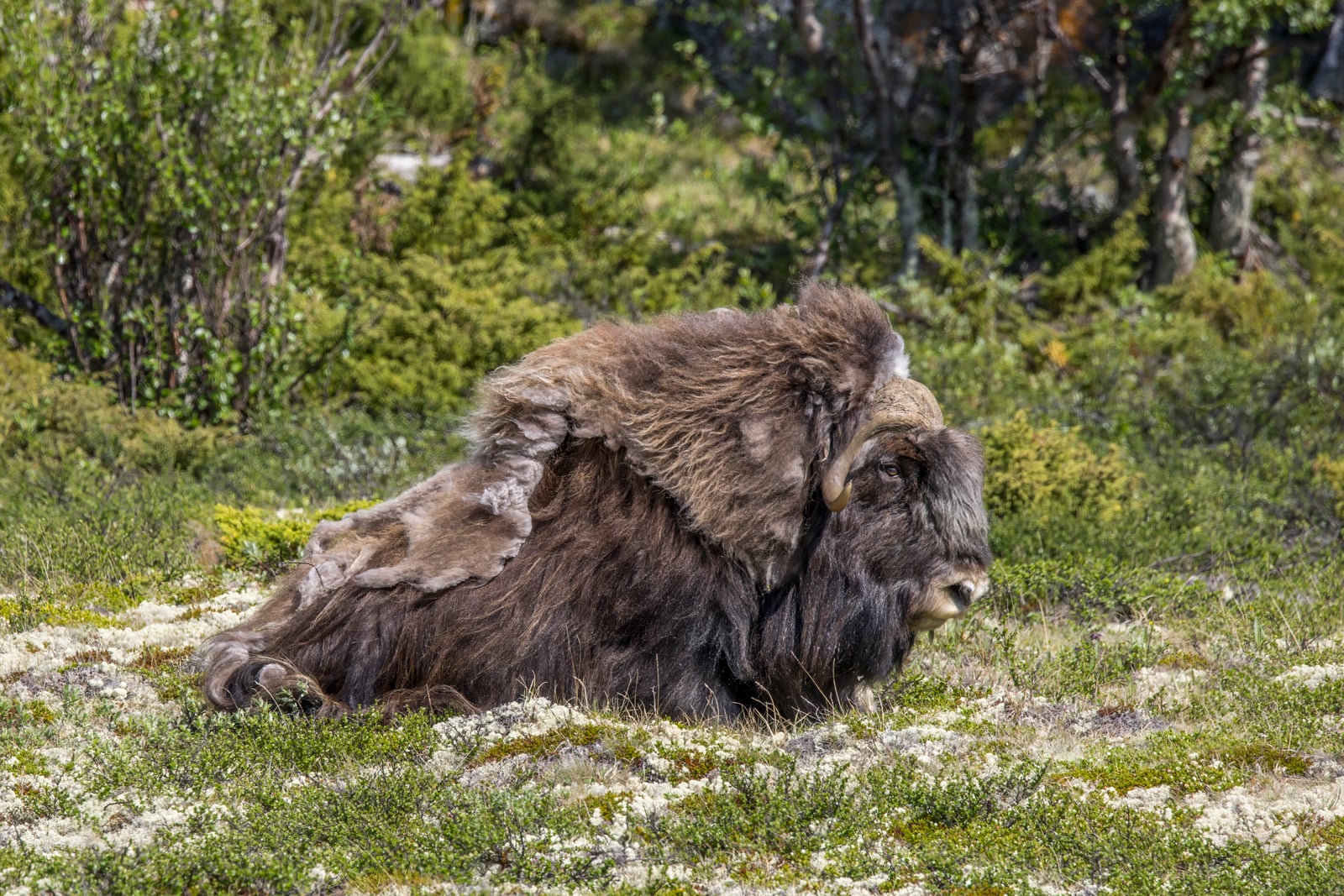
Every spring the qiviut loosens and peels away in great matted sheets as the weather warms. In the wild it snags on shrubs and rocks; on Alaskan farms it’s combed out by hand and spun into yarn. That shed underwool is why the species matters to many people who will never see one in the flesh.
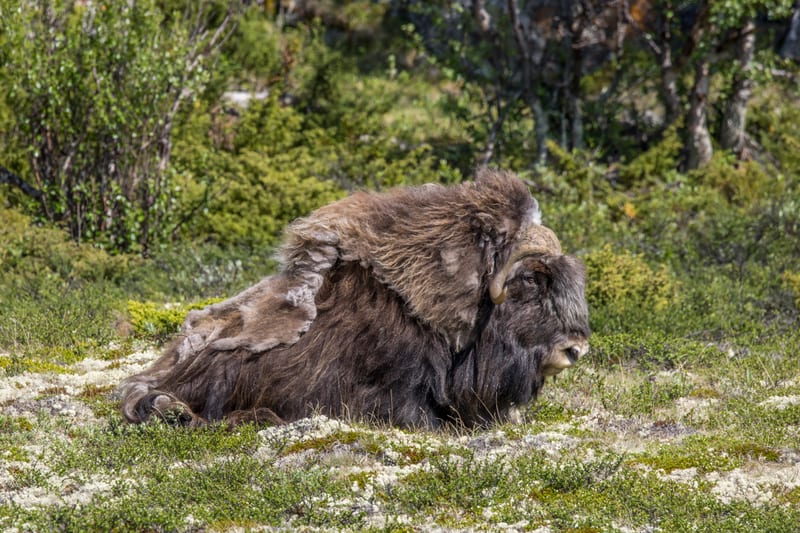
A resting musk ox with thick, molting fur on a mossy Arctic slope
As spring warms the tundra, the qiviut underwool loosens and sheds in ragged patches like these. Photo: Charles J. Sharp, CC BY-SA 4.0.

The living wall against wolves

Musk oxen live in herds, and the herd is their main defense. When wolves or a bear close in, the adults don’t scatter. They pack together and face outward, horns to the threat, with the calves tucked safely behind them. It’s a tactic built for predators that hunt by chasing down stragglers.

A wall of horned, half-ton animals gives a wolf pack nothing to pick off. A bull may even charge out at an attacker and then wheel back into the group. The defense is ancient, and it works against wolves, brown bears, wolverines, and the foxes and eagles that test young calves. Its one weakness is a hunter with a rifle, which is part of why the animal was so easy to wipe out.
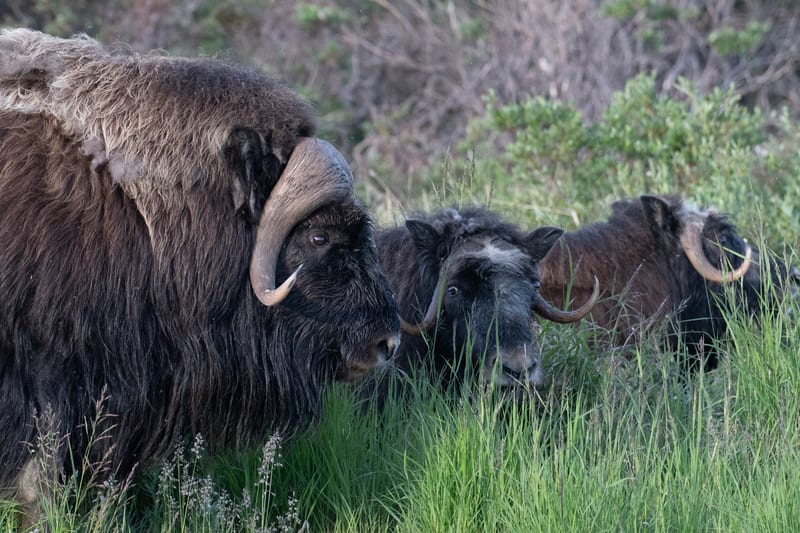
Three musk oxen standing close together in tall summer grass
Musk oxen gather in small herds, and that grouping is the heart of their defense. Photo: Rajan Rao, CC BY 4.0.

Horns, the autumn rut, and telling it from a bison

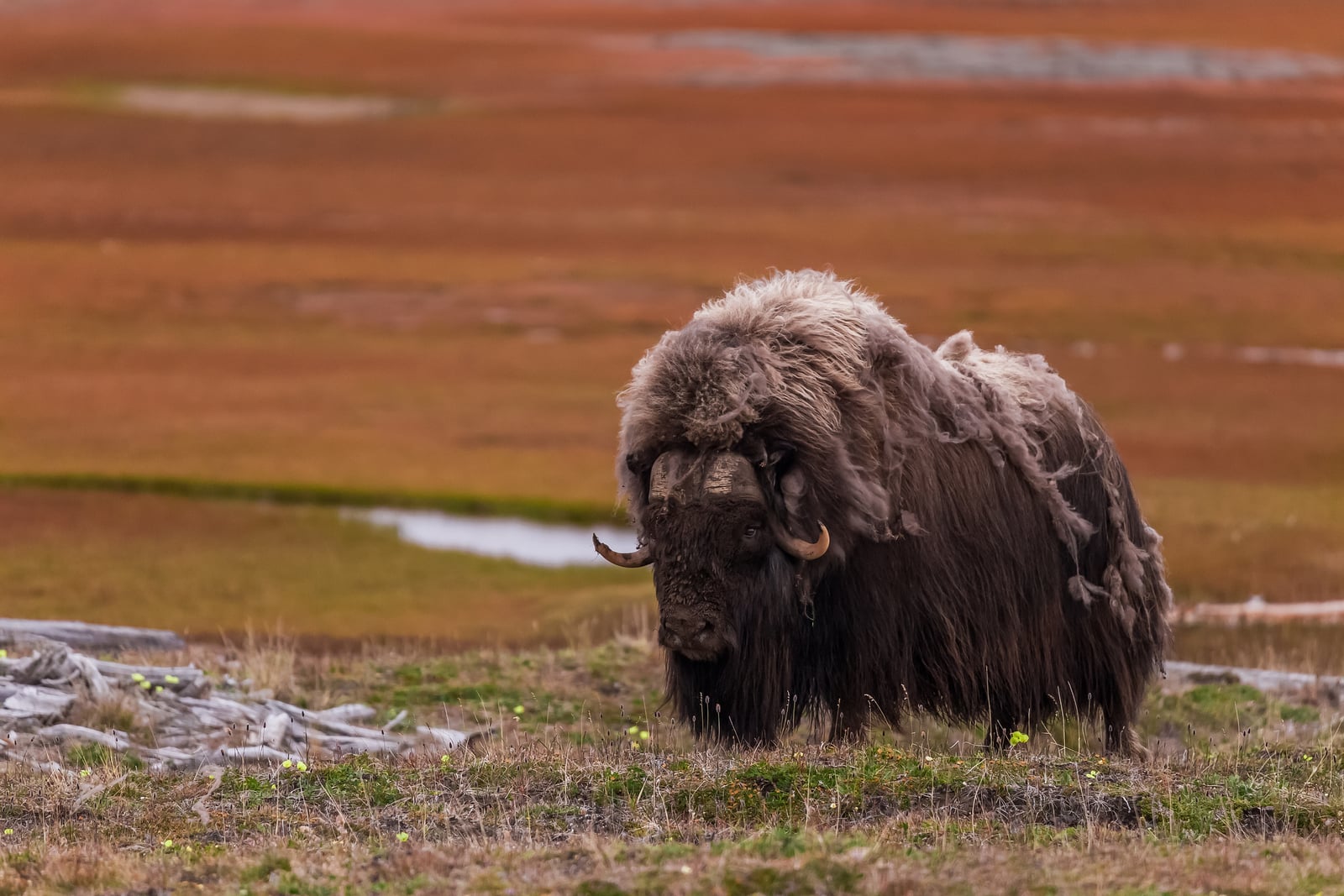
Both sexes grow horns, but a bull’s sweep down from a thick bony plate, called a boss, that shields the top of the skull. In autumn, bulls put that armor to use. They back apart, charge, and slam heads with a crack that carries across the tundra, each fighting for the right to breed. Calves arrive the next spring, timed to the brief green flush of the growing season.

People often take a musk ox for a small bison, and the two do share a stocky, humped shape. The coat and horns tell them apart. A bison is smooth-coated, with short upright horns and a beard. A musk ox is buried in a floor-length curtain of hair, with low, side-sweeping horns and a pale boss between them. And despite the name, this is no ox. It sits on the goat and sheep branch of the family, closer to a mountain goat than to any kind of cattle.
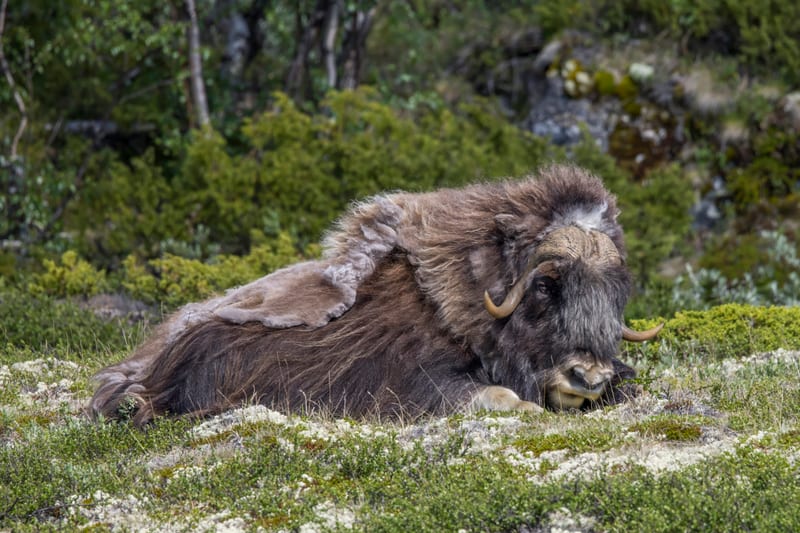
A musk ox resting on tundra shrubs, showing its down-curved horns and pale bony boss
A bull’s horns curve down from the heavy boss that caps its skull, the plate it drives forward in the autumn rut. Photo: Charles J. Sharp, CC BY-SA 4.0.

Wiped out, then brought back

Musk oxen once ranged across northern Alaska, but hunting wiped them out there by the late 1800s. The animals in the state today trace back to a deliberate rescue. In the 1930s a small group brought from Greenland was released on Nunivak Island, off Alaska’s west coast. That founding herd later seeded reintroductions on the mainland and beyond.

The comeback took hold. Worldwide the species sits at low risk of extinction, and its Alaskan range is spreading again from those transplanted animals. It’s still a working part of northern life, prized for qiviut and watched closely by the communities that share the tundra with it. For an animal that vanished from the United States entirely, that’s a rare second chance.


Data & sources

The data and visualizations on this page draw on these open sources:


