
Ord's Kangaroo Rat

Dipodomys ordii

LCLeast Concern

Ord's kangaroo rat is the most widespread kangaroo rat in North America, a small nocturnal rodent of sandy deserts and grasslands. It travels by bounding on oversized hind legs, balanced by a long tufted tail, hauls seeds home in fur-lined cheek pouches, and never drinks free water: digesting dry seeds alone supplies all the moisture it needs. Records below trace more than 6,300 sightings across fifteen states, from Washington's sagebrush flats to the shortgrass prairie of Nebraska.

Range through the year

Where Ord's Kangaroo Rat is seen

Ord's Kangaroo Rat is recorded in 16 US states from 24,221 occurrence records, most heavily in Utah (6,595 records) and New Mexico (5,854).

Current range24,221 records · 16 states
Occurrence data by state and month
Ord's Kangaroo Rat – occurrence records by US state and month (24,221 total across 16 states)
StateJanFebMarAprMayJunJulAugSepOctNovDecYear
Utah7057877741,2551,2021,071764770410124116,595
New Mexico2651854404954421,0546276004396503563015,854
Colorado25203823132235632219412726734321,968
Oklahoma40119103121227216318248207110122491,880
Arizona2357572051601371792577615052201,373
Texas9510926014660132127781548121841,275
Nevada13202531189210281280611955181,202
Kansas6615114811471788830711960781,199
Nebraska1176622441375220271817592
Wyoming5·111045173145722384487
Washington465052463270·21715716425
California23131330676966697521410
Oregon3625512790785325151411398
Idaho521710791212632421521352
South Dakota···7184464·23···156
Montana····316717223555

Based on 24,511 georeferenced US records, 2000-2026. Shading is observation density (where people record sightings), not true abundance. Alaska, Hawaii & Puerto Rico shown as insets.

Explore by state

Ord's Kangaroo Rat across 16 states

Occurrence records, conservation status, and the places it turns up, state by state. Open a state for detail, or visit its full page.

  • UtahNativeCommon6,688 records

    State rankSecure

    Notable placesThe State of Utah School and Institutional Trust Lands Administration 1552 · Grand Staircase-Escalante National Monument · Bears Ears National Monument · Dinosaur National Monument

    Countiesrecorded in 12

    Year-round in Utah, with recorded sightings peaking in April–September.

  • New MexicoNativeCommon5,911 records

    State rankSecure

    Notable placesState Trust Land · White Sands National Park · Aden Lava Flow Wilderness Area · Salinas Pueblo Missions National Monument

    Countiesrecorded in 12

    Year-round in New Mexico, with recorded sightings peaking in June, with a smaller rise in October.

  • ColoradoNativeCommon1,975 records

    State rankSecure

    Notable placesPawnee National Grassland · Great Sand Dunes National Park · Dinosaur National Monument · Tamarack Ranch

    Countiesrecorded in 12

    Year-round in Colorado, with recorded sightings peaking in April–July, with a smaller rise in October.

  • OklahomaNativeCommon1,905 records

    State rankUnranked

    Notable placesLittle Sahara State Park · CLO Lands · Oliver's Woods · Packsaddle Wildlife Management Area

    Countiesrecorded in 12

    Year-round in Oklahoma, with recorded sightings peaking in May–September.

  • ArizonaNativeOccasional1,374 records

    State rankSecure

    Notable placesState Trust Land · Paria Canyon - Vermilion Cliffs Wilderness Area · Glen Canyon National Recreation Area · Prescott National Forest

    Countiesrecorded in 13

    Year-round in Arizona, with recorded sightings peaking in July–August, with a smaller rise in April–May.

  • TexasNativeOccasional1,317 records

    State rankApparently Secure

    Notable placesElephant Mountain Wildlife Management Area · Permanent University Fund · Monahans Sandhills State Park · Padre Island National Seashore

    Countiesrecorded in 12

    Year-round in Texas, with recorded sightings peaking in March.

  • KansasNativeCommon1,217 records

    State rankSecure

    Notable placesMeade State Park · Finney Game Refuge · Sherman State Fishing Lake And Wildlife Area · Cedar Bluff Wildlife Area

    Countiesrecorded in 12

    Year-round in Kansas, with recorded sightings peaking in September.

  • NevadaNativeCommon1,207 records

    State rankSecure

    Notable placesHumboldt National Forest · Valley of Fire State Park · Toiyabe National Forest · Basin and Range National Monument

    Countiesrecorded in 12

    Year-round in Nevada, with recorded sightings peaking in May–August.

  • NebraskaNativeCommon597 records

    State rankSecure

    Notable placesFort Niobrara National Wildlife Refuge_Wilderness Area · Ballards Marsh Wildlife Management Area · Agate Fossil Beds National Monument · Samuel R. Mckelvie National Forest

    Countiesrecorded in 12

    Year-round in Nebraska, with recorded sightings peaking in June.

  • WyomingNativeOccasional487 records

    State rankSecure

    Notable placesSeminoe Reservoir State Park · Bighorn Canyon National Recreation Area

    Countiesrecorded in 12

    Year-round in Wyoming, with recorded sightings peaking in July–August.

  • WashingtonNativeRare430 records

    State rankApparently Secure

    Notable placesJuniper Dunes Wilderness Area · Columbia Basin Wildlife Area Complex · Washington State Department of Natural Resources (WADNR) State Resource Management Area

    Countiesrecorded in 5

    Year-round in Washington, with recorded sightings peaking in October–November, with a smaller rise in March–May and July.

  • CaliforniaNativeOccasional423 records

    State rankUnranked

    Notable placesDoyle Wildlife Area · Granite Mountain Wilderness Area · Hastings Natural History Reserve

    Countiesrecorded in 13

    Year-round in California, with recorded sightings peaking in June–October.

  • OregonNativeOccasional400 records

    State rankApparently Secure

    Notable placesCascade Range · Oregon Badlands Wilderness Area · Crooked River National Grassland

    Countiesrecorded in 12

    Year-round in Oregon, with recorded sightings peaking in June–July.

  • IdahoNativeOccasional357 records

    State rankApparently Secure

    Notable placesCraters Of The Moon National Monument · Snake River Plain · City of Rocks National Reserve · Hagerman Fossil Beds National Monument

    Countiesrecorded in 12

    Year-round in Idaho, with recorded sightings peaking in May–June.

  • South DakotaNativeCommon162 records

    State rankSecure

    Notable placesState Lands

    Countiesrecorded in 6

    Year-round in South Dakota, with recorded sightings peaking in June–July.

  • MontanaNativeRare61 records

    State rankSecure

    Notable placesMontana State Trust Lands · Bighorn Canyon National Recreation Area

    Countiesrecorded in 13

    Year-round in Montana, with recorded sightings peaking in August, with a smaller rise in June.

IUCN Red List status

  1. LC
  2. NT
  3. VU
  4. EN
  5. CR
  6. EW
  7. EX

LC – Least Concern

Widespread and abundant; not at risk.

SizeOrd's Kangaroo Rat beside a 1.8 m adult, drawn to scale
Created by potrace 1.16, written by Peter Selinger 2001-2019 Created by potrace 1.16, written by Peter Selinger 2001-2019
Body length
21–37 cm8 in–14 in
Weight
50–50 g1.8–1.8 oz

Silhouettes drawn to scale against a 1.8 m5 ft 11 in adult.

Elevation

From 200 georeferenced records, the Ord's Kangaroo Rat is recorded from 483 m1,585 ft to 2,394 m7,854 ft, with half of sightings below 1,665 m5,463 ft.

Each band shows the share of georeferenced sightings that fall within it. Records cluster where people live and hike, so low, populated elevations are over-represented. Read this as observation density, not true abundance.

Observation peakAugust316 records

Seasonality from research-grade observation dates across the US (316 records, all years). Reflects when the species is recorded, not a guarantee of presence.

Daily activity clockCathemeral– active in irregular bursts, day and night

410 ord's kangaroo rat observations logged by hour of day. Activity is cathemeral (active in irregular bursts, day and night), peaking around 10 PM.

12 AM: 17 observations1 AM: 10 observations2 AM: 5 observations3 AM: 4 observations4 AM: 4 observations5 AM: 8 observations6 AM: 10 observations7 AM: 24 observations8 AM: 35 observations9 AM: 28 observations10 AM: 28 observations11 AM: 16 observations12 PM: 14 observations1 PM: 7 observations2 PM: 9 observations3 PM: 12 observations4 PM: 15 observations5 PM: 5 observations6 PM: 6 observations7 PM: 11 observations8 PM: 24 observations9 PM: 34 observations10 PM: 49 observations11 PM: 35 observations12 AM6 AM12 PM6 PM

Based on 410 records (all years). Reflects when people record sightings, not only when the animal is active.

Hourly observation counts: 12 AM 17, 1 AM 10, 2 AM 5, 3 AM 4, 4 AM 4, 5 AM 8, 6 AM 10, 7 AM 24, 8 AM 35, 9 AM 28, 10 AM 28, 11 AM 16, 12 PM 14, 1 PM 7, 2 PM 9, 3 PM 12, 4 PM 15, 5 PM 5, 6 PM 6, 7 PM 11, 8 PM 24, 9 PM 34, 10 PM 49, 11 PM 35.

Best encounter

Where and when to see an Ord's Kangaroo Rat

Your best chance: Utah, in August, after dark.

Where
UtahUT
When
August
Time
After darkcathemeral
Trophic relationshipsFood web What a Ord's Kangaroo Rat eats, and what eats it.
Eaten by6
Western Diamond-backed RattlesnakeCrotalus atroxGopher SnakePituophis cateniferWestern RattlesnakeCrotalus viridisLong-nosed SnakeRhinocheilus leconteiGlossy SnakeArizona elegansEastern Screech-owlAsio otus
This speciesOrd's Kangaroo Rat
Sand RicegrassStipa hymenoides
Eats1

A sample of documented feeding relationships, filtered to species that also occur in the US. Diet and predators vary by region and season, and this is not a complete list, many animals eat, and are eaten by, more than what has been formally recorded here.

Life history

The Ord's Kangaroo Rat (50 g1.8 oz) is an omnivore that first breeds around 0.2 years, carries a 29-day gestation, and bears about 3.2 young per litter. Maximum recorded longevity is 9.9 years.

Life cycle

  1. Gestation29 days
  2. Birthlitter of 3.2 young
  3. Sexual maturity0.2 yr (female)
  4. Typical lifespan9.9 years
  5. Maximum recorded longevity9.9 years

Reproduction

Gestation
29days
Litter size
3.2youngaverage
Litters / year
2litters
Age at first breeding
0.2years

Diet composition

Omnivore

By foraging composition: 30% plant material, 30% seeds & grain, 20% fruit, 20% invertebrates.

  • Plant material30%
  • Seeds & grain30%
  • Fruit20%
  • Invertebrates20%

Most active at night.

Typical values for the species, not local measurements. Maximum longevity is the longest lifespan on record; most individuals live far less.

Commonly confused with

Animals people sometimes mistake for the ord's kangaroo rat, and how to tell them apart.

Built to hop, not walk

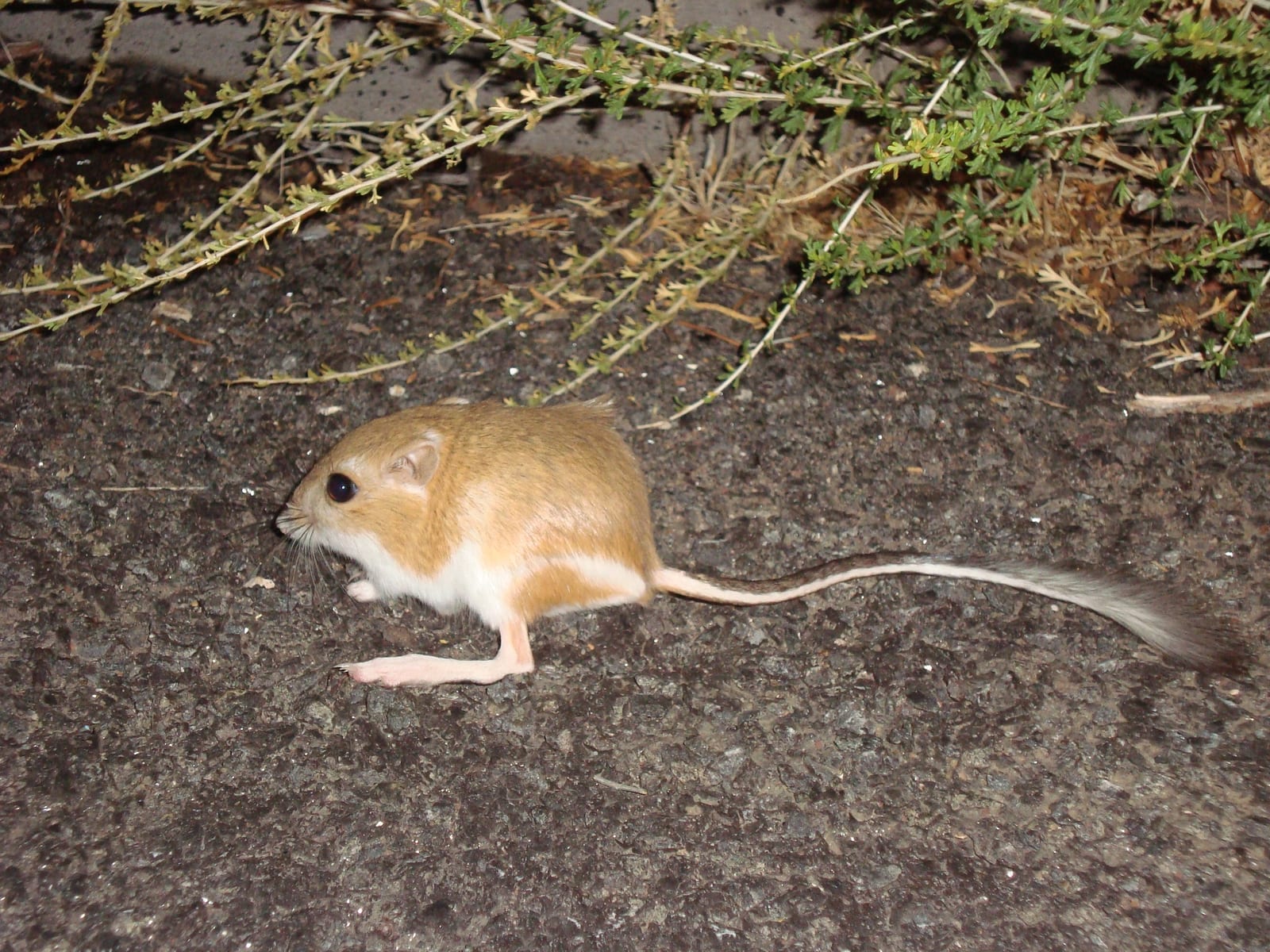
Ord’s kangaroo rat moves by springing on its hind legs alone, like a tiny kangaroo. Its front legs stay tucked and barely touch the ground. Its hind feet are strikingly oversized, nearly a fifth of its whole body length. A long, tufted tail trails behind as a counterbalance in mid-leap.

Gold-brown fur covers its back and fades to white along the belly. A dark stripe runs along the tail, stopping well short of the flared white tip on its much larger cousin, the banner-tailed kangaroo rat. It’s also smaller and darker than the desert kangaroo rat, which runs pale overall with a plain white tail tip instead of a dark one.

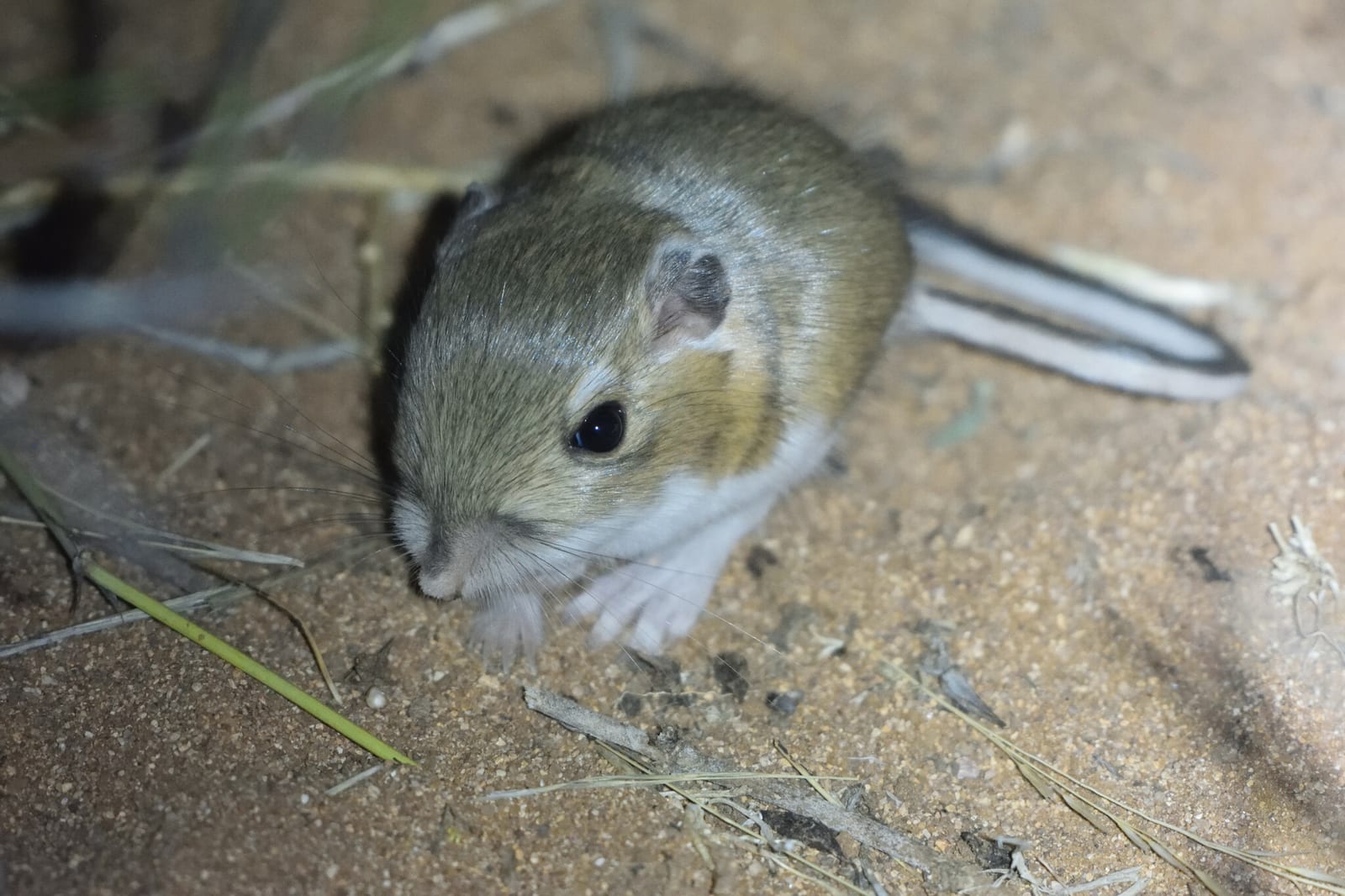
The surest way to tell it apart from its closest look-alike, the Merriam’s kangaroo rat, is underfoot: Ord’s has five toes on each hind foot, Merriam’s only four. That difference shows up cleanly in a track pressed into fine sand. Fur-lined cheek pouches flank its muzzle for hauling seeds home, and large, dark eyes give it sharp night vision for life after dark.
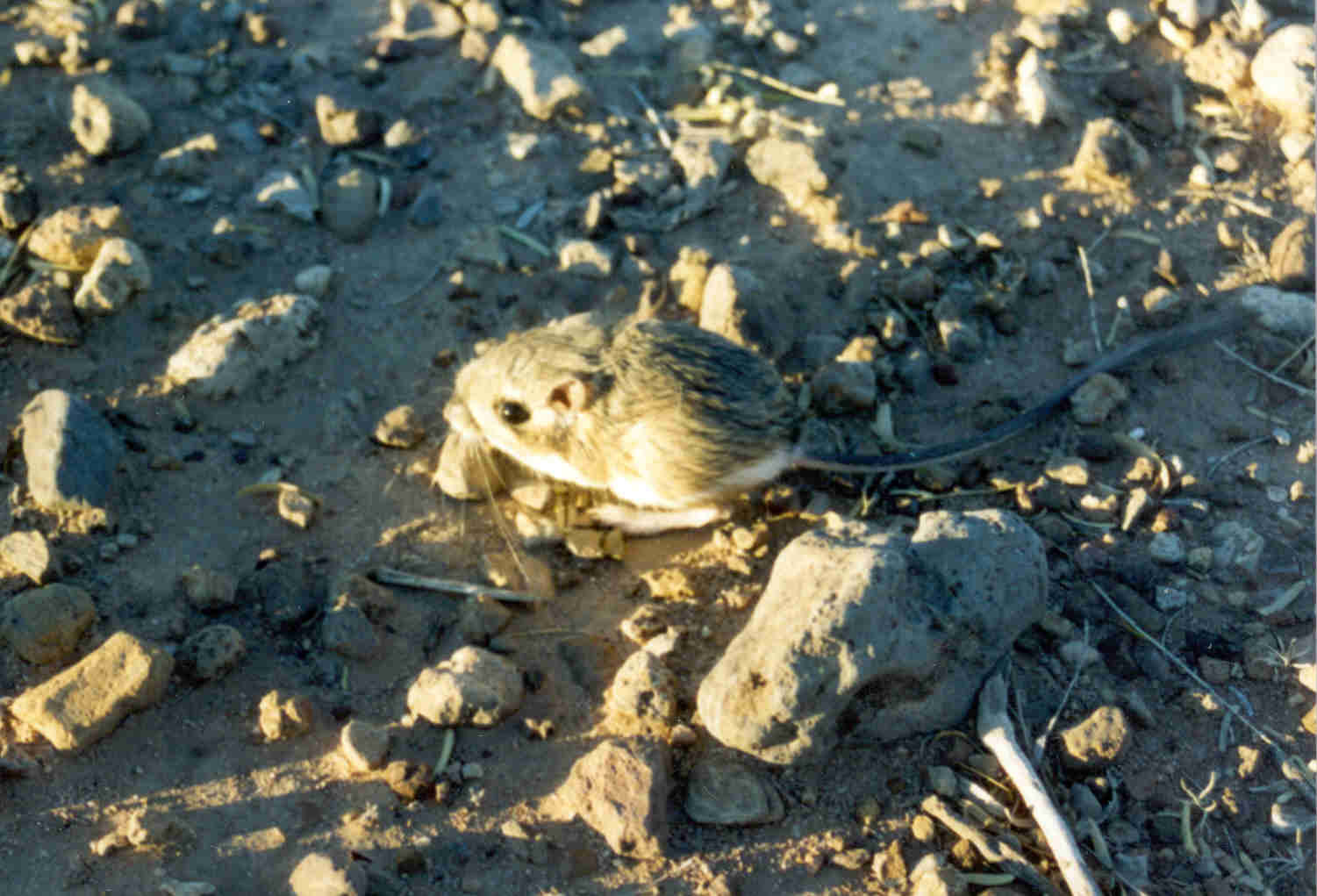
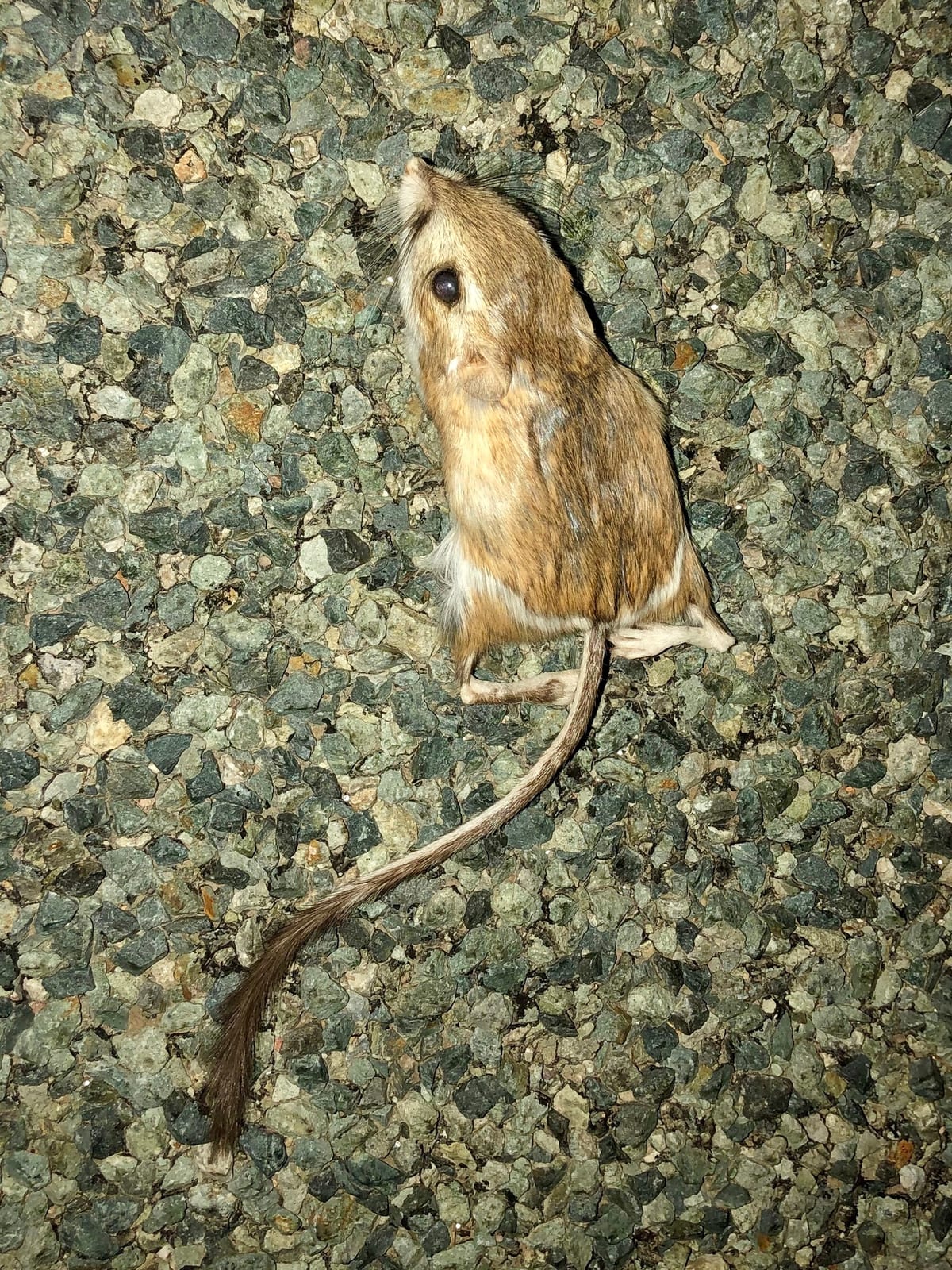
Ord's kangaroo rat standing alert on rocky ground, showing its overall build and dark-tipped tail
Ord’s kangaroo rat standing alert, its compact build and dark-tipped tail on full display. Photo: Juan Cruzado Cortés, CC BY-SA 4.0.

The most far-ranging kangaroo rat in North America

No other kangaroo rat covers as much ground. Its range stretches from the southern Canadian prairies through the Great Basin and the Colorado Plateau, across the southern Great Plains, and down into central Mexico. Within the US it turns up across fifteen states, and the records lean heavily toward one stretch of that territory.

More than half of all documented sightings come from Utah, clustered in the sand-dune country of the Colorado Plateau and the eastern edge of the Great Basin. Colorado and New Mexico hold the next-largest shares. From there the range fans west into Oregon, Washington, and Idaho’s sagebrush steppe. It reaches south into Arizona’s desert grasslands and east across the high plains of Nebraska, Kansas, and Oklahoma.

Loose, deep sand is the one requirement every part of that range shares. Burrows open through a narrow entrance, usually tucked at the base of a bunchgrass clump or low shrub. They drop deep enough that the chamber below stays cool while the surface bakes overhead. Records span elevations from low valley floors to high desert benches above 7,800 feet on the Colorado Plateau, though most cluster around a mile up in Utah’s high desert country.
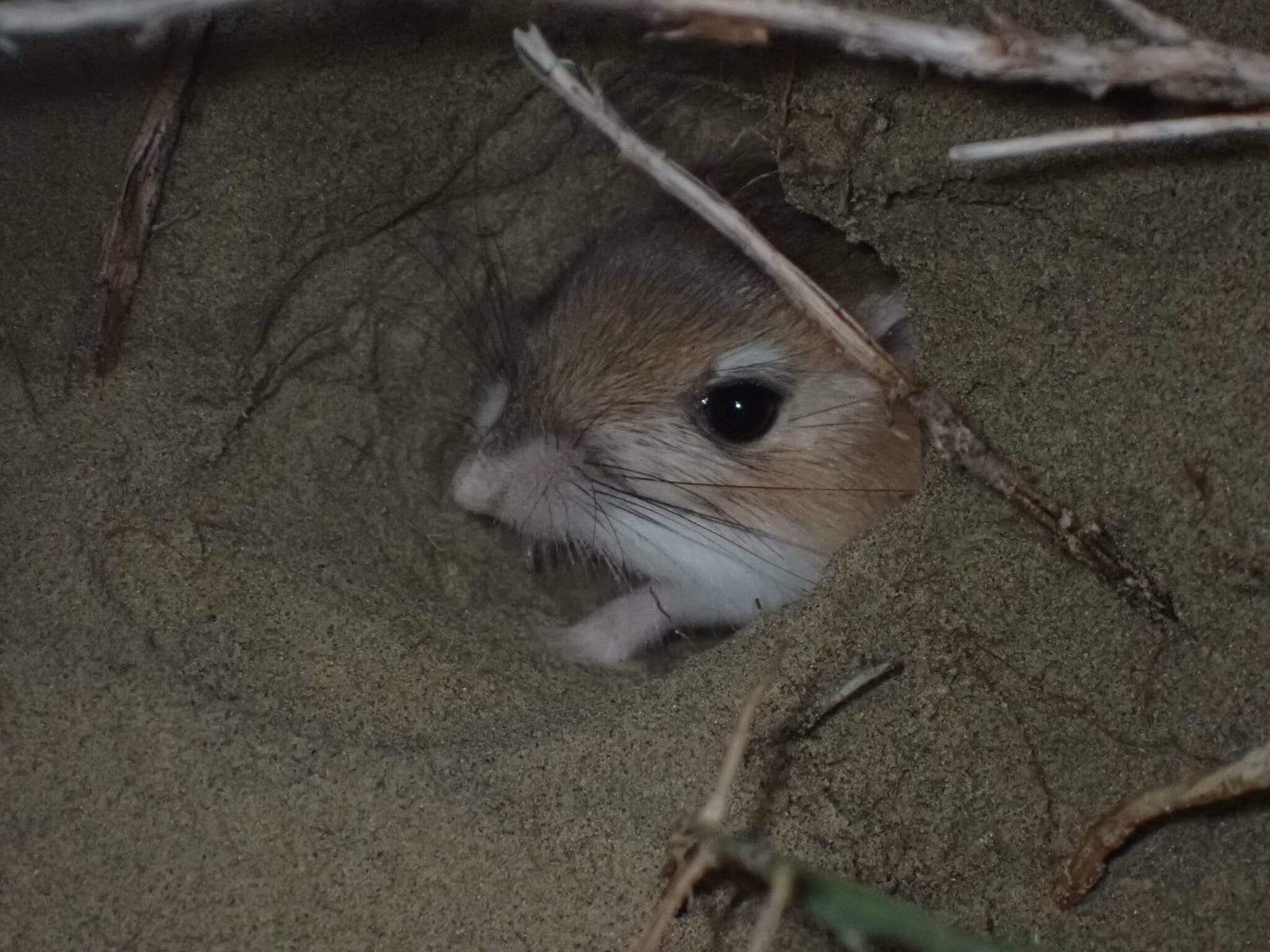
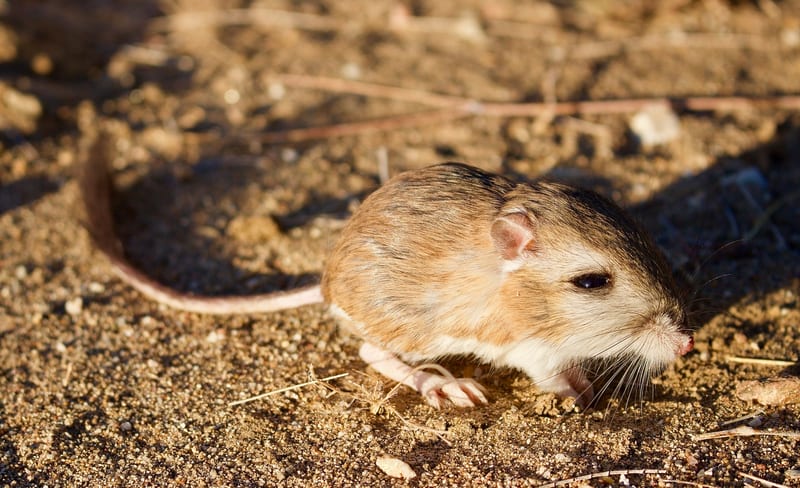
Ord's kangaroo rat peering out from its burrow entrance in sand
Ord’s kangaroo rat pausing at the mouth of its burrow, dug into loose desert sand. Photo: Ellyne Geurts, CC0.

A body that makes its own water

Ord’s kangaroo rat belongs to a family of desert rodents that solved water scarcity from the inside out. They didn’t need to change their behavior: digesting dry seeds releases water as a byproduct, and that alone covers most of what the animal needs.

What little moisture it does lose gets recaptured before it escapes. Its nasal passages cool exhaled air enough to condense the water back out, and its kidneys concentrate urine to some of the highest levels recorded in any mammal. The result is an animal that can live its whole life on a sand dune where standing water never shows up.

Foraging, caching, and staying alive after dark

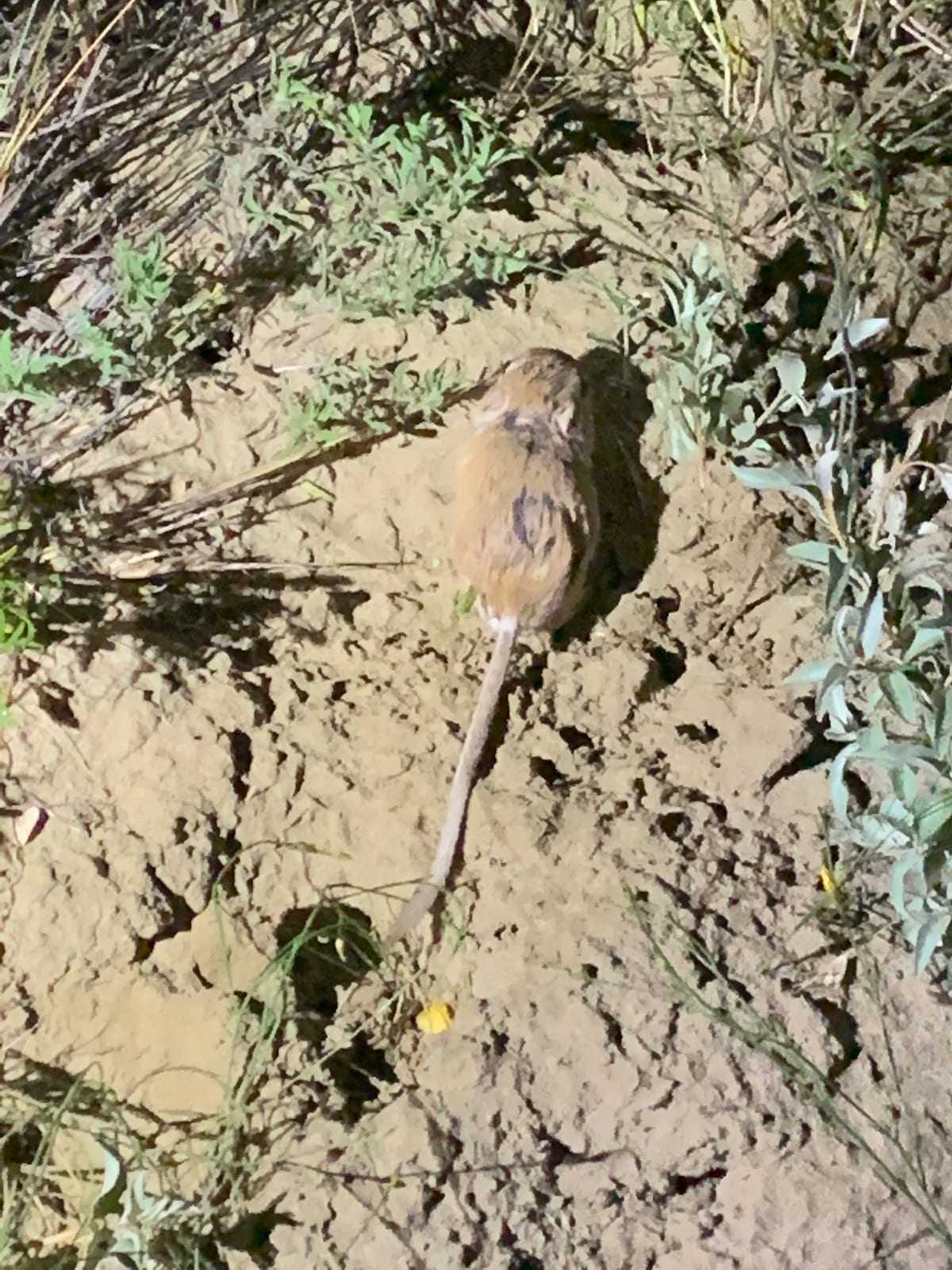
Ord’s kangaroo rat only comes out to feed after dark. Seeds make up most of its diet, especially those of ricegrasses and other dryland grasses. The rest is other plant material, occasional fruit, and a smaller share of insects.

It’s one of the most dedicated scatter-hoarders in its family. A single animal builds dozens to hundreds of small caches across its foraging range, each holding anywhere from a handful to a few hundred seeds. Not every cache gets found again, and the seeds left behind get a head start toward sprouting in freshly disturbed, shaded soil. That makes this small rodent a real engine of plant regrowth across the grasslands and shrub-steppe it calls home.
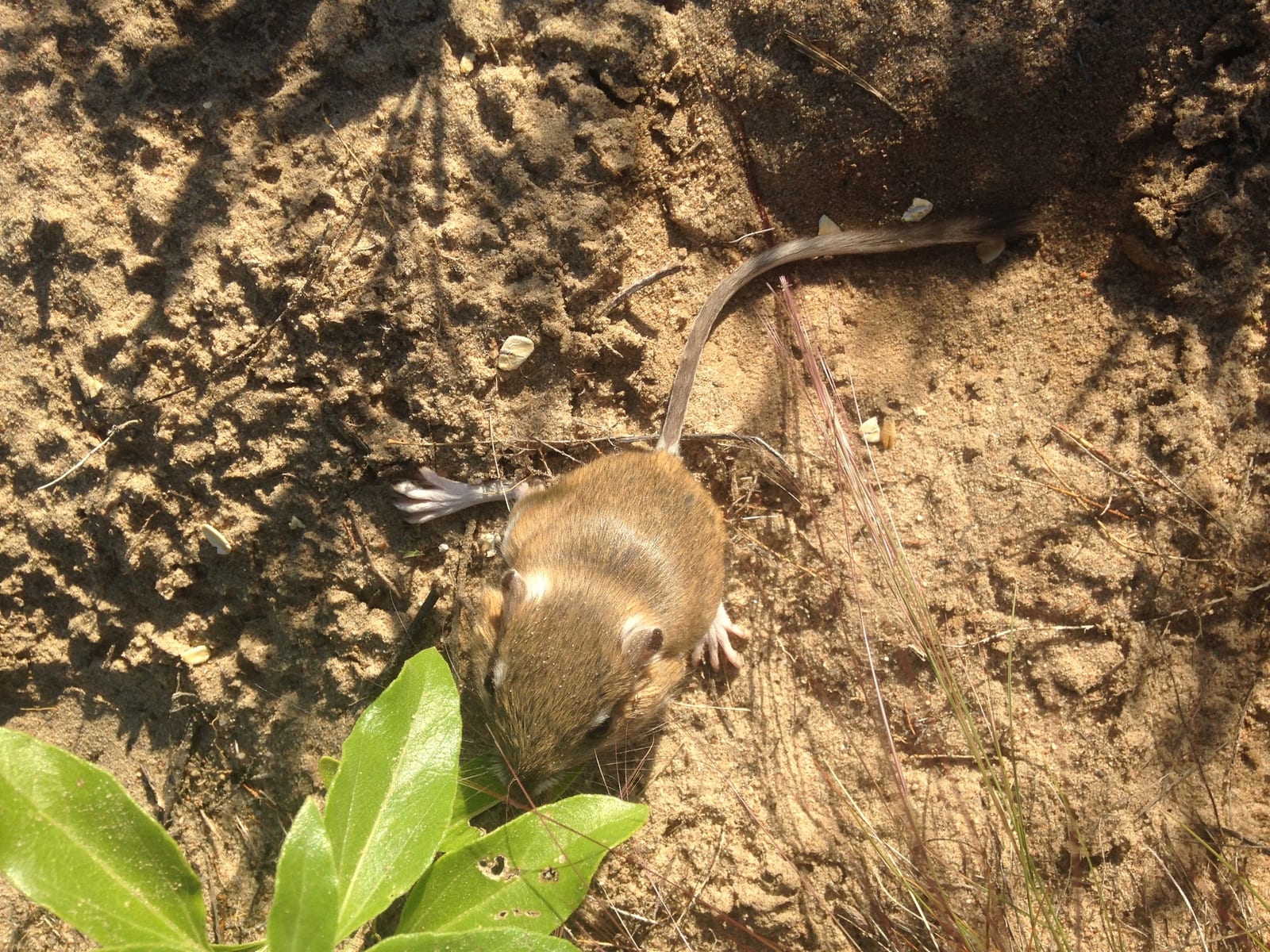
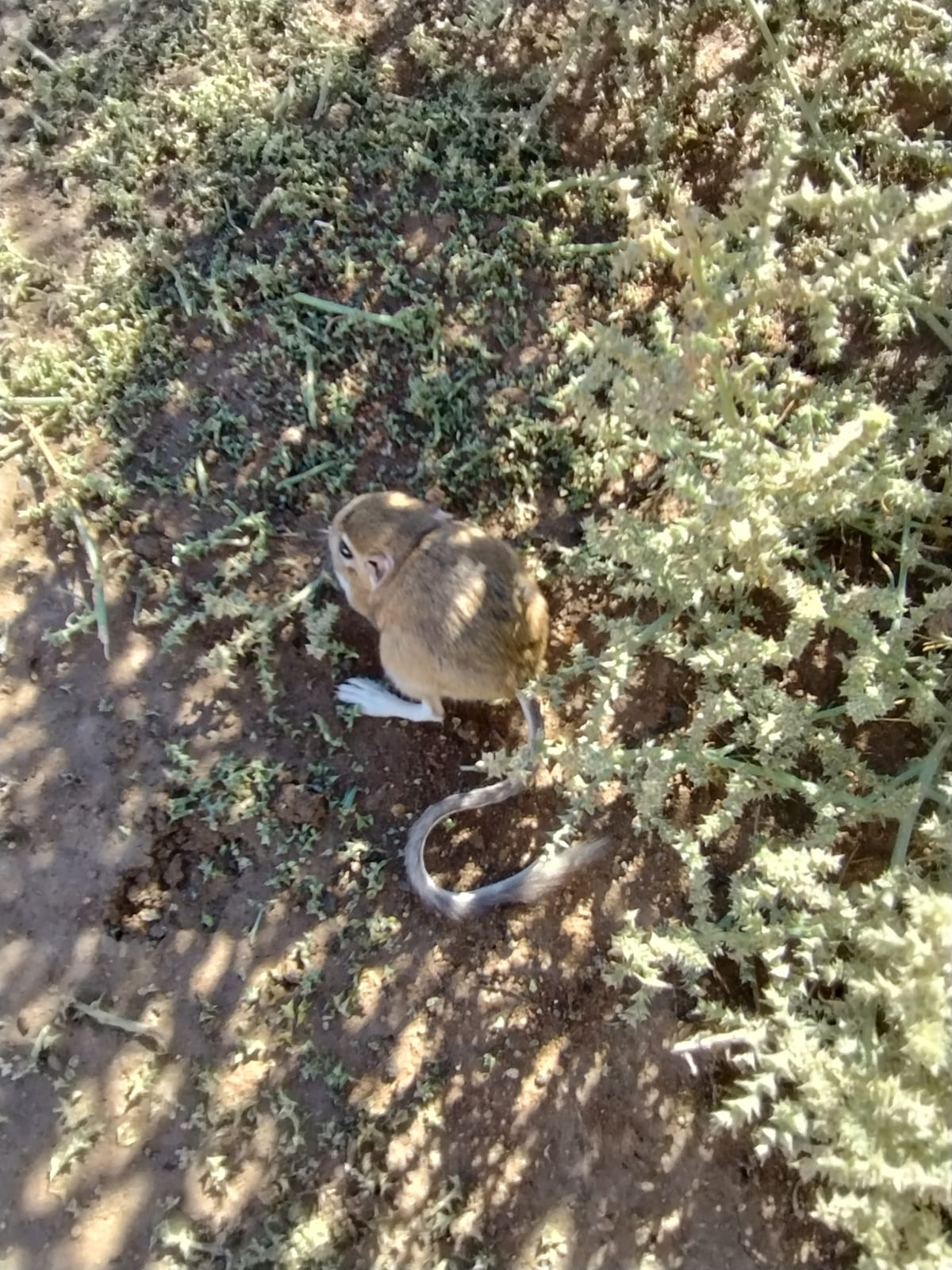
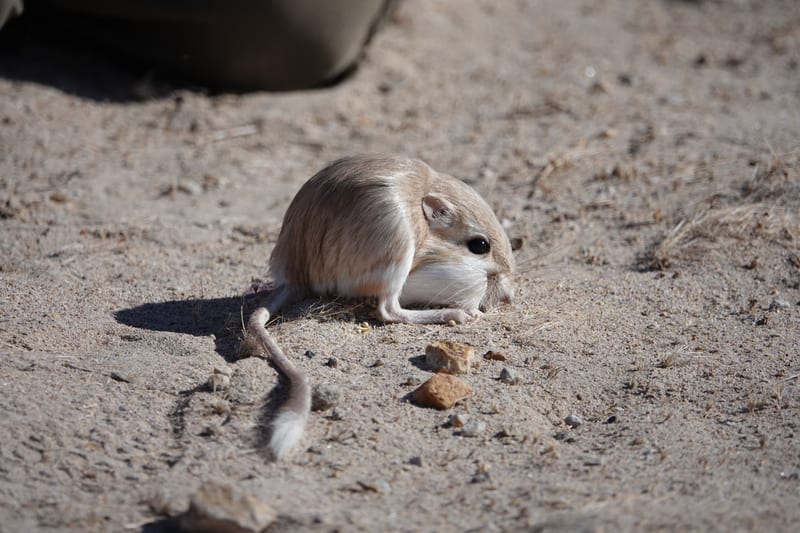
Ord's kangaroo rat foraging on open sand beside green forb growth
Ord’s kangaroo rat foraging across open sand near a patch of green forb growth. Photo: Cole Wolf, CC BY 4.0.

Predators close in from every direction once the sun goes down. Coyotes, kit foxes, badgers, bobcats, and sizeable owls all hunt kangaroo rats routinely, while rattlesnakes, gopher snakes, and glossy snakes work the same burrow systems from ground level. Ord’s kangaroo rat answers with an erratic jumping gait and a spray of sand kicked backward off its powerful hind feet. Then comes a dead sprint for the nearest burrow. On the brightest full-moon nights, activity above ground drops off sharply as the animals wait out the extra exposure underground.

Breeding on the desert’s schedule

Gestation runs about a month, and litters typically hold two to four young, born blind, hairless, and completely dependent in a nest chamber below ground. Pups are weaned within about a month and disperse to nearby burrows soon after, and females can breed within their first year of life.

Most populations produce one or two litters a year, timed to rainfall and the seed crop that follows rather than a fixed calendar. A wet winter across the Great Basin, or a strong monsoon farther south, can trigger an extra breeding pulse. Wild lifespans run short, typically well under a decade, though tagged animals have lived close to ten years.

Common almost everywhere, but not on the northern edge

Across the bulk of its US and Mexican range, Ord’s kangaroo rat remains common and carries a global rating of least conservation concern. Its numbers swing hard from year to year, tracking rainfall and the seed crop that follows. Its high reproductive output lets it bounce back quickly after a dry stretch.

The one real trouble spot sits at the extreme northern edge of its range, where a small, isolated population on the Canadian prairies has been assessed as endangered there. It’s cut off from the rest of the species by more than a thousand kilometers, and squeezed by the conversion of native prairie to cropland. That edge-of-range population aside, this small, unassuming rodent keeps doing outsized ecological work anchoring the seed bank of North America’s drylands.


Data & sources

The data and visualizations on this page draw on these open sources:


