
Common Raccoon

Procyon lotor

Also known as: raccoon, Northern Raccoon

LCLeast Concern

Common raccoons are adaptable night explorers, not merely masked scavengers. Sensitive front paws let them examine food and shelter in darkness, while strong climbing and swimming skills open habitats from marshes to city roofs. The records below show the national reach of that flexibility, tracing observations through every season and across elevations wherever water, cover, and useful den sites come together.

Range through the year

Where Common Raccoon is seen

Common Raccoon is recorded in 48 US states from 100,907 occurrence records, most heavily in Texas (20,609 records) and California (13,522).

Current range100,907 records · 48 states
Alabama · 1,087 records · view state pageArizona · 748 records · view state pageArkansas · 1,313 records · view state pageCalifornia · 13,522 records · view state pageColorado · 1,457 records · view state pageConnecticut · 834 records · view state pageDelaware · 273 records · view state pageDistrict of Columbia · view state pageFlorida · 8,375 records · view state pageGeorgia · 1,206 records · view state pageIdaho · 186 records · view state pageIllinois · 3,107 records · view state pageIndiana · 1,000 records · view state pageIowa · 560 records · view state pageKansas · 528 records · view state pageKentucky · 625 records · view state pageLouisiana · 1,395 records · view state pageMaine · 396 records · view state pageMaryland · 3,010 records · view state pageMassachusetts · 2,768 records · view state pageMichigan · 2,017 records · view state pageMinnesota · 1,584 records · view state pageMississippi · 553 records · view state pageMissouri · 1,381 records · view state pageMontana · 176 records · view state pageNebraska · 434 records · view state pageNevada · 149 records · view state pageNew Hampshire · 478 records · view state pageNew Jersey · 1,290 records · view state pageNew Mexico · 667 records · view state pageNew York · 4,063 records · view state pageNorth Carolina · 3,359 records · view state pageNorth Dakota · 45 records · view state pageOhio · 3,755 records · view state pageOklahoma · 582 records · view state pageOregon · 1,971 records · view state pagePennsylvania · 2,454 records · view state pageRhode Island · 187 records · view state pageSouth Carolina · 981 records · view state pageSouth Dakota · 69 records · view state pageTennessee · 1,337 records · view state pageTexas · 20,609 records · view state pageUtah · 415 records · view state pageVermont · 1,985 records · view state pageVirginia · 3,261 records · view state pageWashington · 2,927 records · view state pageWest Virginia · 394 records · view state pageWisconsin · 1,310 records · view state pageWyoming · 84 records · view state pageAlaskaAKHawaiiHIPuerto RicoPR
Occurrence data by state and month
Common Raccoon – occurrence records by US state and month (100,907 total across 48 states)
StateJanFebMarAprMayJunJulAugSepOctNovDecYear
Texas1,8342,0132,1572,2191,5651,2931,2171,2861,6701,9471,7921,61620,609
California1,3171,2371,0141,1329661,0008908941,2661,4141,3151,07713,522
Florida8647849859657855844044085476326697488,375
New York1902503354936234883303413253231981674,063
Ohio1352243455016555114002432782211341083,755
North Carolina3063343363813103011971922212523022273,359
Virginia2363293824313153492171551962121992403,261
Illinois123138253640527398195163226205147923,107
Maryland1982563373653572862151661882411892123,010
Washington2072071833132873873191991942631921762,927
Massachusetts2171862743803702611801492201991511812,768
Pennsylvania111153215352372429197122145162102942,454
Michigan6410813927336134123114713512252442,017
Vermont83110225264258192150172155172121831,985
Oregon1381571831301902411591361601961431381,971
Minnesota7410815718222223113811313610467521,584
Colorado50348223319820311913015412084501,457
Louisiana9311118523213210592678411194891,395
Missouri608881156173182126124107139102431,381
Tennessee114124140120151146119947672701111,337
Arkansas747612610615613111311912313491641,313
Wisconsin51491031432072181301001279050421,310
New Jersey77821161471591109765106142105841,290
Georgia741011941541359967625610489711,206
Alabama92112119106897359769683115671,087
Indiana3844841742221406160824334181,000
South Carolina8173968310295537871879270981
Connecticut5268878510596725469694928834
Arizona6858495854354964701008558748
New Mexico343351636539573999875446667
Kentucky302356829194755837342619625
Oklahoma2326601016951493532594532582
Iowa262651639479363954422525560
Mississippi383934414840424843626256553
Kansas173158738068533438372217528
New Hampshire333449496251583851221615478
Nebraska172140707259312426262820434
Utah242231583730533149422414415
Maine111725405073475031201418396
West Virginia152636554348313136352612394
Delaware72224235343231419181116273
Rhode Island9563127392016129112187
Idaho12121117152021161819205186
Montana159108171818232815312176
Nevada201312681891214111511149
Wyoming11114781581485284
South Dakota·341012996915169
North Dakota·2156794234245

Based on 144,521 georeferenced US records, 2000-2026. Shading is observation density (where people record sightings), not true abundance. Alaska, Hawaii & Puerto Rico shown as insets.

Explore by state

Common Raccoon across 49 states

Occurrence records, conservation status, and the places it turns up, state by state. Open a state for detail, or visit its full page.

  • TexasNativeCommon31,003 records

    State rankSecure

    Notable placesBrazos Bend State Park · Tyler State Park · Ray Roberts Lake State Park · Palo Duro Canyon State Park

    Countiesrecorded in 12

    Year-round in Texas, with recorded sightings peaking in September–May.

  • CaliforniaNativeCommon21,328 records

    State rankUnranked

    Notable placesGolden Gate National Recreation Area · Point Reyes National Seashore · Pinnacles National Park · Santa Monica Mountains National Recreation Area

    Countiesrecorded in 12

    Year-round in California, with no strong seasonal peak in observations.

  • FloridaNativeCommon11,688 records

    State rankSecure

    Notable placesBill Baggs Cape Florida State Park · Everglades National Park · University of Central Florida Student Union Cypress Dome · Ordway-Swisher Biological Station

    Countiesrecorded in 12

    Year-round in Florida, with recorded sightings peaking in October–May.

  • New YorkNativeCommon6,431 records

    State rankSecure

    Notable placesLong Island · Gateway National Recreation Area · Harriman State Park · Reinstein Woods Nature Preserve And Environmental Education Center

    Countiesrecorded in 12

    Year-round in New York, with recorded sightings peaking in April–July.

  • OhioNativeCommon5,060 records

    State rankUnranked

    Notable placesCuyahoga Valley National Park · Maumee Bay State Park · Wayne National Forest · Quail Hollow State Park

    Countiesrecorded in 12

    Year-round in Ohio, with recorded sightings peaking in April–July.

  • North CarolinaNativeCommon4,278 records

    State rankSecure

    Notable placesLower Haw River State Natural Area · Pisgah National Forest · Nantahala National Forest · University of North Carolina - Chapel Hill Conservation Lands

    Countiesrecorded in 12

    Year-round in North Carolina, with recorded sightings peaking in January–June, with a smaller rise in November.

  • VirginiaNativeCommon4,151 records

    State rankSecure

    Notable placesAssateague Island National Seashore · Hog Island Wildlife Management Area · First Landing State Park · Jefferson National Forest

    Countiesrecorded in 12

    Year-round in Virginia, with recorded sightings peaking in February–June.

  • IllinoisNativeCommon4,069 records

    State rankSecure

    Notable placesShawnee National Forest · Mermet Lake State Fish and Wildlife Area · Adeline Jay Geo-Karis Illinois Beach State Park · Larue-Pine Hills National Natural Landmark

    Countiesrecorded in 12

    Year-round in Illinois, with recorded sightings peaking in April–June.

  • WashingtonNativeCommon3,855 records

    State rankSecure

    Notable placesSan Juan Islands National Monument · Hope Island · San Juan Island National Historical Park · Daniel J. Evans Wilderness Area

    Countiesrecorded in 12

    Year-round in Washington, with recorded sightings peaking in April–July, with a smaller rise in October.

  • PennsylvaniaNativeCommon3,664 records

    State rankSecure

    Notable placesRaccoon Creek State Park · Presque Isle State Park · French Creek State Park · Moraine State Park

    Countiesrecorded in 12

    Year-round in Pennsylvania, with recorded sightings peaking in April–June.

  • MassachusettsNativeCommon3,507 records

    State rankSecure

    Notable placesFranklin Park Zoo · Boston Harbor Islands National Recreation Area · Cape Cod National Seashore · Beaver Brook North Reservation

    Countiesrecorded in 13

    Year-round in Massachusetts, with recorded sightings peaking in March–June.

  • MarylandNativeCommon3,031 records

    State rankSecure

    Notable placesHarriet Tubman Underground Railroad National Historical Park · Chesapeake and Ohio Canal National Historical Park · Assateague Island National Seashore · Mckee Beshers Wildlife Management Area

    Countiesrecorded in 12

    Year-round in Maryland, with recorded sightings peaking in February–June, with a smaller rise in October.

  • MichiganNativeCommon2,855 records

    State rankSecure

    Notable placesUniversity of Michigan Biological Station · Kellogg Biological Station and Experimental forest · Sleeping Bear Dunes National Lakeshore · Asylum Lake

    Countiesrecorded in 12

    Year-round in Michigan, with recorded sightings peaking in April–July.

  • OregonNativeCommon2,601 records

    State rankSecure

    Notable placesMt. Hood National Forest · Deschutes National Forest · Oregon Islands National Wildlife Refuge Wilderness Area · Sauvie Island Wildlife Area

    Countiesrecorded in 12

    Year-round in Oregon, with no strong seasonal peak in observations.

  • TennesseeNativeCommon2,599 records

    State rankSecure

    Notable placesReelfoot National Wildlife Refuge · Chuck Swan State Forest · Meeman-Shelby Forest Wildlife Management Area · Great Smoky Mountains National Park

    Countiesrecorded in 12

    Year-round in Tennessee, with recorded sightings peaking in September–October.

  • VermontNativeCommon2,342 records

    State rankSecure

    Notable placesWest Fairle Wildlife Management Area · Green Mountain National Forest · Green Mountains · Jericho Research Forest

    Countiesrecorded in 12

    Year-round in Vermont, with recorded sightings peaking in March–June.

  • MissouriNativeCommon2,263 records

    State rankSecure

    Notable placesMark Twain National Forest · Castlewood Sp · Powder Valley Conservation Nature Center · Columbia Bottom Ca

    Countiesrecorded in 12

    Year-round in Missouri, with recorded sightings peaking in April–July, with a smaller rise in October and January–February.

  • LouisianaNativeCommon2,161 records

    State rankSecure

    Notable placesPearl River Wildlife Management Area · Jean Lafitte National Historical Park and Preserve · Sherburne Wildlife Management Area/atchafalaya National Wildlife Refuge/bayou Des Ourses Area (usacoe) · West Pearl River

    Countiesrecorded in 12

    Year-round in Louisiana, with recorded sightings peaking in March–April, with a smaller rise in November.

  • MinnesotaNativeCommon2,059 records

    State rankUnranked

    Notable placesMississippi National River and Recreation Area · Carlos Avery State Wildlife Management Area · R J D Memorial Hardwood State Forest · Savage Fen State Scientific and Natural Area

    Countiesrecorded in 12

    Year-round in Minnesota, with recorded sightings peaking in March–July.

  • ColoradoNativeCommon1,925 records

    State rankSecure

    Notable placesPike National Forest · Barr Lake · Chatfield State Park · San Juan National Forest

    Countiesrecorded in 12

    Year-round in Colorado, with recorded sightings peaking in April–October.

  • WisconsinNativeCommon1,815 records

    State rankSecure

    Notable placesDevils Lake State Park-Iansr · Brillion Wildlife Area · High Cliff State Park · Crex Meadows Wildlife Area

    Countiesrecorded in 12

    Year-round in Wisconsin, with recorded sightings peaking in April–July.

  • GeorgiaNativeCommon1,787 records

    State rankSecure

    Notable placesJekyll Island · Chattahoochee River National Recreation Area · Skidaway Island State Park · Jekyll Island State Park

    Countiesrecorded in 12

    Year-round in Georgia, with recorded sightings peaking in March–June.

  • New JerseyNativeCommon1,782 records

    State rankSecure

    Notable placesGateway National Recreation Area · Kittatinny Valley State Park · Sparta Mountain Wildlife Management Area · Stokes State Forest

    Countiesrecorded in 12

    Year-round in New Jersey, with recorded sightings peaking in March–July, with a smaller rise in October.

  • IndianaNativeCommon1,510 records

    State rankSecure

    Notable placesIndiana Dunes National Park · Hoosier National Forest · Shades State Park · Potato Creek State Park

    Countiesrecorded in 12

    Year-round in Indiana, with recorded sightings peaking in April–June.

  • ArkansasNativeCommon1,463 records

    State rankSecure

    Notable placesBuffalo National River · Pinnacle Mountain State Park · Village Creek State Park · Ouachita National Forest

    Countiesrecorded in 12

    Year-round in Arkansas, with recorded sightings peaking in March–October.

  • AlabamaNativeCommon1,392 records

    State rankSecure

    Notable placesDauphin Island · Turkey Creek Nature Preserve · Little River Canyon National Preserve · Shell Mound Park

    Countiesrecorded in 12

    Year-round in Alabama, with recorded sightings peaking in January–June, with a smaller rise in August–November.

  • South CarolinaNativeCommon1,332 records

    State rankSecure

    Notable placesCongaree National Park · Huntington Beach State Park · Hunting Island State Park · Myrtle Beach State Park

    Countiesrecorded in 12

    Year-round in South Carolina, with no strong seasonal peak in observations.

  • ConnecticutNativeCommon1,146 records

    State rankSecure

    Notable placesState Park · Mansfield Hollow Wildlife Management Area · Norwalk River Flood Control Site 7B · Barn Island Wildlife Management Area

    Countiesrecorded in 8

    Year-round in Connecticut, with recorded sightings peaking in March–July, with a smaller rise in September–October.

  • ArizonaNativeCommon1,094 records

    State rankApparently Secure

    Notable placesCoconino National Forest · State Trust Land · Patagonia Lake State Park · Prescott National Forest

    Countiesrecorded in 12

    Year-round in Arizona, with recorded sightings peaking in August–November, with a smaller rise in January.

  • New MexicoNativeCommon1,022 records

    State rankApparently Secure

    Notable placesRio Grande Valley State Park · Rio Grande corridor · Cibola National Forest · Bottomless Lakes State Park

    Countiesrecorded in 12

    Year-round in New Mexico, with recorded sightings peaking in July–October, with a smaller rise in December and April–May.

  • KentuckyNativeCommon960 records

    State rankSecure

    Notable placesLand Between the Lakes Other · Land Between the Lakes National Recreation Area · Daniel Boone National Forest · John James Audubon State Park

    Countiesrecorded in 12

    Year-round in Kentucky, with recorded sightings peaking in March–August.

  • OklahomaNativeCommon893 records

    State rankUnranked

    Notable placesCLO Lands · Ouachita National Forest · Red Slough Wildlife Management Area & Waterfowl Refuge Portion · Quartz Mountain State Resort Park

    Countiesrecorded in 12

    Year-round in Oklahoma, with recorded sightings peaking in March–May.

  • IowaNativeCommon885 records

    State rankSecure

    Notable placesDecorah and the Driftless Area · MacBride Recreation Area · Sweet Marsh Wildlife Management Area · Lake Keomah State Park

    Countiesrecorded in 12

    Year-round in Iowa, with recorded sightings peaking in April–June, with a smaller rise in September.

  • KansasNativeCommon861 records

    State rankSecure

    Notable placesSlate Creek Wetlands · Cheyenne Bottoms Wildlife Area · Kansas Ecological Reserves · Clinton Wildlife Area

    Countiesrecorded in 12

    Year-round in Kansas, with recorded sightings peaking in March–July, with a smaller rise in October and December.

  • MississippiNativeCommon670 records

    State rankSecure

    Notable placesGulf Islands National Seashore · Holly Springs National Forest · Lefleur's Bluff State Park · Graveline Bay Coastal Reserve

    Countiesrecorded in 12

    Year-round in Mississippi, with no strong seasonal peak in observations.

  • NebraskaNativeCommon662 records

    State rankSecure

    Notable placesOak Glen Wildlife Management Area · the Platte River · Niobrara National Scenic River · Oliver Reservoir State Recreation Area

    Countiesrecorded in 12

    Year-round in Nebraska, with recorded sightings peaking in April–June.

  • UtahNativeCommon652 records

    State rankSecure

    Notable placesZion National Park · Bears Ears National Monument · Capitol Reef National Park · Arches National Park

    Countiesrecorded in 12

    Year-round in Utah, with recorded sightings peaking in April–July, with a smaller rise in September–October.

  • New HampshireNativeCommon591 records

    State rankSecure

    Notable placesUNew Hampshire Property · White Mountain National Forest · UNew Hampshire - Horticulture Farm · Saint-Gaudens National Historical Park

    Countiesrecorded in 10

    Year-round in New Hampshire, with recorded sightings peaking in March–July, with a smaller rise in September.

  • MaineNativeCommon588 records

    State rankSecure

    Notable placesAcadia National Park · Katahdin Woods and Waters National Monument · Baxter State Park · Moosehead Lake

    Countiesrecorded in 12

    Year-round in Maine, with recorded sightings peaking in May–August.

  • West VirginiaNativeCommon583 records

    State rankSecure

    Notable placesJackson's Mill · Kanawha State Forest · Monongahela National Forest · Tea Creek Wildlife Management Area

    Countiesrecorded in 12

    Year-round in West Virginia, with recorded sightings peaking in March–July, with a smaller rise in September–October.

  • DelawareNativeCommon427 records

    State rankSecure

    Notable placesFirst State National Historical Park · Lums Pond State Park · Woodland Beach Wildlife Area · Saint Jones Reserve

    Countiesrecorded in 3

    Year-round in Delaware, with recorded sightings peaking in April–June.

  • District of ColumbiaNativeCommon267 records

    State rankSecure

    Notable placesNational Capital Parks · Rock Creek Park · the Anacostia River · the Potomac River

    Countiesrecorded in 1

    Year-round in District of Columbia, with recorded sightings peaking in March–May.

  • Rhode IslandNativeCommon259 records

    State rankSecure

    Notable placesBay Islands · Prudence Island · Colt State Park · Lincoln Woods State Park

    Countiesrecorded in 5

    Year-round in Rhode Island, with recorded sightings peaking in April–June.

  • IdahoNativeCommon243 records

    State rankSecure

    Notable placesKaniksu National Forest · Boise Headquarters Office · American Falls Hatchery · Edson Fichter Nature Area

    Countiesrecorded in 12

    Year-round in Idaho, with recorded sightings peaking in April–November.

  • NevadaNativeCommon217 records

    State rankSecure

    Notable placesToiyabe National Forest · Lake Mead National Recreation Area · Big Bend of the Colorado State Park · Mason Valley Wildlife Management Area

    Countiesrecorded in 13

    Year-round in Nevada, with recorded sightings peaking in November–April, with a smaller rise in June and August–September.

  • MontanaNativeCommon201 records

    State rankSecure

    Notable placesLolo National Forest · Montana State Trust Lands · St. John's Fishing Access Site · Bighorn Canyon National Recreation Area

    Countiesrecorded in 12

    Year-round in Montana, with recorded sightings peaking in May–October.

  • WyomingNativeOccasional165 records

    State rankSecure

    Notable placesGrand Teton National Park · Yellowstone National Park · Keyhole Reservoir State Park · Medicine Lodge Wildlife Habitat Management Area

    Countiesrecorded in 12

    Year-round in Wyoming, with recorded sightings peaking in May–July, with a smaller rise in September–October and March.

  • South DakotaNativeCommon111 records

    State rankSecure

    Notable placesPalisades · Nine Mile Creek · Newton Hills · Coteau Lakes Game Production Area

    Countiesrecorded in 12

    Year-round in South Dakota, with recorded sightings peaking in April–June.

  • North DakotaNativeCommon73 records

    State rankSecure

    Notable placesNd State Lands - Surface Ownership · Oahe Wildlife Management Area · Fort Abraham Lincoln State Park · Lewis And Clark State Park

    Countiesrecorded in 12

    Year-round in North Dakota, with recorded sightings peaking in April–July.

IUCN Red List status

  1. LC
  2. NT
  3. VU
  4. EN
  5. CR
  6. EW
  7. EX

LC – Least Concern

Widespread and abundant; not at risk.

Elevation

From 200 georeferenced records, the Common Raccoon is recorded from sea levelsea level to 1,637 m5,371 ft, with half of sightings below 90 m295 ft.

Each band shows the share of georeferenced sightings that fall within it. Records cluster where people live and hike, so low, populated elevations are over-represented. Read this as observation density, not true abundance.

Observation peakApril112,508 records

Seasonality from research-grade observation dates across the US (112,508 records, all years). Reflects when the species is recorded, not a guarantee of presence.

Daily activity clockCathemeral– active in irregular bursts, day and night

1,391 common raccoon observations logged by hour of day. Activity is cathemeral (active in irregular bursts, day and night), peaking around 8 PM.

12 AM: 47 observations1 AM: 40 observations2 AM: 40 observations3 AM: 28 observations4 AM: 41 observations5 AM: 30 observations6 AM: 45 observations7 AM: 45 observations8 AM: 44 observations9 AM: 56 observations10 AM: 69 observations11 AM: 65 observations12 PM: 60 observations1 PM: 57 observations2 PM: 47 observations3 PM: 53 observations4 PM: 50 observations5 PM: 53 observations6 PM: 85 observations7 PM: 93 observations8 PM: 119 observations9 PM: 107 observations10 PM: 63 observations11 PM: 54 observations12 AM6 AM12 PM6 PM

Based on 1,391 records (all years). Reflects when people record sightings, not only when the animal is active.

Hourly observation counts: 12 AM 47, 1 AM 40, 2 AM 40, 3 AM 28, 4 AM 41, 5 AM 30, 6 AM 45, 7 AM 45, 8 AM 44, 9 AM 56, 10 AM 69, 11 AM 65, 12 PM 60, 1 PM 57, 2 PM 47, 3 PM 53, 4 PM 50, 5 PM 53, 6 PM 85, 7 PM 93, 8 PM 119, 9 PM 107, 10 PM 63, 11 PM 54.

Sounds & calls

Hear the Common Raccoon: 2 field recordings. Press play to listen.

Best encounter

Where and when to see a Common Raccoon

Your best chance: Texas, in April, around dusk.

Where
TexasTX
When
April
Time
Around duskcathemeral
Trophic relationshipsFood web What a Common Raccoon eats, and what eats it.
Eaten by5
Gray WolfCanis lupusGolden EagleAquila chrysaetoslizards & snakesRed FoxVulpes vulpesBobcatLynx rufus
This speciesCommon Raccoon
Common TernSterna hirundoEastern Screech-owlMegascops asioAmerican CootFulica americanaKilldeerCharadrius vociferusMangrove Yellow WarblerSetophaga petechiaMute SwanCygnus olorGreat EgretArdea alba
Eats7

A sample of documented feeding relationships, filtered to species that also occur in the US. Diet and predators vary by region and season, and this is not a complete list, many animals eat, and are eaten by, more than what has been formally recorded here.

Life history

The Common Raccoon (3.5–9 kg7.7–19.8 lb) is an omnivore that first breeds around 1 years, carries a 63-day gestation, and bears about 3.4 young per litter. Maximum recorded longevity is 21 years.

Life cycle

  1. Gestation63 days (≈2.1 months)
  2. Birthlitter of 3.4 young
  3. Sexual maturity1 yr (female)
  4. Typical lifespan21 years
  5. Maximum recorded longevity21 years

Reproduction

Gestation
63days≈2.1 months
Litter size
3.4youngaverage
Litters / year
1litter
Age at first breeding
1years

Diet composition

Omnivore

By foraging composition: 40% invertebrates, 20% seeds & grain, 20% fruit, 20% vertebrates.

  • Invertebrates40%
  • Seeds & grain20%
  • Fruit20%
  • Vertebrates20%

Most active at night.

Typical values for the species, not local measurements. Maximum longevity is the longest lifespan on record; most individuals live far less.

Commonly confused with

Animals people sometimes mistake for the common raccoon, and how to tell them apart.

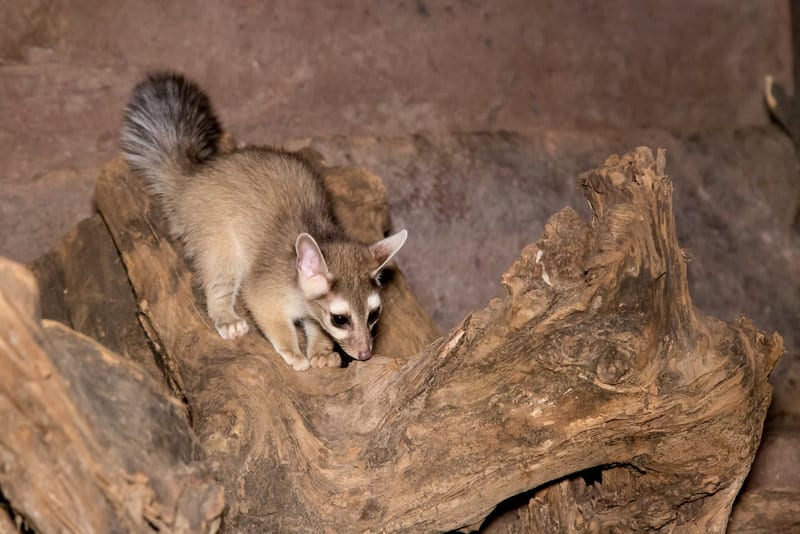
Ringtail

Photo:Theo Kruse Burgers' ZooWikimedia Commons (CC BY-SA 4.0)

Ringtail

Bassariscus astutus

How to tell apart Ringtail is much smaller and slimmer with huge eyes ringed in white and a tail with sharp black-and-white bands roughly equal to body length; raccoon is bulkier with a black face mask and shorter ringed tail.

The mask is only the start

The face pattern isn’t its only useful field mark.

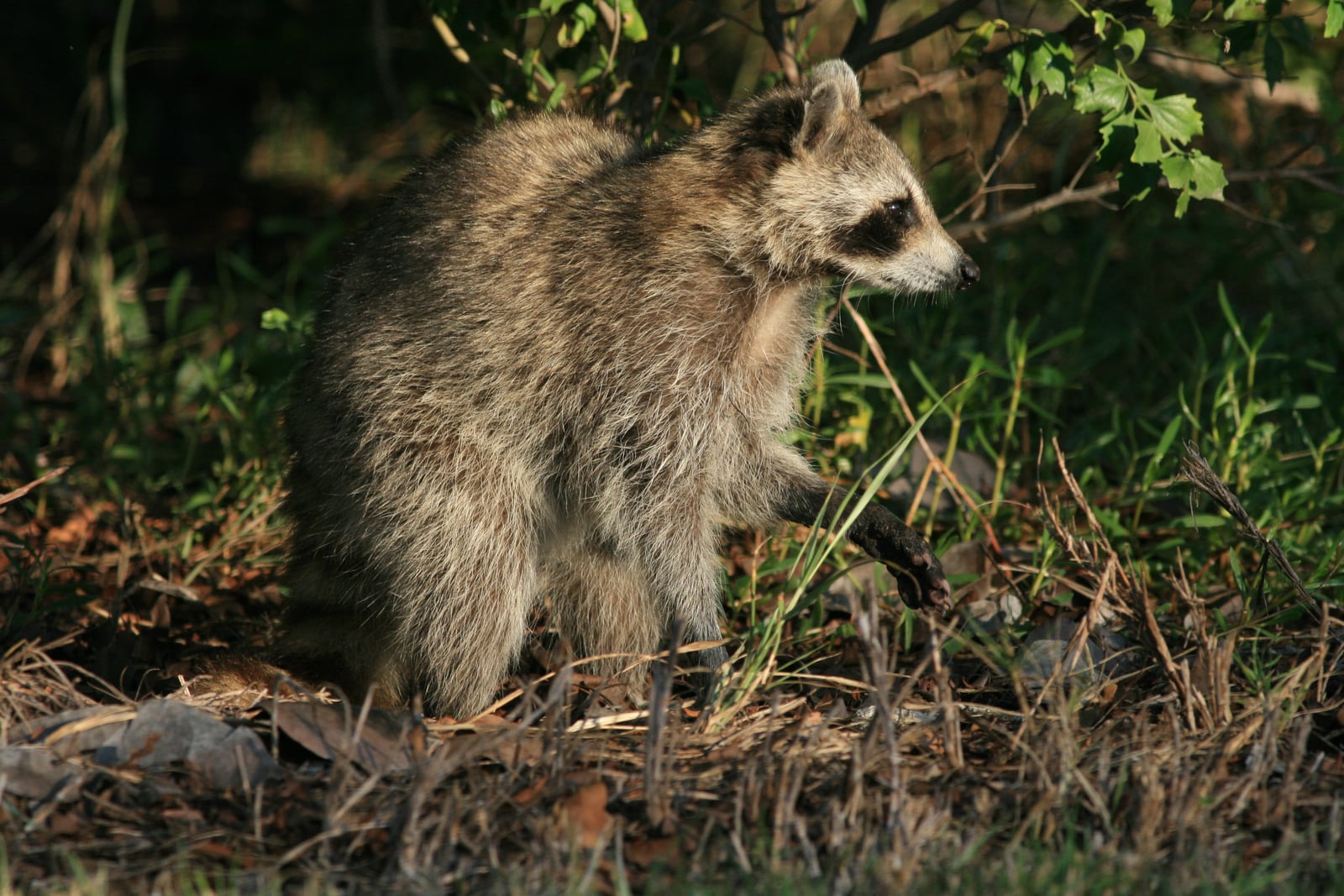
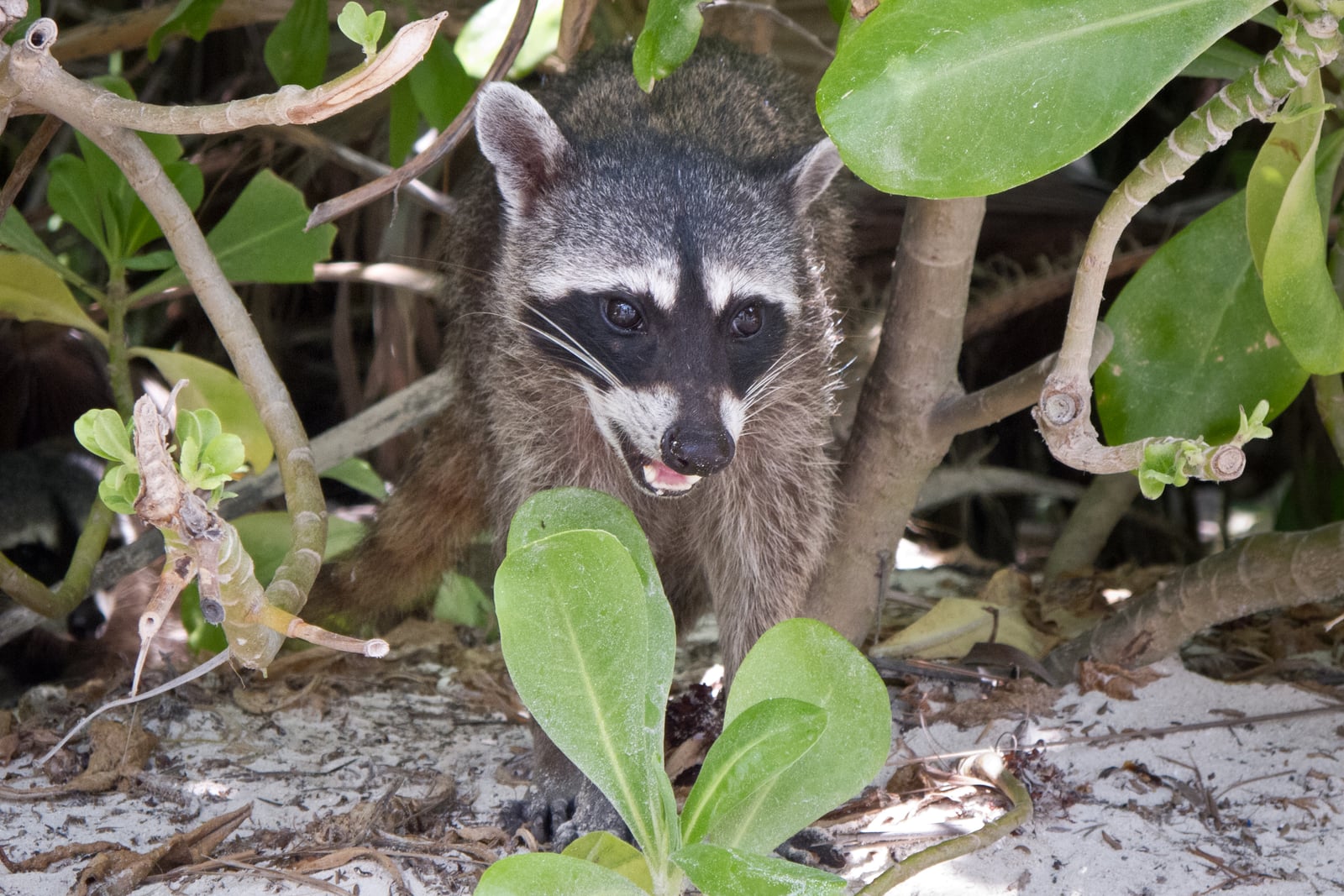
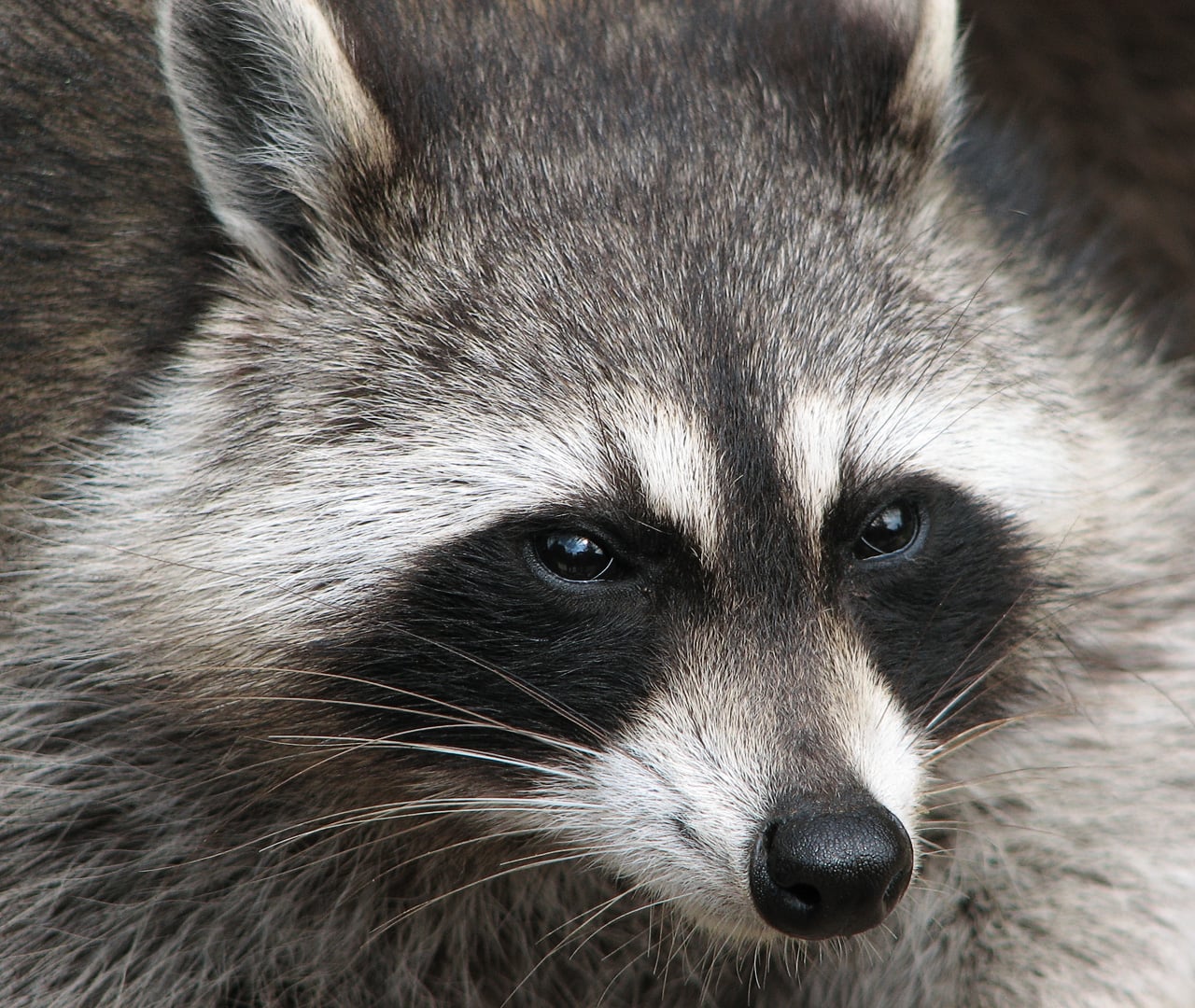
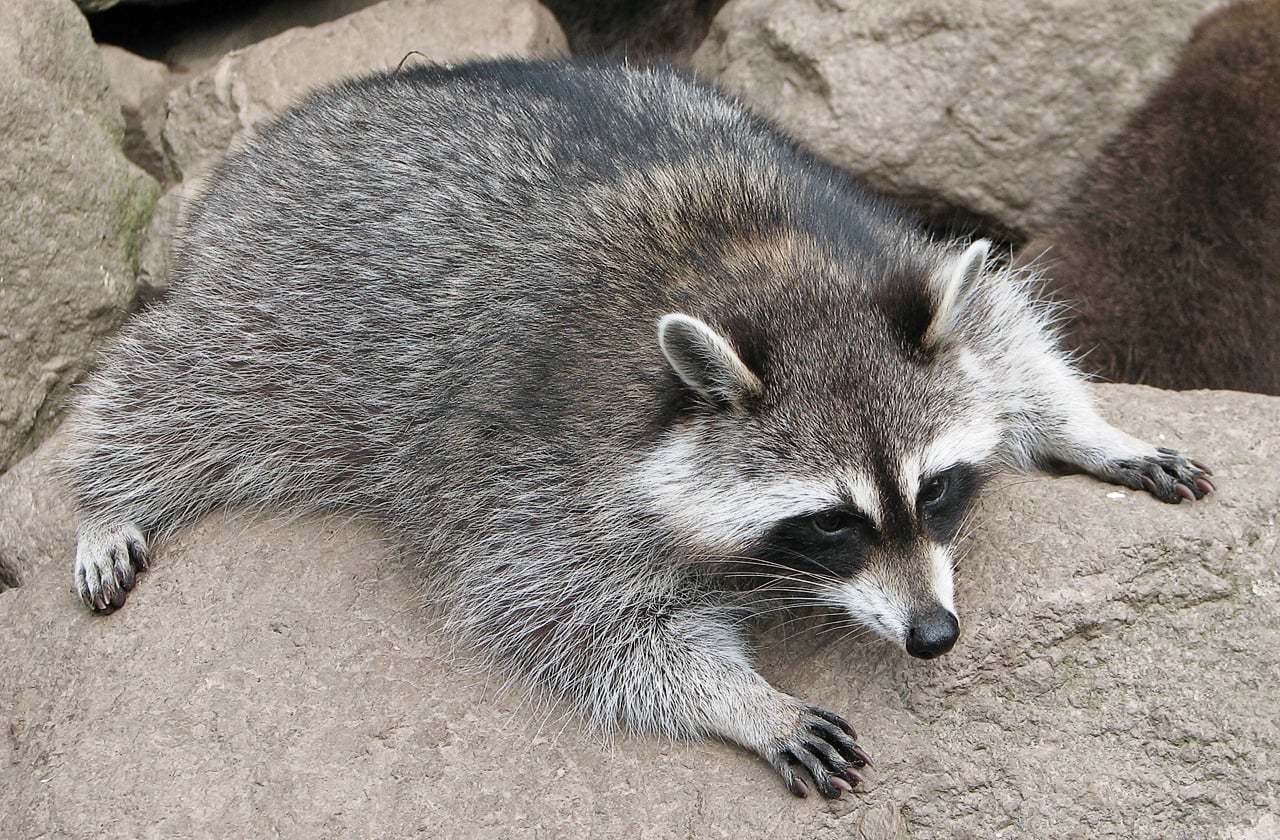
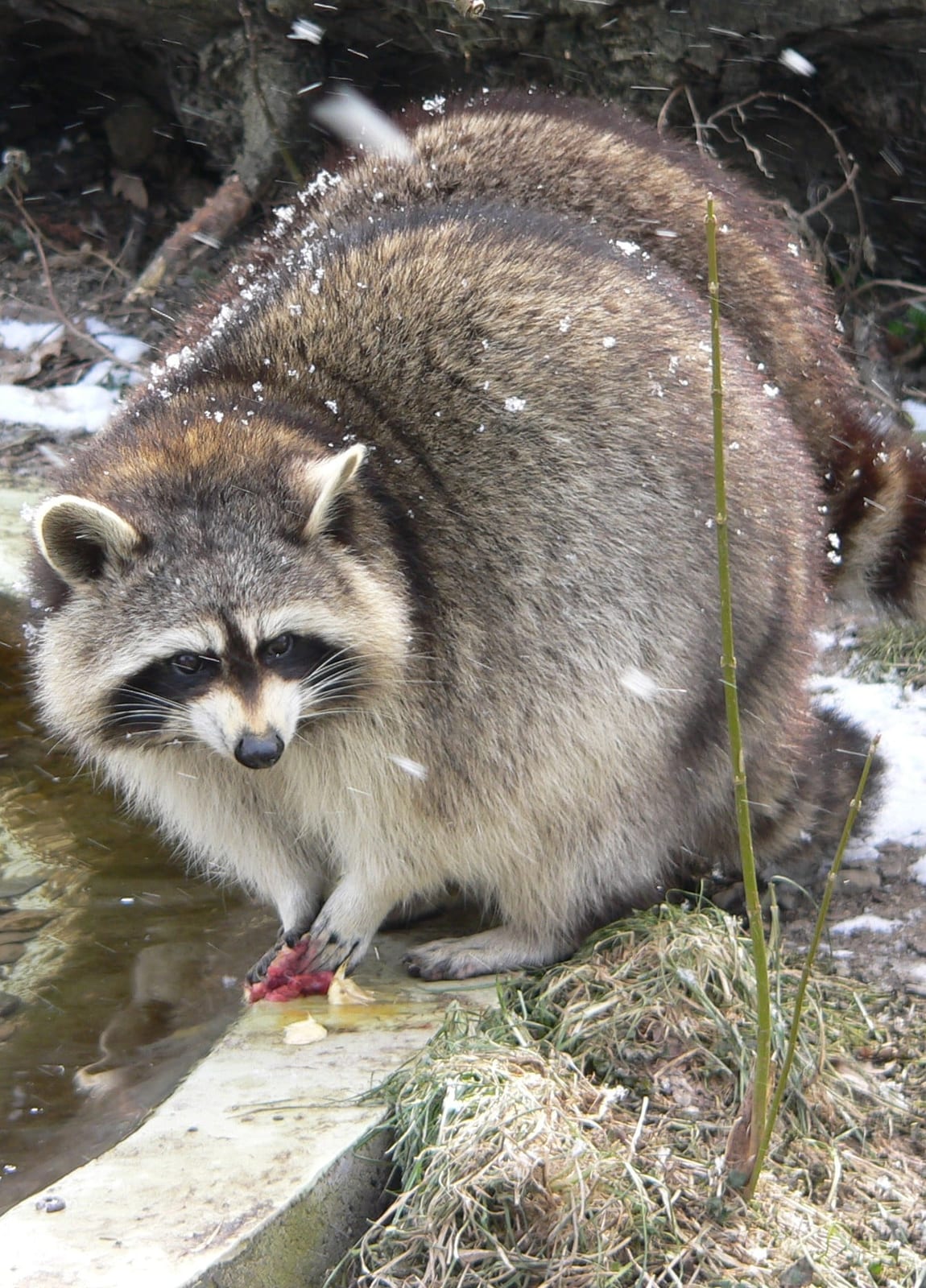
A raccoon is easiest to recognize by the black face mask, pale cheek edges, and thick tail with alternating dark and pale rings. Adults are compact and heavy for their length, with a hunched back, short legs, and a grizzled gray-brown coat that can look silver, brown, or almost black in poor light. The hands matter as much as the face. Each forefoot has five long mobile toes, so tracks show fingerlike prints rather than the blunt pads of a dog or cat.

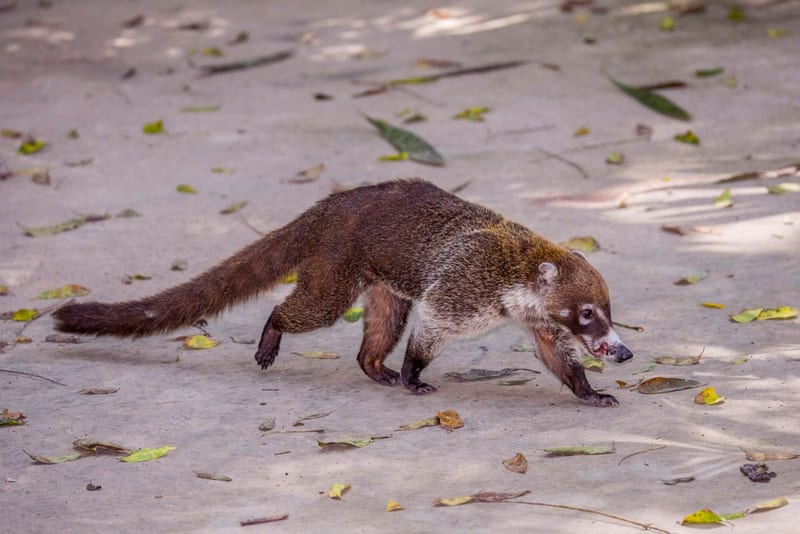
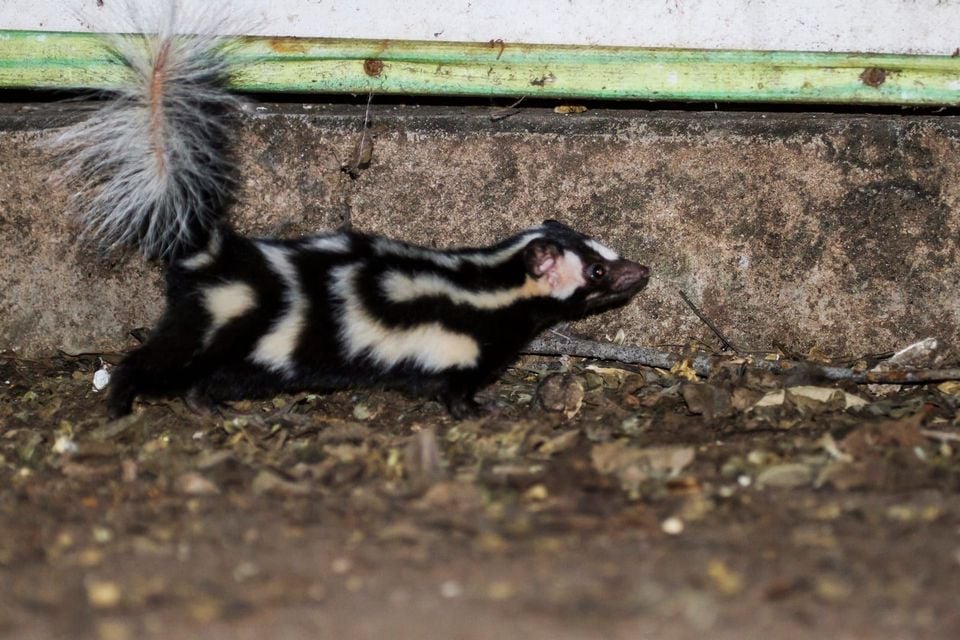
White-nosed coatis are slimmer, longer-snouted, and often carry the tail upright. Ringtails are much smaller and more delicate, with a very long black-and-white tail and oversized eyes. Spotted skunks are black and white, low, and narrow-bodied rather than gray and broad-faced.
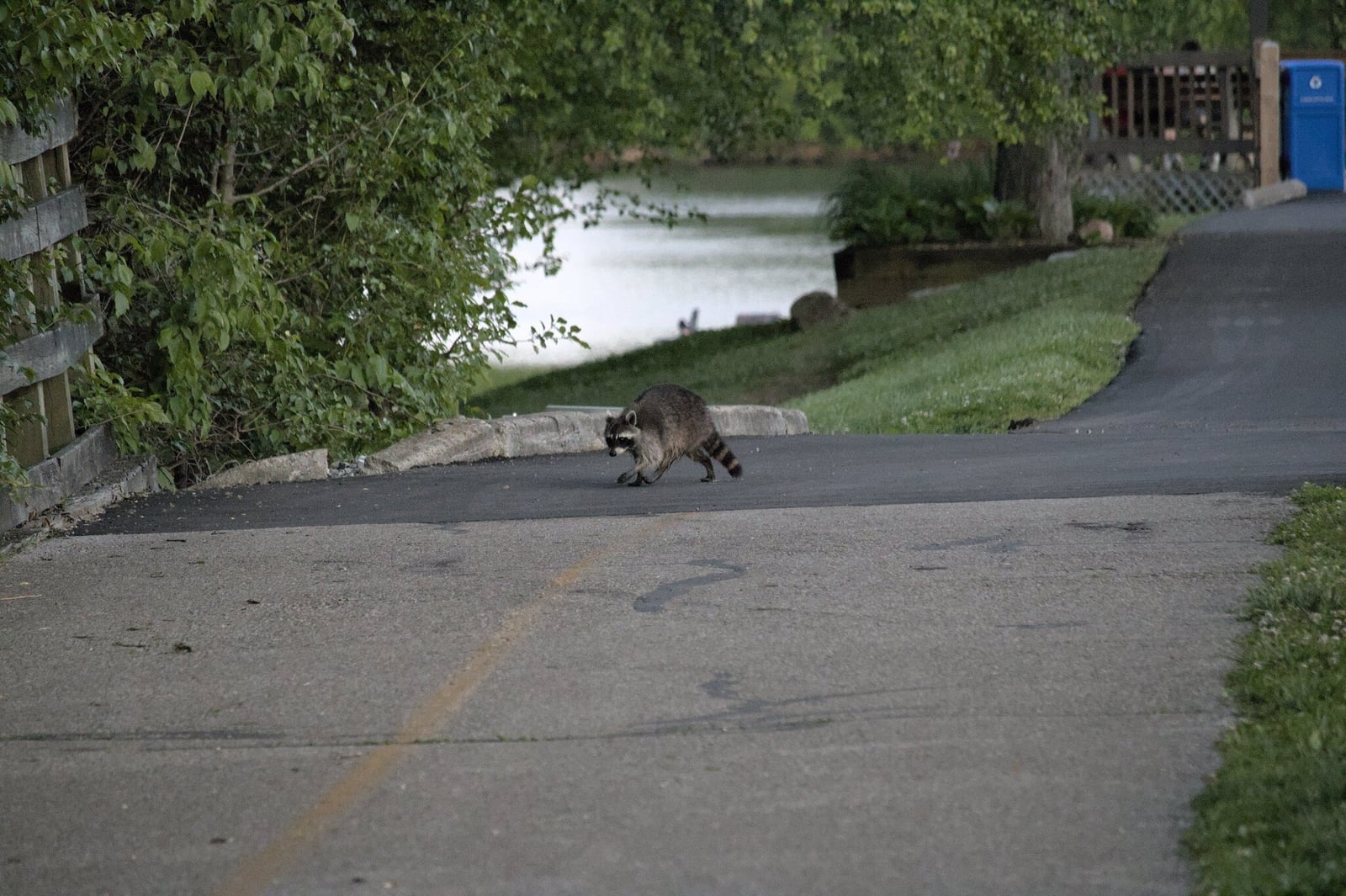
Common raccoon crossing a paved urban edge at dusk
Urban edges give raccoons food, cover, and travel lanes, especially near water. Photo: familiarjumpingspider, CC BY 4.0.

Water, trees, roofs, and night work

Raccoons occupy most of the contiguous United States and southern Canada, with the strongest densities where water, cover, and food meet. Bottomland hardwoods, marsh edges, streamside woods, oak forests, farm ponds, suburban parks, and coastal wetlands all fit the pattern. In dry country they follow rivers, irrigated neighborhoods, stock tanks, and canyon water. In cities they use storm drains, attics, chimneys, sheds, and hollow ornamental trees as substitutes for natural den sites.

The species is mostly nocturnal, but it is not locked to darkness. Mothers with young and animals in quiet areas may move by daylight, while urban raccoons usually shift later to avoid people and traffic.

Hands that read the dark

Raccoons eat like generalists because they investigate like specialists. The forepaws probe mud, leaf litter, cavities, and shallow water for crayfish, insects, frogs, eggs, fruit, nuts, seeds, carrion, and discarded human food. Wetting food is not a cleanliness ritual. Water improves tactile feedback, and the animal often rolls, turns, and tests objects before eating them.

That flexible feeding explains why raccoons do well in both wild wetlands and neighborhoods. A single animal may take aquatic prey along a creek, berries in a hedgerow, acorns under oaks, and spilled pet food in the same nightly route.

Den season and family breakup

Breeding usually occurs in late winter. After about nine weeks of gestation, females raise a litter in a protected cavity, burrow, rock crevice, attic, or other sheltered den. The young open their eyes after several weeks, begin following the mother as mobile juveniles, and learn feeding routes through summer and fall. Most family groups separate by the next breeding season.

Adult males do not help raise young. Several adults may feed near the same rich food source, but the normal social unit is either a solitary animal or a female with dependent young.

Why raccoons thrive around people

The common raccoon is rated Least Concern and remains abundant across much of its native range. Its success around people comes from a rare mix: climbing ability, swimming ability, dexterous forepaws, a broad diet, and a tolerance for fragmented habitat. That same mix creates conflict when raccoons enter buildings, open containers, or feed around pets and poultry. Nationally, the species is best understood as a resilient native mammal that becomes most visible wherever human food and den sites are easy to reach.


Data & sources

The data and visualizations on this page draw on these open sources:


